 Compare money transfers from Vietnam
 KRW




 GBR











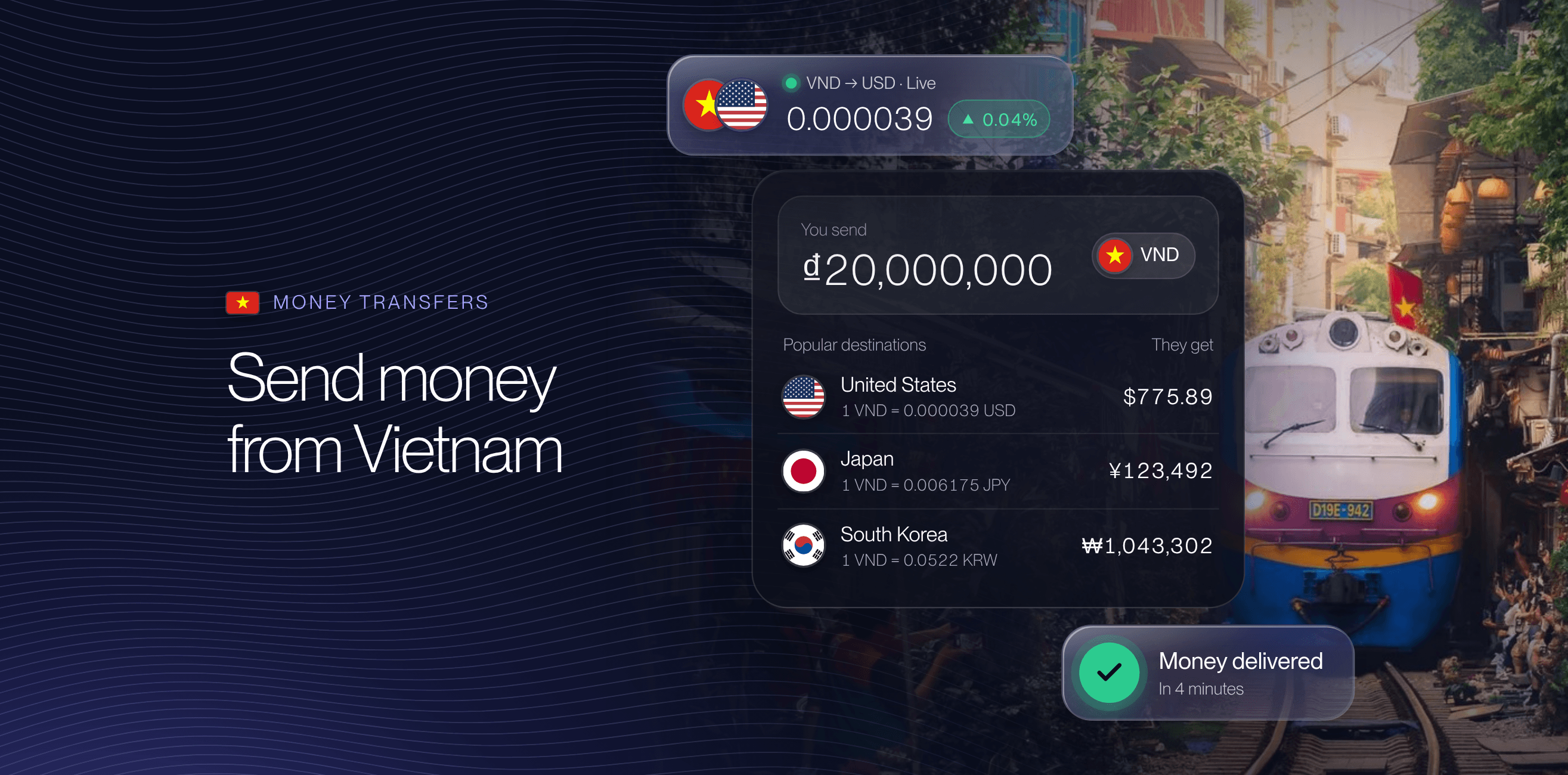
How to Send Money From Vietnam

To send money from Vietnam, you use a licensed bank, which charges a small percentage fee with a minimum, a SWIFT charge and a margin in its exchange rate. Vietbank charges 0.18% for tuition with a minimum of USD 5, plus USD 7 for SWIFT, but the bigger cost is the rate: on 26 November 2026 Vietcombank sold US dollars about 0.7% above the midpoint of its own rates.
The quick answer: Wise, Remitly and Xe do not accept payments in Vietnamese dong, so money leaves Vietnam through banks, for purposes the State Bank of Vietnam allows, such as study, medical treatment and supporting relatives. Compare the exchange rate between two or three banks, because it decides most of the cost.
This page sets out the rules on what you can send, what Vietnamese banks charge, what VND 50 million, VND 250 million and VND 1 billion really cost, how long a transfer takes, and the rules on carrying cash.
Who sends money from Vietnam
Vietnam is one of the world's big receivers of remittances, about $16 billion in 2024 according to World Bank data, but many households also need to send money from Vietnam. The largest group by far is families paying for children to study abroad, followed by people supporting relatives overseas, travellers, and foreign workers moving their salary home.
Families paying for study abroad
Nearly 250,000 Vietnamese were studying abroad in 2025, a record, according to the Ministry of Education and Training. The most popular destinations were South Korea with 43,300, Japan with 36,300, Australia with 33,000, the US with 31,300, Taiwan with 27,400, China with 23,500 and Canada with 17,100.
Most of these students are self-funded, so tuition and living costs leave Vietnam through bank transfers. Tuition is usually a large payment once or twice a year, so the exchange rate on the day matters more than the fee.
People supporting relatives abroad
Many families send money from Vietnam to relatives working or studying in Korea, Japan, Taiwan and elsewhere, often to help with living costs in the first months. The rules allow transfers to support relatives abroad, based on a reasonable need for living expenses.
Emigrants and heirs
Vietnamese moving abroad for good can transfer assets they built up in Vietnam before they became foreign citizens or residents abroad, and heirs can transfer an inheritance. These payments are usually large and need documents that prove the value of the property or the inheritance.
Foreign workers and expats
Foreign staff working in Vietnam are often paid in dong and want to move part of their salary home. Banks let foreign individuals transfer legal income abroad, and some, such as VPBank, now offer this online through their apps. Banks usually ask for the labour contract or work permit and proof that income tax has been paid.
For expats a money transfer from Vietnam is a monthly routine, so it is worth asking whether the employer can pay part of the salary into a foreign currency account, which some banks allow.
Travellers and business trips
Business trips, holidays and family visits are another reason to send money from Vietnam or buy currency to take along. The rules allow it, based on reasonable need and capped at the destination country's GDP per capita, and banks can sell currency notes for the trip as well as transfer money ahead to pay for accommodation or courses.
The rules behind every money transfer from Vietnam
Vietnam controls the sale of foreign currency, so the purpose of the payment decides whether a bank can sell you dollars and how many. The State Bank of Vietnam sets the rules in Circular 20/2022/TT-NHNN, which took effect on 15 February 2023, and licensed banks apply them at the counter.
Permitted purposes for Vietnamese citizens
Vietnamese residents can buy, transfer or carry foreign currency abroad for study and medical treatment, business trips, travel and visits, fees and charges abroad, supporting relatives, inheritance, and settling abroad. Each purpose needs documents, such as an admission letter, a hospital estimate, proof of the relationship, or inheritance papers.
A bank cannot sell more than the documents justify, and you cannot use the same set of documents to buy currency at several banks beyond the stated amount.
How much you can send
For study and medical treatment, the amount is set by the school's or hospital's notice of costs. Where there is no notice for living costs, the bank decides based on reasonable need, capped at the destination country's GDP per capita. The same GDP per capita cap applies to travel and to supporting relatives abroad.
For inheritance the limit is the value of the inherited property, and for settling abroad it is the value of the property formed in Vietnam. Banks set their own internal rules for other lawful needs.
What the rules do not cover
Investing abroad is not one of the purposes for a one-way transfer. Buying shares, funds or a business abroad follows Vietnam's separate rules on outward investment, which involve registration and, for direct investment, an investment certificate. If someone offers to move money abroad for an investment without that paperwork, treat it as a warning sign.
Rules for foreign individuals
Foreign individuals who earn legal income in Vietnam can buy foreign currency to send it abroad. Expect the bank to ask for your passport, work permit or temporary residence card, labour contract and tax documents. If you leave Vietnam for good, finalise your personal income tax first, because the tax office's records are what the bank relies on.
Foreign nationals and non-resident Vietnamese can use VPBank's app to transfer legal income abroad online, which saves the branch visits that used to be needed.
Documents banks ask for
Every money transfer from Vietnam for a personal purpose needs documents that show the purpose and the amount. The bank keeps copies and checks that the amount you buy does not exceed what the documents support. A transfer for a student's living costs, for example, needs proof of enrolment and an estimate of living costs.
What Vietnamese banks charge to send money abroad
For a money transfer from Vietnam, banks charge a service fee as a percentage of the amount with a minimum, plus a SWIFT or telex fee, and VAT may be added. Some waive fees on certain days or in their apps. The exchange rate is set by each bank within the State Bank's band.
Bank | Service fee | SWIFT and extras | Notes |
|---|---|---|---|
0.18% for study or medical (min USD 5) | SWIFT USD 7 | 0.18% (min USD 10) for family support and travel | |
Vietbank, settlement and inheritance | 0.2% (min USD 10, max USD 1,000) | SWIFT USD 7 | Foreign bank fees at actual |
0.15% at the counter (min USD 5), free Tuesday to Thursday | SWIFT USD 5, free Tuesday to Thursday | USD 25 collected for the foreign bank, fees exclude VAT |
Vietbank
Vietbank's schedule from December 2025 charges 0.18% for transfers for study or medical treatment, with a minimum of USD 5, and 0.18% with a minimum of USD 10 for family support, business trips, travel and visits. Transfers for settling abroad, inheritance or other legal income cost 0.2%, with a minimum of USD 10 and a maximum of USD 1,000. A SWIFT message costs USD 7.
Vietbank charges foreign bank fees at actual cost. On SHA or BEN transfers you can add up to USD 100 to cover intermediary and receiving bank fees, which helps if the recipient must get a set amount.
VPBank
VPBank's schedule from 27 October 2026 charges standard customers 0.15% at the counter with a minimum of USD 5, but waives the fee on Tuesdays, Wednesdays and Thursdays. The SWIFT charge of USD 5 is also waived on those days. VPBank also collects a foreign bank fee on behalf of the overseas bank, USD 25 for a US dollar transfer or GBP 35 for pounds.
VPBank's fees exclude VAT. It also offers outward transfers through Western Union, priced on Western Union's own schedule.
Other Vietnamese banks
Vietcombank, BIDV, VietinBank, Techcombank and the other large banks publish their own schedules, usually a percentage with a minimum and a maximum plus a telex fee, with cheaper rates in the app. Several run promotions on study or family support transfers. Check the current schedule and any promotion before you send money from Vietnam.
The exchange rate margin Vietnamese banks do not show
When you buy foreign currency to send abroad, the bank uses its selling rate. On 26 November 2026 Vietcombank sold US dollars at VND 26,010 and bought them by transfer at VND 25,630, so its selling rate sat about 0.7% above the midpoint. On VND 1 billion, that margin is worth about VND 7.3 million, far more than any fee.
The gap is wider for other currencies. The same day, Vietcombank's euro selling rate sat about 2.1% above the midpoint and its Australian dollar rate about 1.6% above, so families paying tuition in Europe or Australia should compare rates between banks with particular care.

Hidden extras on a bank transfer
A SWIFT payment can pass through intermediary banks, which may deduct a fee before the money arrives, and the receiving bank may charge too. If the recipient must get an exact amount, such as a tuition invoice, ask for OUR, or at Vietbank add an amount to cover the foreign bank fees.
VAT can apply on top of the published fees, and amending or tracing a payment costs extra: USD 10 plus fees at Vietbank and VPBank. Getting the details right the first time is the cheapest way to avoid these charges.
The best ways to send money from Vietnam
For residents of Vietnam, every legal route for a money transfer from Vietnam runs through a licensed bank. The choice is which bank, which channel and which day.

A bank transfer by SWIFT
A bank transfer is the standard way to send money from Vietnam to an account abroad. It covers tuition, living costs, family support, inheritance and expats' salaries. You choose the purpose, provide the documents, and the bank sells you the currency at its selling rate and sends it by SWIFT.
Banks compete on fees and promotions, but the rate margin is where most of the cost sits. Ask two or three banks for their selling rate on the same morning and work out the dong cost of the amount you need to send.
A foreign currency account
Vietnamese residents can hold foreign currency accounts at licensed banks. If you already hold dollars or euros, for example from salary paid in foreign currency or money received from abroad, you can send them for a permitted purpose without buying currency at the selling rate. The documents for the purpose are still needed, and the bank's transfer and SWIFT fees still apply.
This is the main way to avoid the rate margin. Families who receive money from relatives abroad sometimes keep part of it in a foreign currency account to pay a student's costs later.
Banking apps
Most large Vietnamese banks now let you make an international transfer in their app, at least for some purposes. Apps are often cheaper: VPBank waives its transfer fee in its NEO app. The documents still have to be uploaded, and the first transfer for a new purpose may need a branch visit.
Western Union through banks
Some Vietnamese banks, including VPBank, offer outward Western Union transfers. These can pay cash to a recipient without a bank account, which helps in a few countries. Fees follow Western Union's schedule and the rate includes a margin, so ask for the amount the recipient will get.
Paying tuition through the school's platform
Many universities abroad accept payments through approved international payment platforms that let you pay from Vietnam. They can be convenient for families, but the rate they quote includes their own margin. Compare their total with a bank transfer before you pay.
Wise, Remitly and Xe
Wise, Remitly and Xe are popular for sending money to Vietnam, but none of them accepts payments in dong from senders in Vietnam. If you have money in an account abroad, for example a student's account in Australia, you can use them from that account.
Which option for which transfer
Situation | Best fit | Why |
|---|---|---|
Tuition to a university abroad | Bank SWIFT transfer, compare rates | Pays the school directly with the documents |
Living costs for a student | Bank app transfer on a fee-free day | Lower fees for regular payments |
Support for a relative without a bank account | Western Union through a bank | Cash pickup in the destination |
Expat sending salary home | Bank app for legal income | Online, with labour contract and tax documents |
Large inheritance or settlement transfer | Bank branch | Needs documents and a negotiated rate |
Read our guide to international wire transfer fees for how bank transfers are priced elsewhere.
How much a money transfer from Vietnam costs
The cost of a money transfer from Vietnam is mostly the exchange rate margin, plus a small fee. The table uses Vietbank's published fees for study and medical transfers and Vietcombank's US dollar selling rate of VND 26,010 on 26 November 2026, before VAT and intermediary fees.
Amount sent | US dollars at the selling rate | Fees | Rate margin | Total | Share |
|---|---|---|---|---|---|
VND 50 million | USD 1,922 | About VND 312,000 | About VND 365,000 | About VND 677,000 | 1.4% |
VND 250 million | USD 9,612 | About VND 632,000 | About VND 1.83 million | About VND 2.46 million | 1.0% |
VND 1 billion | USD 38,447 | About VND 1.98 million | About VND 7.31 million | About VND 9.29 million | 0.9% |
Sending VND 50 million
VND 50 million buys about USD 1,922 at Vietcombank's selling rate. Vietbank's 0.18% fee would be USD 3.46, so the USD 5 minimum applies, and with USD 7 for SWIFT the fees come to about VND 312,000. The rate margin adds about VND 365,000, for a total of around 1.4%.
This is a typical money transfer from Vietnam for a few months of a student's living costs. If you can, send a semester's worth at once on a fee-free day.

Sending VND 250 million
VND 250 million is about USD 9,612, a common size for a semester's tuition in Korea or Japan. The fee is about USD 24 including SWIFT, and the rate margin about VND 1.83 million, so the total is about 1%. A better rate from another bank would save more than any fee waiver.
Sending VND 1 billion
For VND 1 billion, about USD 38,447, the fee is around USD 76 including SWIFT, and the rate margin around VND 7.3 million. At this size, ask the bank for a better rate; large amounts are often priced individually. Our guide to transferring large sums internationally covers what else to check.
Euros and Australian dollars cost more
The euro and Australian dollar spreads at Vietcombank were about 2.1% and 1.6% above the midpoint on 26 November 2026. On VND 250 million to a European university, that is about VND 5 million in the rate alone. Comparing two or three banks' selling rates for the currency you need is the single best way to cut the cost.
Comparing two banks on the same transfer
Because the rate decides most of the cost, two banks can quote very different totals for the same money transfer from Vietnam. On VND 250 million, a selling rate just half a percent better saves about VND 1.25 million, more than the whole fee. Ask each bank for the dong cost of the exact foreign amount you need, including fees, and compare those totals.
Many banks give better rates to customers with larger balances or on larger transfers. If you plan a big tuition payment, ask your relationship manager for a negotiated rate a few days before.
What the gap costs over a year
For a family sending VND 50 million a month to a student abroad, the fees and dollar margin come to about VND 8.1 million a year. Sending VND 150 million each quarter instead cuts the fixed fees, though the rate margin stays the same share. The rate is where the real saving is.
How long a money transfer from Vietnam takes
Timing depends on how quickly the bank checks your documents and on the route the payment takes abroad. The checks happen before the money leaves, so a missing document delays a transfer more than the transfer itself.
Method | Typical time | Notes |
|---|---|---|
Bank SWIFT transfer | 1 to 3 business days | Longer through intermediary banks |
Banking app transfer | 1 to 3 business days | Faster to set up, same SWIFT route |
Western Union through a bank | Minutes for cash pickup | Fees per Western Union's schedule |
Bank SWIFT transfers
A SWIFT payment from a Vietnamese bank usually reaches a major currency account within one to three business days. Payments made after the bank's cut-off, at weekends or around Tet and other holidays take longer, and the receiving country's holidays count too.

Document checks
The bank checks your documents before it sells the currency. A first transfer for a new purpose, such as the first semester's tuition, takes longest. Later transfers for the same purpose are usually quicker. If the documents are close to expiry, such as an admission letter for a past semester, ask the school for an updated letter before you go to the bank, because an out-of-date document is one of the most common reasons a payment is refused.
What slows a transfer down
The usual causes are a missing document, an amount above what the documents justify, a name that does not match the account, or a wrong SWIFT code. Our guide to how long a money transfer takes explains the other common delays.
If tuition is due in September, start the money transfer from Vietnam in July or early August, and avoid the weeks around Tet for payments due in February.
Tracking a payment
Ask your bank for the SWIFT reference once the payment is sent. The recipient's bank can use it to find the payment, and your bank can trace it through intermediary banks if it has not arrived after three business days. Tracing costs USD 10 plus fees at Vietbank and VPBank.
How to send money from Vietnam step by step
The steps are similar at every bank: prove the purpose, give the recipient's details, and approve the purchase of foreign currency.
What you need
- Your citizen ID card or passport, and work permit or residence card if you are a foreign national
- The recipient's full name, bank name, account number or IBAN, and the SWIFT code
- Documents for the purpose: admission letter and fee notice, hospital estimate, proof of relationship, or inheritance papers
- Tax documents if you are sending salary as a foreign worker
Check the bank details twice. Read what an IBAN is if the recipient is in Europe or the UK.
From your Vietnamese bank
- Open your bank's app or visit a branch that handles international transfers.
- Choose an outward transfer and the purpose, such as study or support for relatives.
- Enter the recipient's details and SWIFT code, and choose SHA, BEN or OUR for the charges.
- Upload or show the documents for the purpose.
- Approve the purchase of foreign currency at the bank's selling rate.
- Keep the transaction reference in case you need to trace the payment.
Ask the bank to confirm the rate and all fees before you approve. If you transfer money from Vietnam to the same recipient often, save them as a beneficiary in the app.
Paying tuition with a money transfer from Vietnam
Universities publish their own international payment instructions, usually a SWIFT transfer with the student's ID in the reference. Pay only to the account on the university's official website and keep the bank's payment advice as proof.
If the university needs the exact invoice amount, choose OUR or add an amount for foreign bank fees, because a shortfall can delay enrolment.
Sending money from Vietnam as a foreign national
Expats should ask their bank which documents it needs to transfer money from Vietnam, usually the work permit or residence card, the labour contract and tax records. Some banks let you do this online. Before leaving Vietnam for good, finalise your personal income tax and move your savings while your documents are still valid.
Using a banking app
If your bank offers international transfers in its app, it is usually the simplest way to transfer money from Vietnam for regular payments. You upload the documents once for a purpose, then repeat the transfer when you need to. Check that the app shows the exchange rate before you confirm, and compare it with the counter rate for large amounts.
Limits, cash and reporting when you send money from Vietnam
Beyond the purpose rules for a money transfer from Vietnam, a few more rules apply to anyone who wants to send money from Vietnam or carry cash across the border.
Carrying cash out of Vietnam
You must declare cash above USD 5,000 or the equivalent in other foreign currency, or above VND 15 million, to customs when you leave Vietnam. The law does not cap the amount you may carry, but undeclared cash can be fined. Vietnamese citizens buying foreign currency cash for a trip abroad can buy it at a licensed bank for study, medical treatment, business, travel or visits.
Cash is rarely the best way to move savings. It is easy to lose, and the cash selling rate includes a margin like any other. A bank transfer to your own account abroad is safer, and the paperwork it leaves behind proves where the money came from if you are ever asked.
Using documents only once
Circular 20 bars using one set of documents to buy more foreign currency than they justify, at one bank or several. Banks keep the documents and record each sale, so trying to stretch them across banks is easy to spot.
How to transfer money from Vietnam for larger amounts
For large transfers, such as an inheritance or the proceeds of a property sale when settling abroad, the limit is the value shown in the documents. Allow extra time for the bank to check them, and ask for a negotiated rate.
Is it safe to send money from Vietnam?
Yes, when you use a licensed bank. The State Bank of Vietnam supervises banks and foreign exchange, and payments through banks are recorded and traceable.
Who regulates money transfers in Vietnam
The State Bank of Vietnam licenses banks to deal in foreign exchange and sets the rules on outward transfers in Circular 20/2022/TT-NHNN. Banks apply the rules, keep the documents and report transactions to the State Bank.
Scams that target senders in Vietnam
Common scams include fake study abroad agents who ask for tuition to be paid to their own accounts, fake job offers abroad that ask for fees, and callers posing as police or bank staff. Romance and investment scams that ask for transfers abroad are also common.
No bank or police officer will ask you to move money to a "safe" account. If a call is urgent and secret, hang up and call your bank on its official number.
Simple rules that protect you
Only send money from Vietnam to accounts you know, and only for the purpose your documents show. Pay tuition directly to the university, not to an agent, and confirm any new account details by phone on a number you already have.
What to do if a transfer goes wrong
If money has not arrived after three business days, ask your bank to trace it with the SWIFT reference. If you sent it to the wrong account, contact the bank at once, because a recall only works before the receiving bank credits the money. Keep every receipt and document, since the bank needs them to investigate.
Top destinations for a money transfer from Vietnam
The routes people use most for a money transfer from Vietnam follow study and family ties: South Korea, Japan, Australia, the US, Taiwan, China and Canada.
Choosing the currency to send
Send in the currency of the recipient's account whenever you can. If you send US dollars to a won, yen or euro account, the receiving bank converts them at its own rate, and you pay two margins instead of one. Vietnamese banks sell all the major currencies, so ask for the destination currency and compare its selling rate across banks.
Some students hold US dollar accounts abroad for exactly this reason. If the student's bank pays a fair rate, sending dollars can work, but check before you assume it.
Vietnam to South Korea
South Korea is the top destination for Vietnamese students, with 43,300 in 2025, and many Vietnamese also work there. Tuition and living costs go by SWIFT, often in US dollars that Korean banks convert, so ask the student whether the account takes dollars or won. Put the student's name and the tuition reference clearly in the payment details, so the university can match the money to the right account without delay. See the Vietnam to South Korea route.
Vietnam to Japan
Japan hosted 36,300 Vietnamese students in 2025, many on language programmes. Japanese banks often charge to receive an overseas payment, so ask the student what their bank deducts. Sending in yen avoids a second conversion. Language schools in Japan usually ask for a year's tuition up front, so the first payment is large, and later living cost transfers are smaller and regular. See the Vietnam to Japan route.
Vietnam to Australia
Australia hosted 33,000 Vietnamese students in 2025. The Australian dollar spread at Vietcombank was about 1.6% above the midpoint in our check, so compare banks' rates before paying tuition. Australian universities publish international payment options on their websites, and a money transfer from Vietnam to Australia should go straight to the account shown there. See the Vietnam to Australia route.
Vietnam to the US
About 31,300 Vietnamese studied in the US in 2025 by the Ministry's count. Dollar transfers have the narrowest spreads at Vietnamese banks, but a US correspondent bank may deduct a fee unless you choose OUR. Families who send money from Vietnam to a student in the US every month can save by sending a semester's living costs in one transfer. See the Vietnam to US route.
Vietnam to Taiwan
Taiwan hosted 27,400 Vietnamese students in 2025, and many Vietnamese also work there. Transfers usually go in US dollars and are converted by the Taiwanese bank, so check its rate too. Many Vietnamese students in Taiwan also work part time, so families often send less after the first year. See the Vietnam to Taiwan route.
Vietnam to China
China hosted 23,500 Vietnamese students in 2025, and trade ties are close. Payments go by SWIFT in yuan or US dollars. Chinese banks can deduct fees on incoming payments, so check with the recipient. Chinese universities often accept tuition in yuan only, so ask whether the school's account takes dollars before you transfer money from Vietnam, because a returned payment costs fees both ways. See the Vietnam to China route.
Vietnam to Canada
Canada hosted 17,100 Vietnamese students in 2025, many of them at schools rather than universities. Tuition goes by SWIFT to the school's account in Canadian dollars. Canadian schools usually publish a reference format for international payments, and getting it right avoids the payment sitting unmatched for days. Compare the Canadian dollar selling rate between banks, since spreads are wider than for US dollars. See the Vietnam to Canada route.
Bottom line
No online specialist takes dong from senders in Vietnam, so a money transfer from Vietnam goes through a licensed bank, for a purpose the State Bank allows and backed by documents. Bank fees are modest, often under USD 25, so the exchange rate margin decides most of the cost, especially for euros and Australian dollars.
The one rule: compare the selling rate for your currency at two or three banks, and use fee-free days and apps for regular payments. Use the international money transfer comparison guide and the comparison tool on this page before you send money from Vietnam.
Related guides
- What is the mid-market exchange rate?: the benchmark every quote should be measured against
- Telegraphic transfer fee: the fixed charge on every bank wire
- Do banks charge for money transfers?: the fees behind a bank payment
- What is a remittance?: how family transfers work
- Send money from Thailand: the same guide for senders in Thailand
Sources
- Vietbank: International payment fee schedule, December 2025
- VPBank: International transfer fee schedule for individuals, October 2026
- Webgia: Vietcombank exchange rates
- State Bank of Vietnam: Circular 20/2022/TT-NHNN
- Indovina Bank: Notice on Circular 20/2022/TT-NHNN
- Vietnam Business Law: Restrictions on one-way money transfer abroad
- State Bank of Vietnam: Circular 15/2011/TT-NHNN on carrying cash
- Vietnam Government News: Record number of Vietnamese students abroad
- Thoi bao Tai chinh: VPBank expands international transfers
- Trading Economics: Vietnam personal remittances received