 Compare money transfers from Singapore
 INR




 GBR










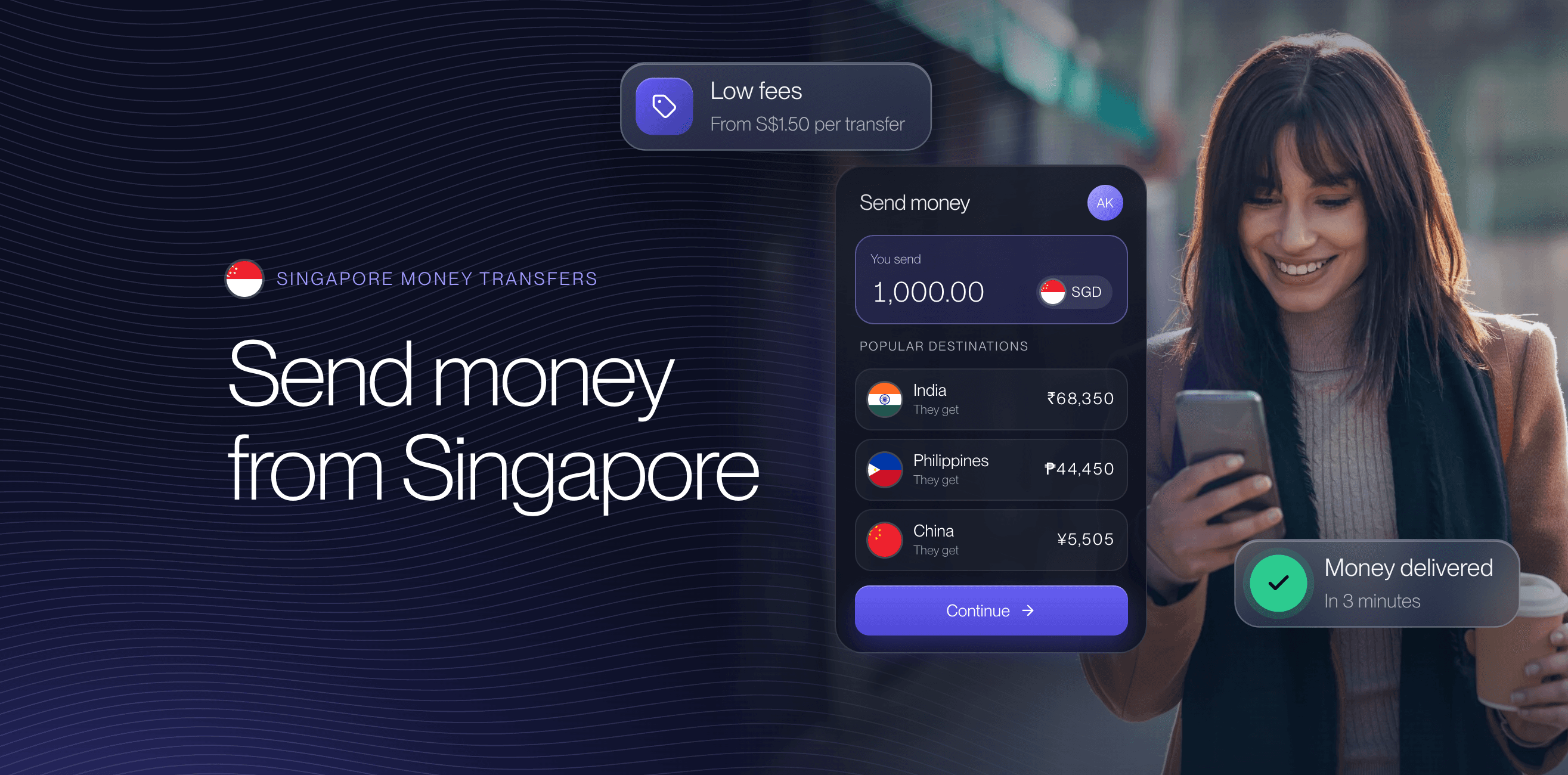
How to Send Money From Singapore

A telegraphic transfer from a Singapore bank account usually costs S$20 to S$40 in cable and commission charges before the exchange rate is even counted. In our October 2026 price check, sending S$1,000 to India, the Philippines, Malaysia, Indonesia or China through Wise cost between S$3 and S$12 in total.
Singapore runs on foreign talent and foreign labour. About 1.66 million people hold work passes here, and most of them send part of every pay packet home. Add residents paying tuition abroad, buying property in Malaysia or Australia, or supporting parents overseas, and money leaves the country every day on hundreds of routes.
This guide prices every common way to make a money transfer from Singapore: DBS and POSB, OCBC, UOB and HSBC, the online specialists, remittance counters and PayPal. It covers what each one costs in SGD across the main routes, how long it takes, the rules on limits and tax, and what you need before you start.
Who Sends Money From Singapore
Most money sent from Singapore is sent by its 1.66 million foreign workers: 1.24 million Work Permit holders, including 323,800 migrant domestic workers, plus 177,300 S Pass and 204,300 Employment Pass holders, according to the Ministry of Manpower's June 2026 figures. Citizens and permanent residents send too, for tuition, property and family abroad.
Each group feels a different part of the price. A domestic worker sending S$500 home every month feels every fixed fee and every cable charge. A professional moving S$30,000 of savings back to the UK barely notices the fee and loses real money to the exchange rate. A family paying a university in Melbourne needs the money there by a deadline. The cheapest way to send money overseas from Singapore depends on which of these you are.
Work Permit holders and domestic workers
This is the largest group by headcount. Construction, marine and process workers alone number 490,700, many of them from Bangladesh, India and China, while domestic workers come mainly from Indonesia, the Philippines and Myanmar. Transfers are regular, often monthly on payday, and usually between S$300 and S$1,000. A large share of recipients collect cash or receive money into a mobile wallet rather than a bank account.
That is why the remittance counters in Little India, Lucky Plaza and Peninsula Plaza stay busy on Sundays. Their fees are low by world standards, often S$3 to S$5, but on a S$300 transfer even S$5 is 1.7 percent before the rate is counted. For this group, a low fixed fee and the right payout option at the other end matter as much as the exchange rate.
Professionals on Employment Passes and S Passes
Mid-career and senior foreign professionals send larger, less frequent sums: mortgage payments on a flat in Bangalore, savings back to a UK or Australian account, school fees for children who stayed at home, or money into investments abroad. Amounts of S$5,000 to S$50,000 are common.
For this group the exchange rate is everything. A margin of 2 percent on S$30,000 is S$600, far more than any cable charge a bank could add. They also tend to send to the same accounts repeatedly, so a provider with a multi-currency account and saved recipients saves time as well as money.
Singaporeans paying for study, property and family abroad
Citizens and permanent residents send money overseas for children studying in Australia, the UK or the US, for property in Johor, Perth or London, and to support relatives in Malaysia, Indonesia and China. These payments are usually large, made a few times a year, and tied to a deadline set by a university or a property lawyer.
Here the risk is not only cost but certainty. A telegraphic transfer that loses S$25 to an intermediary bank can leave a tuition invoice short, which is why the amount that actually arrives, and the charge option you choose on a bank transfer, matter as much as the headline price.
What Singapore Banks Charge to Send Money Abroad
Singapore banks charge between S$0 and about S$40 in fees to send money abroad, depending on the bank and the channel. A DBS telegraphic transfer to a non-DBS account carries a S$20 cable charge, UOB adds a S$30 cable charge to its online commission, and every bank also earns a margin on the exchange rate it sets.
Local banks now give you two ways to send. The traditional route is a telegraphic transfer, sent over SWIFT, which carries a commission, a cable charge and sometimes agent bank fees deducted along the way. The newer route is each bank's own remittance product, such as DBS Remit or OCBC's online overseas transfers, which waive the fees on popular currencies and make their money on the exchange rate instead. Our guide to international wire transfer fees explains how each charge works.
Bank | Fees to send abroad | Exchange rate margin |
|---|---|---|
DBS and POSB (DBS Remit) | S$0 to 50+ destinations, same day | 1.09% to India, 1.16% to the Philippines (World Bank, Aug 2025) |
DBS (telegraphic transfer) | Commission waived when converted; S$20 cable to non-DBS accounts; agent charges may apply | 0.79% to India and the Philippines (World Bank, Aug 2025) |
OCBC | Online: cable and commission waived, agent fees still apply. Otherwise 1/8% commission (S$10 to S$100) plus S$20 cable | Not published |
UOB | 1/16% online (S$10 to S$100), 1/8% in branch, plus S$30 cable (S$20 to Malaysia) and agent charges | Not published |
HSBC Singapore | S$0 on its quoted transfers | 0.04% to 1.45% across five routes (20 Oct 2026) |
Maybank Singapore | S$40 on a S$260 transfer to the Philippines | 5.64% (World Bank, Aug 2025) |
Fees from the DBS and OCBC transfer pages (checked October 2026) and UOB's fee schedule of 15 May 2026 as reported by WorldFirst. Margins from the World Bank's Remittance Prices Worldwide survey (19 to 25 August 2025) and Wise's public comparison data for HSBC Singapore (20 October 2026).

DBS and POSB
DBS Remit is the bank's fee-free remittance service, available to both DBS and POSB customers in digibank. It charges S$0 in transfer fees to more than 50 destinations in 19 currencies, with same-day delivery on most of them. The cost sits in the rate. In the World Bank's August 2025 survey DBS Remit converted 1.09 percent below mid-market to India and 1.16 percent below to the Philippines, so about S$11 to S$12 of every S$1,000 stayed with the bank.
A standard DBS telegraphic transfer is a different product. The handling commission is waived when the money is converted, but a S$20 cable charge applies to accounts outside the DBS group, transfers take 2 to 4 working days, and agent banks can deduct their own fees. On a S$1,000 transfer that is roughly S$28 once the 0.79 percent margin the World Bank measured is added. DBS has also been rolling out a 12-hour cooling period since March 2026 when customers raise their overseas transfer limits, an anti-scam measure worth knowing before a deadline.
OCBC
OCBC waives the cable charge and commission on overseas transfers made in its app or online banking. Its page says the waiver runs until 31 December 2026, although its own terms still carry a 2025 date, so check before relying on it. Agent fees are still charged, vary with the amount and currency, and are shown as an indicative figure before you confirm. OCBC quotes 19 currencies and promises same-day delivery if you submit before each currency's cut-off, which ranges from 9.30am for Australian dollars and pesos to 6pm for US dollars.
In a branch the old tariff applies: a 1/8 percent commission between S$10 and S$100 plus a S$20 cable charge. OCBC also pays out to ten overseas wallets, including Alipay, Weixin Pay, Touch 'n Go, OVO and GCash, which is useful for family members without a bank account. Like most banks, it does not publish the margin in its rate.
UOB
UOB still prices overseas transfers the traditional way. The commission is 1/16 percent online and 1/8 percent in a branch, with a minimum of S$10 and a maximum of S$100, and a cable charge of S$30 applies to every country except Malaysia, where it is S$20. Agent bank charges come on top. A S$1,000 transfer sent online therefore costs S$40 in fees before the exchange rate, or S$30 to Malaysia.
SWIFT transfers from UOB usually take 1 to 5 business days. UOB does not publish its margin either. WorldFirst puts typical bank margins at DBS and UOB at around 2 to 3 percent on the rate, which would add S$20 to S$30 on S$1,000.
HSBC Singapore
HSBC is a smaller player in Singapore retail banking, but its fee-free transfers are among the best priced from any bank here. On 20 October 2026 its quotes on S$1,000 converted just 0.04 percent below mid-market to Malaysia, 0.65 percent to Indonesia and 0.98 percent to India, rising to 1.44 percent to the Philippines and 1.45 percent to China. For an existing HSBC customer sending ringgit, nothing else we priced came close.
The exchange rate margin they do not show
The mid-market rate is the midpoint between what buyers and sellers pay for a currency, the rate you see on Google or Reuters. A bank or remittance service converts at a worse rate and keeps the difference. You can check any quote yourself: divide what the recipient will get by what you send, then compare it with the mid-market exchange rate at the same moment.
Here is a worked example across two routes from 20 to 22 October 2026. At mid-market, S$1,000 was worth 74,163 Indian rupees and 49,687 Philippine pesos. HSBC's zero-fee quotes paid 73,437 rupees and 48,971 pesos, so the recipient in India got 727 rupees less and the one in Manila 716 pesos less, worth about S$10 and S$14. Sent once, that is small. Sent every month for years, a margin of 1 to 3 percent is real money that never reaches your family.
Hidden extras on a bank transfer
On a SWIFT transfer you choose who pays the charges: OUR means you pay everything, SHA splits them, and BEN takes them from the amount sent. With SHA or BEN, intermediary and receiving banks can deduct S$15 to S$40 before the money lands, so the recipient gets less than you expected. Funding a remittance with a credit card can count as a cash advance: in the World Bank's survey Remitly's credit card fee was S$11.79 against S$3.99 by debit card.
PayPal is the costliest option we priced. It converted 5 percent below mid-market to the Philippines and 4.6 percent to Malaysia, so S$1,000 cost S$56 and S$52, and on S$10,000 to the UK, Australia or the US it cost S$436 to S$463. Our breakdown of PayPal's international transfer fees shows where that money goes. OFX, built for larger sums, also took S$44 to S$53 on our S$1,000 quotes.
The Best Ways to Send Money From Singapore
The cheapest way to send money from Singapore is usually an online specialist paid by PayNow or bank transfer. Wise and Remitly both hold MAS licences and send from Singapore, and on our October 2026 quotes Wise cost 0.3 to 1.1 percent of the amount across five Asian routes. Xe does not currently accept customers living in Singapore.
Singapore has one of the most competitive remittance markets in Asia. Besides Wise and Remitly, residents can use DBS Remit, HSBC's fee-free transfers, Instarem, SingX, Western Union and dozens of licensed remittance counters. That competition keeps prices low, and it means no single provider wins every route: on our quotes HSBC was cheapest to Malaysia, Instarem to China and Western Union online to Bangladesh. Compare the amount that arrives, not the advertised fee. Xe was checked on its own send-from country list in October 2026, which covers Europe, North America, Australia and New Zealand but not Singapore.
Wise
Wise converts at the mid-market rate and charges one fee, shown before you pay. On S$1,000 that fee was S$3.08 to Malaysia, S$3.63 to Indonesia, S$4.02 to India, S$4.63 to the Philippines and S$11.40 to China on 22 October 2026, and it was the entire cost of each transfer. On S$10,000 to Australia it was S$19.82, or 0.20 percent, because the percentage part of the fee falls as the amount grows, with further discounts from S$30,000.
You can fund a transfer by PayNow, by bank transfer from any local bank, by debit card or from a Wise balance, and send up to S$2 million in one transfer. Wise's delivery estimates on our quotes were seconds to India, the Philippines and Malaysia, about an hour to Indonesia and about two hours to China. It also gives you a multi-currency account, useful if you pay rent or school fees abroad every month. Our full Wise review covers limits and the account, and our walkthrough on how to use Wise to transfer money internationally shows each screen.
Remitly
Remitly is built for sending money home, and Remitly Singapore Pte Ltd holds a Major Payment Institution licence from MAS. It pays out to bank accounts, to mobile wallets such as GCash and Maya, for cash pickup at agents including Cebuana Lhuillier and M Lhuillier in the Philippines, and on some routes by home delivery. You can pay with a Visa or Mastercard debit or credit card, Apple Pay or a prepaid card, and send up to S$130,000 in a single transaction once fully verified.
It offers two speeds. Express, funded by card, usually arrives in minutes. Economy, funded by bank transfer, takes 3 to 5 business days and costs less. Remitly was not in the live comparison data we used, but in the World Bank's August 2025 survey it charged S$3.99 to India and the Philippines with a margin of 1.20 to 1.65 percent. New customers get a promotional rate on the first S$750, so check the price on your second transfer too. Our Remitly review covers the full fee structure.
Which option for which transfer
The right provider depends on how the money needs to arrive, where it is going and how much you are sending. This is how the options line up on the transfers people actually make from Singapore.
Job | Best fit | Why |
|---|---|---|
Bank deposit to India, Indonesia or the Philippines | Wise | S$3.63 to S$4.63 all-in on our S$1,000 quotes |
Cash pickup or mobile wallet in the Philippines | Remitly | Cebuana Lhuillier, M Lhuillier, GCash and Maya payouts |
Ringgit to a Malaysian account | Wise, or HSBC if you already bank there | Wise S$3.08; HSBC S$0.37 on our quote |
S$10,000 or more to the UK, Australia or the US | Wise | 0.20 to 0.25 percent on our quotes |
Regular bills or school fees abroad | Wise | Hold and pay from a multi-currency account |

How Much Does It Cost to Send Money From Singapore?
Sending S$1,000 from Singapore cost S$3 to S$12 through Wise across India, the Philippines, Malaysia, Indonesia and China on 22 October 2026, and S$0.37 to S$14.50 through HSBC Singapore. A telegraphic transfer starts at about S$28 at DBS and S$40 in fees alone at UOB, while PayPal took S$52 to S$56.
The table below prices the same S$1,000 on five of the busiest routes from Singapore, for every provider in the comparison data. Total cost is the fee plus whatever the exchange rate took, measured against the mid-market rate on each route at the time of the quote, so the cheapest option on each route is easy to spot.
Provider | India (INR) | Philippines (PHP) | Malaysia (MYR) | Indonesia (IDR) | China (CNY) |
|---|---|---|---|---|---|
Wise | S$4.02 | S$4.63 | S$3.08 | S$3.63 | S$11.40 |
HSBC Singapore | S$9.80 | S$14.41 | S$0.37 | S$6.48 | S$14.50 |
Instarem | S$4.85 | S$6.98 | S$5.96 | S$8.22 | S$6.49 |
Western Union (online) | Not quoted | S$8.62 | Not quoted | S$7.77 | Not quoted |
OFX | S$44.47 | S$50.86 | S$47.11 | S$53.25 | S$43.98 |
PayPal | Not quoted | S$56.45 | S$51.86 | Not quoted | Not quoted |
Total cost on S$1,000 against the mid-market rate. Quotes from Wise's public comparison data collected 22 October 2026 (HSBC Singapore 20 October 2026). Rates move by the minute, so treat small gaps as noise and large ones as the real story.

A typical S$1,000 transfer across the main routes
The pattern is consistent. The specialists cost 0.3 to 1.2 percent of the amount on every route, the bank remittance products up to about 1.5 percent, and the telegraphic transfers and PayPal far more. DBS Remit's 1.1 percent margin works out at roughly S$11 to S$12 on S$1,000. A DBS telegraphic transfer is about S$28 once the S$20 cable charge is added, and UOB's online transfer is S$40 in fees before its margin, which pushes the total to S$60 or more if the rate is 2 to 3 percent off mid-market.
Three results are worth noting. HSBC's ringgit quote was almost exactly mid-market, Instarem was the cheapest option to China, and Western Union's online prices to the Philippines and Indonesia were within a few dollars of the specialists. Remitly's World Bank pricing of S$3.99 plus a 1.2 to 1.65 percent margin would put it at roughly S$16 to S$20 on S$1,000, before any welcome rate.
A large transfer: S$10,000 to the UK, Australia and the US
On bigger amounts the exchange rate does almost all the damage. Sending S$10,000 on 22 October 2026, Wise cost S$24.60 to the UK, S$19.82 to Australia and S$24.43 to the US. Western Union's online quotes were unusually sharp that day, at S$3.37 for pounds and S$17.33 for US dollars, but S$25.12 for Australian dollars. HSBC Singapore cost S$75 to S$119, OFX about S$85 to S$91, and PayPal S$436 to S$463.
That is the case for never sending a large sum by default through whatever your bank offers. At the 2 to 3 percent margin WorldFirst reports for local banks, the same S$10,000 would cost S$200 to S$300 in the rate alone. Our guide to the best way to transfer large sums internationally covers rate alerts, locking a rate and splitting payments for property and tuition.
What the gap adds up to over a year
Take S$800 a month sent home to India, the Philippines or Indonesia, a common pattern for a worker on a Work Permit or S Pass. Through Wise at our quoted prices that is roughly S$3 to S$4 a transfer, or about S$35 to S$45 a year. Through a DBS telegraphic transfer it is around S$26 a transfer, or about S$315 a year. Through UOB online it is S$40 in fees alone each month, at least S$480 a year before the margin.
Switching saves roughly S$270 to S$440 a year on one modest remittance, which for many families is a month's worth of the money being sent. The saving grows with every dollar you add.
How Long Does It Take to Send Money From Singapore?
A telegraphic transfer from a Singapore bank usually takes 1 to 5 business days. The banks' own remittance products are faster, with DBS Remit and OCBC's online transfers arriving the same day before cut-off. Wise estimated seconds to India, the Philippines and Malaysia, about an hour to Indonesia and about two hours to China on our October 2026 quotes.
Method | Typical time |
|---|---|
Bank telegraphic transfer (DBS, UOB) | 1 to 5 business days (DBS quotes 2 to 4 working days) |
DBS Remit | Same day to 50+ destinations |
OCBC online transfer | Same day if sent before the currency's cut-off (9.30am to 6pm) |
Wise | Seconds to India, the Philippines and Malaysia; about 1 hour to Indonesia; about 2 hours to China; up to 24 hours for US dollars |
Remitly Express | Usually minutes, card funded |
Remitly Economy | 3 to 5 business days, bank funded |
Cash pickup | Minutes once the transfer is funded |
Specialist times are the providers' own estimates on our 22 October 2026 quotes; bank times are from DBS, OCBC and UOB's published ranges.
How long each option takes
A telegraphic transfer passes through your bank, often one or more intermediary banks, and then the recipient's bank. Each hop adds time, and a transfer sent late on a Friday may not move until Monday in Singapore and later still in the destination's time zone. Our guide to how long a wire transfer takes breaks down each stage.
Specialists and bank remittance products are faster because they hold money in each country and pay out locally. Your Singapore dollars go into the provider's account here, often instantly through FAST or PayNow, and the recipient is paid from a local account through instant systems such as IMPS in India, InstaPay in the Philippines and DuitNow in Malaysia. That is why a transfer to a Mumbai bank account can land in seconds while a SWIFT transfer to the same account takes days.

What slows a transfer down
Most delays come from a handful of causes. Banks have daily cut-off times that vary by currency: at OCBC, pesos and Australian dollars must be in by 9.30am for same-day processing, while US dollars can wait until 6pm. Weekends and public holidays stop the clearing systems, and holidays at the other end, such as Eid in Indonesia or Golden Week in China, can hold the payout even when Singapore is open.
Your first transfer with a new provider can take longer while it checks your identity, although verifying with Singpass Myinfo where it is offered speeds this up. Large transfers can trigger questions about the source of funds, and raising your bank's overseas transfer limit can now come with a cooling period of up to 12 hours. How you pay matters too: PayNow and FAST reach the provider in seconds, while a card payment for Remitly Express is instant but costs more.
How to Send Money From Singapore, Step by Step
To send money from Singapore, open an account with a MAS-licensed provider, verify your identity with your NRIC or work pass and proof of address, enter the amount and the recipient's details, then pay by PayNow, bank transfer or debit card. A bank telegraphic transfer needs the recipient's SWIFT code and usually costs more.
What you need before you start
Citizens and permanent residents need their NRIC, and foreigners need a passport plus their Employment Pass, S Pass, Dependant's Pass or Work Permit, which carries the FIN number providers ask for. You also need a Singapore address, and some providers ask for a recent bank statement or utility bill to prove it. Work Permit holders can usually register, but some providers accept only certain passes, so check before you commit. For larger transfers, expect to show where the money came from, such as a payslip, a CPF statement or a sale agreement.
For the recipient you need their full name exactly as it appears on their account, plus the local details: an account number and IFSC code in India, an account number or GCash mobile number in the Philippines, an account number in Malaysia, or an Alipay account or UnionPay card in China. Our guide to the bank details you need to transfer money lists what each country asks for. Getting them right the first time is the best way to avoid a stuck transfer.
With an online provider
- Create an account and verify your identity with your NRIC or pass, or with Singpass Myinfo where offered.
- Enter how much you want to send and check the amount your recipient will get.
- Add the recipient's bank, wallet or cash pickup details.
- Pay by PayNow, bank transfer or debit card.
- Track the transfer and share the reference with your recipient.
PayNow is usually the quickest way to fund a Wise transfer, because the money leaves your DBS, OCBC, UOB or other local account in seconds. Avoid paying with a credit card unless speed matters more than cost, since some issuers treat it as a cash advance with its own fee and interest.
From your own bank account
To transfer money from Singapore through your own bank, open digibank, the OCBC app or UOB TMRW and add an overseas payee with their name, address, bank name, SWIFT code and account number or IBAN. Choose the currency, check the fee and the rate the bank shows, and pick the charge option: OUR if the full amount must arrive, SHA if you are happy to split the charges. Use the bank's own remittance product, such as DBS Remit, where your currency is covered, because it skips the cable charge.
Banks set daily overseas transfer limits that you can change in the app. If you need to raise yours for a large payment, do it a day early, because the anti-scam cooling period can delay the new limit.
With cash
You can still walk into a licensed remittance counter or a Western Union agent and pay in cash, and for workers without a local bank account that is often the only option. Singapore's counters are cheap by world standards: in the World Bank's August 2025 survey, cash transfers to the Philippines cost S$3 to S$6 in fees with margins of up to 1.3 percent, and Western Union's cash price to India was S$3.

The catch is the fixed fee on small amounts and the time spent queuing on a Sunday. If you have a debit card or a PayNow account, sending online usually costs less, and your family can still collect cash at the other end through Remitly or Western Union.
Limits, Tax and Reporting When You Send Money From Singapore
Singapore does not cap or tax the money you send abroad. Limits come from each provider: Remitly allows up to S$130,000 per transfer and Wise up to S$2 million, depending on how far you have verified your identity. The one legal reporting rule is for physical cash: carrying more than S$20,000 across the border must be declared to ICA.
How much you can send
Nothing in Singapore law caps how much you can send. When you send money abroad from Singapore, the limit depends on the provider and on your verification level. Specialists start new customers on lower limits and raise them as you add documents, and Remitly's limits also vary by destination and payment method. Banks set daily overseas transfer limits by account, which you can adjust in the app, and OCBC's online transfers have a minimum of S$100 or US$100. For a large one-off payment, such as a property deposit, verify your account well in advance and ask the provider about its upper limits before the deadline.
Is money sent abroad taxed in Singapore?
No. Singapore has no tax on remittances and no gift tax, and it abolished estate duty in 2008, so money you send to family abroad is not taxed here. The exception is a gift of property or shares, which can attract stamp duty even when no money changes hands. The country at the other end may have its own rules: in India, for example, gifts above ₹50,000 a year from someone who is not a relative are taxable for the recipient. This is general information rather than tax advice, so check with a tax professional on large or unusual transfers.
Reporting rules and extra checks
Anyone carrying cash or bearer negotiable instruments worth more than S$20,000 into or out of Singapore must declare it to ICA, electronically within 72 hours before travelling. Failing to do so is an offence under the Corruption, Drug Trafficking and Other Serious Crimes (Confiscation of Benefits) Act, with a fine of up to S$50,000, up to three years in prison, or both.
Licensed payment institutions and banks must also check who you are and, on larger or unusual transfers, where the money came from, under MAS anti-money laundering rules. Splitting a large payment into small ones to avoid those checks tends to attract more attention, not less. Legitimate senders have nothing to worry about: keep records of where large sums came from and send them in one go.
Is It Safe to Send Money From Singapore?
Sending money from Singapore through a licensed provider is safe. Cross-border money transfer firms need a licence from MAS under the Payment Services Act 2019, and Major Payment Institutions must safeguard customer money, keeping it apart from their own funds. You can check any provider on MAS's Financial Institutions Directory before you send.
Who regulates money transfers in Singapore
The Monetary Authority of Singapore licenses banks and payment firms alike. Under the Payment Services Act, a firm offering cross-border money transfers needs either a Standard or a Major Payment Institution licence, and the larger operators hold the major one. Wise trades in Singapore as Wise Asia-Pacific Pte Ltd under Major Payment Institution licence PS20200413, and Remitly as Remitly Singapore Pte Ltd, also a Major Payment Institution.
Safeguarding means customer money is held with established banks or under a guarantee, so it would not be used to pay the firm's creditors if it failed. Before using any smaller remittance counter, look it up on the MAS Financial Institutions Directory: an unlicensed operator is both illegal and the most common way people lose money they meant to send home. Our guide to the safest way to send money internationally covers what to check.
Scams that target senders in Singapore
The risk is rarely the provider. It is the person asking for the money. The scams most often reported in Singapore include government official impersonation, fake job offers that ask you to move money on, investment scams promoted on social media, and phishing messages that steal banking logins. Since December 2024, the Shared Responsibility Framework requires banks and telcos to meet anti-phishing duties, and can make them share losses when they fail to.
That protection covers phishing, not a transfer you authorise yourself to a scammer. Once money has been paid out abroad, especially as cash, it is almost impossible to get back, so the time to check is before you press send.
The Routes People Send on Most From Singapore
India, the Philippines, Malaysia, Indonesia and China are the busiest routes for money leaving Singapore, reflecting where its workers and residents come from. Each route has its own payout systems and quirks, from IFSC codes in India to GCash in the Philippines, DuitNow in Malaysia and Alipay in China, which decide how fast and cheaply money arrives.
Singapore to India
Transfers to India need the recipient's account number and IFSC code, and can pay into the NRE or NRO accounts many Indians abroad keep. Payouts usually go through IMPS and land in seconds. On S$1,000 Wise cost S$4.02 and Instarem S$4.85, against S$9.80 at HSBC and about S$11 through DBS Remit. Compare today's rates on our Singapore to India page.
Singapore to the Philippines
Many recipients in the Philippines use GCash or Maya, or collect cash at Cebuana Lhuillier and M Lhuillier, so the payout option matters as much as price. Remitly covers all of them. For bank deposits Wise cost S$4.63 on S$1,000 and Western Union online S$8.62, while PayPal took S$56.45. Check prices on the Singapore to Philippines page.
Singapore to Malaysia
Ringgit is one of the cheapest currencies to send from Singapore, because so many banks and providers serve the route. HSBC's quote was almost exactly mid-market and Wise cost S$3.08 on S$1,000, while UOB's cable charge to Malaysia is S$20 rather than S$30. OCBC also pays out to Touch 'n Go wallets. See the Singapore to Malaysia page for live prices.
Singapore to Indonesia and China
Indonesia is a major route for domestic workers, and bank deposits arrive in about an hour with Wise, which cost S$3.63 on S$1,000, while OCBC can pay out to OVO wallets. Start with the Singapore to Indonesia page. For China, recipients often prefer Alipay or Weixin Pay, and Instarem was cheapest on our quote at S$6.49 against S$11.40 with Wise. Compare both on the Singapore to China page.
Bottom Line
The cheapest way to send money from Singapore is an online specialist or a fee-free remittance product funded by PayNow or bank transfer, not a telegraphic transfer. Across India, the Philippines, Malaysia, Indonesia and China, Wise cost S$3 to S$12 on S$1,000, while a telegraphic transfer from DBS or UOB cost S$28 to S$40 or more, and PayPal over S$50. Check the amount that arrives rather than the fee, choose the payout your family actually uses, and keep the SWIFT transfer for the rare payment that has to go that way.
Sources
- Wise public price comparison data, SGD to INR, PHP, MYR, IDR, CNY, BDT, GBP, AUD and USD, collected 10 to 22 October 2026
- World Bank Remittance Prices Worldwide: Singapore to the Philippines (Q3 2025)
- World Bank Remittance Prices Worldwide: Singapore to India (Q3 2025)
- Ministry of Manpower: Foreign workforce numbers (June 2026)
- DBS: International transfers, DBS Remit and telegraphic transfer charges
- OCBC: Overseas funds transfer fees and cut-off times
- WorldFirst: UOB overseas transfer fees (August 2026)
- Wise: Is it safe to send money with Wise in Singapore (MAS licence)
- Remitly Singapore: sending limits
- Xe: countries you can register to send money from
- Singapore Police Force: reporting cross-border movement of cash above S$20,000
- IMDA and MAS: Implementation of the Shared Responsibility Framework
- ScamShield Helpline 1799