 Compare money transfers from Saudi Arabia
 INR




 GBR










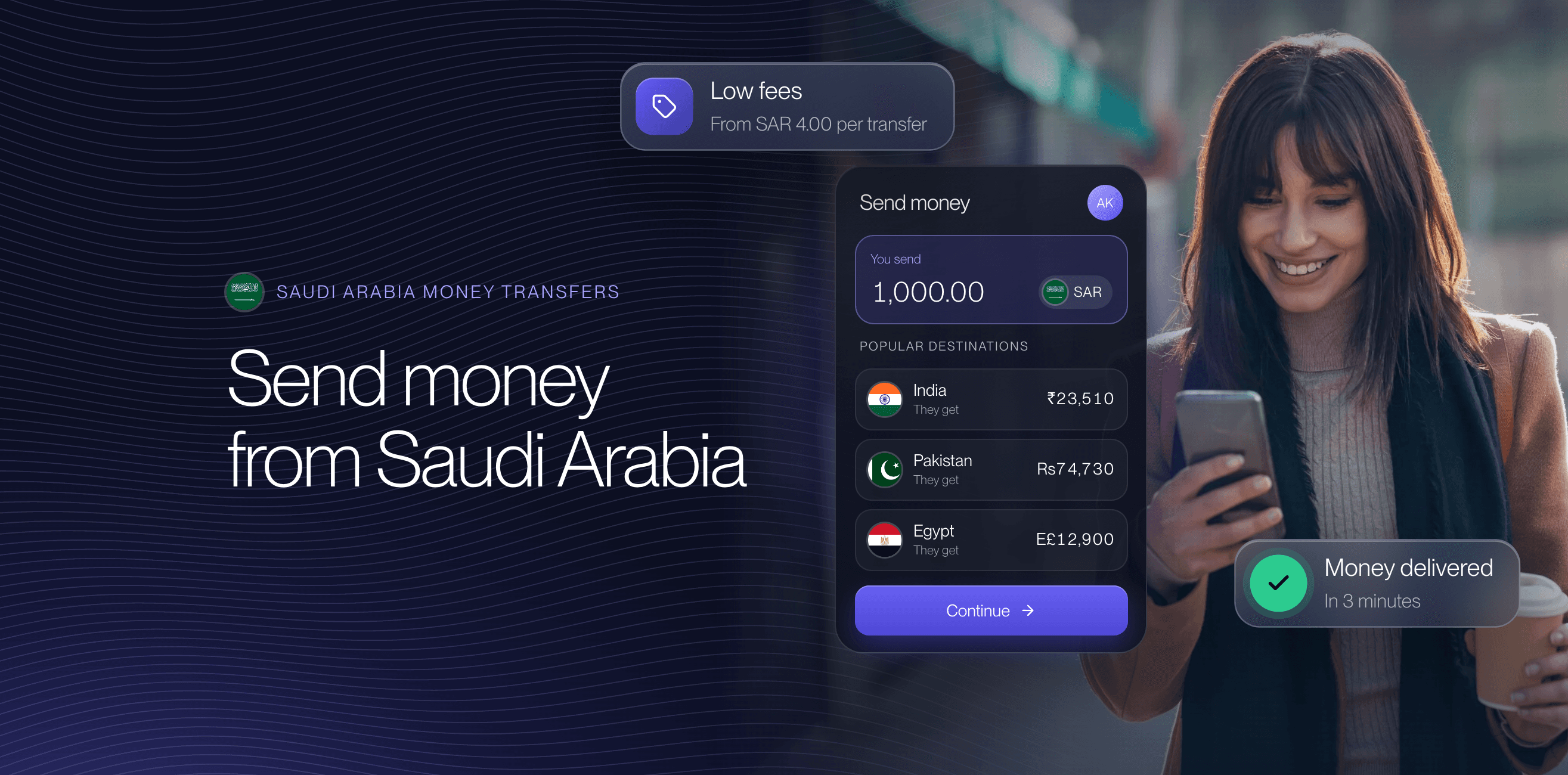
How to Send Money From Saudi Arabia

Most Saudi banks sell two ways to send money abroad, and the one at the top of the banking app is usually the dearer one. A standard transfer over SWIFT carries a flat fee, VAT on top and a margin in the exchange rate, while the same bank's own remittance service often costs a fraction of it.
For expat workers sending part of their wages to India, Pakistan, Egypt, the Philippines or Bangladesh, that choice comes round every month. Licensed wallets have widened the gap further, and the global apps many people know from other countries still do not send from riyals.
This guide compares every common way to make an international money transfer from Saudi Arabia: what each costs in riyals, how long it takes, the rules on limits and tax, and what you need before you send.
Who Sends Money From Saudi Arabia
Expat workers sent SAR 165.5 billion out of Saudi Arabia in 2025, up 15 percent on 2024, according to Saudi Central Bank (SAMA) data reported by Argaam. Saudi nationals sent another SAR 70.4 billion. Most of it is wages sent home to South Asia, Egypt and the Philippines, in regular transfers of a few hundred to a few thousand riyals.
The money moves on a monthly rhythm. SAMA's figures run at SAR 12 billion to SAR 15 billion a month. That steady flow shapes what senders need: a low fixed fee on a modest amount, delivery the same day, and a way to reach family members who may collect cash or use a mobile wallet rather than a bank account. Every one of these is a remittance in the plain sense, wages sent to people at home, and the cost of each one adds up over a working life.
Workers sending wages home
This is the largest group by far. Much of the Kingdom's construction, domestic, retail, health care and driving work is done by workers from India, Pakistan, Bangladesh, Egypt, the Philippines, Nepal, Sri Lanka and Indonesia, and most of them send part of every salary home. Typical transfers are SAR 500 to SAR 3,000, once or twice a month.
On these amounts the fixed fee does the damage. A SAR 75 bank fee on a SAR 750 transfer is 10 percent before the exchange rate is counted. A SAR 15 wallet fee on the same amount is 2 percent. That gap is why the remittance services built for this market exist, and why most experienced senders never use a standard bank transfer for money home.
Leaving the Kingdom with end-of-service savings
The largest single transfers come when an expat leaves for good. The end-of-service award, savings and the final salary often go out in one or two transfers of SAR 20,000 or more, shortly before a final exit visa. On a sum that size the fee barely matters and the exchange rate decides the cost: a 1.5 percent margin on SAR 50,000 is SAR 750.
Timing matters too. Banks close or restrict accounts once the residency ends, so the money needs to move while the Iqama is still valid and the account is fully active. Leaving it to the last week before departure is the most common way people end up carrying cash or paying more than they should.
Saudi nationals, students and businesses
Saudi nationals sent SAR 70.4 billion abroad in 2025: tuition and living costs for students overseas, property and travel spending, and support for family members living abroad. These transfers are larger and less frequent than worker remittances and often go to bank accounts in the UK, the US, Europe and the Gulf, where a standard bank transfer is the usual route. Small businesses paying suppliers abroad use the same SWIFT channel, so the bank's fee and its rate on dollars, euros and pounds are what they pay.
What Saudi Banks Charge to Send Money Abroad
A standard transfer from a Saudi bank to an account abroad costs SAR 40 to SAR 100 in fees before 15 percent VAT. Al Rajhi charges SAR 50 online and SAR 75 in a branch, and Riyad Bank's own example totals SAR 100 for standard customers. The exchange rate adds roughly 0.4 to 2 percent on top.
Every big Saudi bank offers two very different products. The first is the standard international transfer over SWIFT, which goes to any bank account in the world in any major currency. The second is the bank's own remittance service, such as Tahweel Al Rajhi, Enjaz at Bank Albilad, Fawri at Bank AlJazira or SNB QuickPay, which pays out through partner banks and agents in the main expat home countries. The remittance service is almost always cheaper, sometimes by SAR 50 or more on a single transfer, yet the standard transfer is the one many people pick by default in their bank app.
Bank | Standard transfer abroad (published fee) | Remittance service | Typical exchange rate margin |
|---|---|---|---|
Al Rajhi Bank | SAR 50 online, SAR 75 in a branch, plus VAT | Tahweel Al Rajhi, fee shown in the app | About 0.4% to 1.4% |
Saudi National Bank (SNB) | SAR 50 per transfer (reported 2024) | SNB QuickPay, fee shown before you confirm | Not in the comparison data |
Riyad Bank | SAR 50 execution plus SAR 50 correspondent fee, SAR 100 for standard customers | Western Union in the app | Not published |
SAB (Saudi Awwal Bank) | Up to SAR 40 plus VAT (schedule from 20 February 2026) | SAB remittance, SAR 15 to SAR 40 plus VAT | About 1.8% to 2% |
Bank Albilad | SAR 75 recorded by the World Bank | Enjaz, SAR 0 to SAR 50 before VAT | About 0.5% to 1.5% |
Fees from each bank's published tariff or product page, before 15% VAT, checked 22 October 2026. Margins are approximate, from the World Bank's Remittance Prices Worldwide survey for standard bank transfers, collected 21 August to 2 September 2025.

Al Rajhi Bank
Al Rajhi's tariff lists SAR 50 for a transfer to a bank outside the Kingdom through its electronic channels and SAR 75 in a branch, both before VAT, so SAR 57.50 and SAR 86.25 once the 15 percent tax is added. Amending or cancelling a transfer abroad costs extra on top. Add the margin in the rate, and a standard Al Rajhi transfer of a few hundred riyals home ends up costing more than a tenth of the money.
The cheaper route at the same bank is Tahweel Al Rajhi, its remittance arm, with more than 135 dedicated centres, access through 520 Al Rajhi branches, the Al Rajhi app, the urpay wallet and ATMs. Al Rajhi does not publish a Tahweel fee table, so the fee appears in the app before you confirm, and it runs regular route promotions, such as SAR 5 transfers to India in May 2026. Its Send Now Pay Later option lets you pay for a transfer with a credit card in instalments, which adds card costs that make a transfer far more expensive; our guide to paying for a transfer by credit card explains why.
Saudi National Bank (SNB)
SNB, formed from the merger of NCB and Samba, has charged a flat SAR 50 for a standard transfer abroad, plus any foreign exchange cost, according to reporting in 2024. For money home, most SNB customers use SNB QuickPay, the bank's remittance service, with its own app, ATM card and phone banking. QuickPay fees depend on the country and the amount and are shown during the transfer, so check the full price, fee and rate, before you confirm.
SNB was not in the World Bank's 2025 sample, so there is no independent measure of its margin. Treat the rate shown in the app as the real price and compare the amount your recipient will get, in rupees or pesos, with what a wallet quotes for the same transfer at the same moment.
Riyad Bank
Riyad Bank publishes the clearest breakdown of what a SWIFT transfer really costs. Its example shows a SAR 50 execution fee and a SAR 50 correspondent bank fee, so SAR 100 for a standard customer. Silver customers get 25 percent off the execution fee (SAR 87.50 in total), Golden customers 50 percent (SAR 75), and Private and Diamond customers pay only the SAR 50 correspondent fee.
Where the receiving bank has an agreement with Riyad Bank you can choose to pay every charge yourself so the beneficiary gets the full amount; otherwise intermediary and receiving banks may deduct their own fees on the way. For cash pickup and small transfers home, the Riyad Bank app also offers Western Union, which is the cheaper route for most remittances.
SAB (Saudi Awwal Bank)
SAB's personal schedule, in force from 20 February 2026, lists up to SAR 40 plus VAT for a transfer to a bank outside the Kingdom. A SWIFT investigation, when a payment goes missing, costs SAR 150. SAB's remittance service pays to bank accounts worldwide, to cash pickup in the Philippines, India, Pakistan, Bangladesh and the UAE, and to wallets in the Philippines, Pakistan, Sri Lanka, Bangladesh, Kenya and Ghana, for fees of SAR 15 to SAR 40 plus VAT.
SAB, then listed as Saudi British Bank, had the highest margins of the banks the World Bank measured in 2025, close to 2 percent on the routes it checked. On a mid-sized transfer that means the rate costs more than the fee, which is easy to miss when the fee is the only number on the screen.
The exchange rate margin they do not show
The riyal is pegged at 3.75 to the US dollar, so the margin on a dollar transfer is small. The cost hides in the conversion into Indian and Pakistani rupees, Philippine pesos and Egyptian pounds, where each bank and service sets its own rate. The benchmark is the mid-market exchange rate, the midpoint between buying and selling prices that you see on Google or Reuters.
Every 1 percent of margin costs SAR 10 on a SAR 1,000 transfer, whichever currency it lands in. The banks' margins run from under half a percent to around 2 percent depending on the route, while the cheapest remittance services usually keep well under 1 percent. Neither appears on the receipt as a charge.
Hidden extras on a transfer from Saudi Arabia
VAT comes first. Saudi banks quote most fees before the 15 percent tax, so a SAR 50 fee is SAR 57.50 at the checkout. On a standard SWIFT transfer, correspondent and receiving banks can deduct their own fees before the money lands, which is why Riyad Bank prices a SAR 50 correspondent charge into its example. Our guide to international wire transfer fees explains how those deductions work.
Mistakes cost money too. Banks charge to amend or cancel a transfer abroad and charge more again to trace a payment that has gone missing. Funding a transfer with a credit card, through instalment plans such as Al Rajhi's, adds the card's own costs. None of these appear in the headline fee, and all of them are avoidable.
The Best Ways to Send Money From Saudi Arabia
The best way to send money from Saudi Arabia is a licensed wallet or a bank's own remittance service: STC Bank, Fawri, Enjaz, Tahweel Al Rajhi or Western Union through a local partner. On the main routes home they usually cost 1.5 to 5 percent of a typical transfer, against more than 10 percent for a standard bank transfer.
The global specialists are not an option for riyals today. We checked each provider's own site on 22 October 2026: Wise's list of currencies you can send from does not include SAR, Remitly's list of 33 sending countries does not include Saudi Arabia, and Xe only registers senders who live in Europe, North America, Australia and New Zealand. Until that changes, the cheapest routes are local, and the providers below are all licensed by SAMA or run by SAMA-licensed banks.
STC Bank
STC Bank, the digital bank that grew out of the stc pay wallet, is the cheapest option on many routes. It sends to Western Union cash pickup at more than 525,000 locations, to bank accounts in more than 100 countries and to other wallets. Its published fees, before VAT, are SAR 15 to India, Bangladesh, Egypt, Indonesia, Nepal, the Philippines, Sri Lanka, Sudan, Vietnam and Yemen, SAR 20 to countries such as China, Jordan, Turkey and Kenya, SAR 25 to the rest of the world, and nothing to Pakistan on transfers of SAR 375 or more.
STC Pay's margins were among the lowest measured on the main routes, although some STC products on the same routes carried wider ones, so compare the amount received rather than the fee. Most transfers were rated at under one hour.
Fawri (Bank AlJazira)
Fawri is Bank AlJazira's remittance service and runs on the MoneyGram network, with an app and walk-in centres. It pays to bank accounts and for cash pickup. In the World Bank's 2025 check its fee was SAR 15 to SAR 16, and its margin to Egypt was the lowest measured on that route. Delivery was same day, and cash to Pakistan arrived in under an hour.
That makes Fawri a strong default for bank deposits to Egypt and for cash pickup across South Asia, and it sat close to the cheapest option on most of the other main routes as well.
Enjaz (Bank Albilad)
Enjaz is Bank Albilad's remittance network, with centres across the Kingdom and an app. Fees run from SAR 0 to SAR 50 before VAT depending on the destination and how the money is paid out, and the full price is shown before you confirm. It offers instant credit to bank accounts in India, instant cash or account payout in Pakistan and Nepal, and instant cash pickup in the Philippines.
A standard SWIFT transfer from a Bank Albilad account, by contrast, carries a far larger flat fee. The same bank, two products, and a difference of SAR 50 or more on every transfer.
Tahweel Al Rajhi and urpay
Tahweel Al Rajhi has the largest physical network of the bank remittance services, more than 135 dedicated centres, and reaches more than 200 countries. You can send from the Al Rajhi app, the urpay wallet, ATMs and point-of-sale terminals as well as the centres. urpay, the wallet run by Al Rajhi's Neoleap, also offers Western Union transfers, which gives Al Rajhi customers a cash pickup route in most countries.
Tahweel does not publish a fee table, and its prices change with promotions. Check the fee and the amount received in the app, then compare it with STC Bank or Fawri for the same transfer before you send.
Western Union and MoneyGram
Western Union is available in Saudi Arabia mainly through partners: STC Bank, urpay and the Riyad Bank app. MoneyGram runs behind Fawri and others. On the last independent price check, Western Union was the cheapest option to Pakistan, where it charged no fee, but one of the dearer services to India.
Both suit cash pickup, especially in countries where the recipient has no bank account. Compare the amount received rather than the fee, since a zero fee usually means a wider exchange rate margin.
Which option for which transfer
The right service depends on where the money is going and how it needs to arrive. This is how the options line up on the transfers people actually make from Saudi Arabia.
Transfer | Best fit | Why |
|---|---|---|
Bank deposit to India, the Philippines or Bangladesh | STC Bank or Fawri | Low flat fee and some of the lowest margins measured |
Money to Pakistan | STC Bank or Western Union | No fee on most transfers |
Bank deposit to Egypt | Fawri | Lowest margin measured on the route |
Cash pickup | Western Union through STC Bank, or Fawri (MoneyGram) | Large agent networks in every main home country |
Mobile wallet such as GCash or bKash | STC Bank or SAB remittance | Pay straight into wallets on the main routes |
Large one-off sum, such as end-of-service savings | Compare a remittance service with your bank's rate | On big amounts the margin decides the cost |
Account in the UK, US or Europe | Standard bank transfer | Remittance services focus on South Asia, Africa and Southeast Asia |

How Much Does It Cost to Send Money From Saudi Arabia?
A typical SAR 750 transfer home from Saudi Arabia costs about SAR 11 to SAR 32 through a wallet or remittance service and SAR 78 to SAR 90 through a standard bank transfer. Most of the bank's cost is its flat fee, which is why the gap is widest on small amounts.
The table below shows the total cost of sending SAR 750, the fee plus what the exchange rate margin took, for every service the World Bank sampled on the four biggest routes. Each cell is that service's cheapest product on the route, with the total as a share of the amount sent.
Service | India | Pakistan | Philippines | Egypt |
|---|---|---|---|---|
STC Pay (STC Bank) | SAR 23.55 (3.1%) | SAR 13.50 (1.8%) | SAR 19.20 (2.6%) | SAR 24.38 (3.3%) |
Fawri | SAR 26.35 (3.5%) | SAR 22.95 (3.1%) | SAR 20.72 (2.8%) | SAR 19.75 (2.6%) |
MoneyGram | SAR 26.78 (3.6%) | SAR 31.80 (4.2%) | SAR 20.25 (2.7%) | SAR 21.58 (2.9%) |
Western Union | SAR 31.03 (4.1%) | SAR 10.80 (1.4%) | SAR 23.90 (3.2%) | SAR 25.78 (3.4%) |
TeleMoney | SAR 29.98 (4.0%) | SAR 29.23 (3.9%) | SAR 30.58 (4.1%) | SAR 30.13 (4.0%) |
Al Rajhi Bank | SAR 85.65 (11.4%) | SAR 83.55 (11.1%) | Not sampled | SAR 78.15 (10.4%) |
Bank Albilad | SAR 86.18 (11.5%) | SAR 85.05 (11.3%) | SAR 81.00 (10.8%) | SAR 78.75 (10.5%) |
SAB | SAR 88.28 (11.8%) | SAR 90.30 (12.0%) | Not sampled | Not sampled |
Route average | SAR 41.95 (5.6%) | SAR 37.61 (5.0%) | SAR 28.64 (3.8%) | SAR 38.59 (5.2%) |
Total cost of a SAR 750 transfer from the World Bank's Remittance Prices Worldwide survey, Saudi Arabia to India, Pakistan, the Philippines and Egypt, collected 21 August to 2 September 2025.

A typical transfer: SAR 1,000
Apply the same fees and margins to SAR 1,000 and the picture barely moves. The cheapest service on each main route costs roughly SAR 14 to SAR 26, or 1.4 to 2.6 percent of the money.
A standard bank transfer costs several times as much. Once VAT and the margin are counted, Al Rajhi online and SAB come to roughly SAR 60 to SAR 70, and Riyad Bank's standard SWIFT transfer starts at SAR 100 before the rate. That puts the bank route at 6 to 10 percent, against 1.4 to 3.5 percent for the remittance services.
A large transfer: SAR 10,000
On a bigger sum, such as end-of-service savings, the margin does most of the damage and the fee fades. At the margins measured last year, SAR 10,000 costs about SAR 40 to SAR 120 through the cheapest remittance service on each main route, against roughly SAR 100 to SAR 250 for a standard bank transfer.
Two cautions on large amounts. Wallets and remittance services have per-transfer and daily limits, so check them before the day you need to send. And ask the bank for its rate on a large sum before you commit: a quote in writing lets you compare the amount that will arrive, which is the only number that matters.
What the gap adds up to over a year
Take SAR 1,500 a month, a common pattern for workers who transfer money from Saudi Arabia to family. Through a standard Al Rajhi transfer online, fee and margin together come to roughly SAR 750 to SAR 950 a year. Through the cheapest remittance service on the route it is closer to SAR 250 to SAR 350, so switching saves roughly SAR 480 to SAR 640 a year on one ordinary remittance.
How Long Does It Take to Send Money From Saudi Arabia?
Most wallets and remittance services in Saudi Arabia deliver in under an hour or the same day: the World Bank rated STC Pay, Western Union and TeleMoney at under one hour, and Fawri and MoneyGram at same day. A standard SWIFT transfer can take from the same day to three working days.
Method | Typical time |
|---|---|
STC Bank to Western Union cash pickup | Usually minutes |
STC Bank wallet and bank transfers | Under one hour on the main routes |
Fawri | Same day; cash to Pakistan under an hour |
Enjaz | Instant to Indian bank accounts; instant cash in Pakistan, Nepal and the Philippines |
Tahweel Al Rajhi | Described as instant on most routes |
Standard bank transfer (SWIFT) | Same day to one to three working days |
Times from the World Bank's 2025 survey and the providers' own descriptions. Bank times depend on the route and the intermediary banks.
How long each option takes
Remittance services are fast because they do not send each transfer across the world through a chain of banks. They hold funds with partner banks in India, Pakistan, the Philippines and other home countries and pay out locally, through instant systems such as IMPS in India and Raast in Pakistan or through agent networks for cash. Your riyals stay in Saudi Arabia and the partner pays the recipient from money already in place.
A standard SWIFT transfer passes through your bank, sometimes one or more intermediary banks, and the recipient's bank, and each step can add time. Our guide on how long a wire transfer takes breaks down each stage. For money home, the remittance services are both faster and cheaper, which is rare in banking.

What slows a transfer down
Saudi banks work Sunday to Thursday, and the weekend falls on Friday and Saturday, so a SWIFT transfer sent on Thursday afternoon may not move until Sunday, while the receiving bank may be closed on its own weekend. Public holidays stop the bank system too: the Eid al-Fitr and Eid al-Adha breaks, Founding Day on 22 February and National Day on 23 September, plus holidays at the receiving end, such as Diwali in India.
The rest are checks. A first transfer to a new beneficiary can be held while the bank or app confirms it, an expired Iqama blocks transfers until it is renewed and updated, and large or unusual amounts can trigger questions about where the money came from. A name that does not match the recipient's bank record is the most common reason a transfer is returned.
How to Send Money From Saudi Arabia, Step by Step
To send money from Saudi Arabia you need a valid Iqama or Saudi ID, an account or wallet in your name, and the recipient's details. Add the beneficiary in your bank app, STC Bank or a remittance app, check the fee and the amount that will arrive, then confirm with the one-time code sent to your registered mobile number.
What you need before you start
The Iqama is the document that matters most. Banks and wallets verify you against it, and most digital onboarding now runs through Nafath, the national digital identity app, so your Iqama and your Absher details need to be current. If your Iqama expires, banks restrict the account until you renew it and update the new expiry date with them, so renew early if a transfer is due. You also need a Saudi mobile number registered in your own name to receive the one-time codes that confirm every transfer.
For the recipient you need their full name exactly as it appears on their bank account or ID, and the local details: an account number and IFSC code in India, a 24-character IBAN starting with PK in Pakistan, an account number or GCash mobile number in the Philippines, a 29-character IBAN starting with EG in Egypt, or an account number and routing number in Bangladesh. Our guide to the bank details you need for a transfer covers each format. For a large transfer, keep a salary certificate or end-of-service letter ready in case the bank asks where the money came from.
With a wallet or remittance app
- Download STC Bank, urpay, Enjaz, Fawri or Tahweel Al Rajhi and verify your identity with your Iqama, usually through Nafath.
- Add money from your Saudi bank account by a local instant transfer, which costs SAR 0.50 to SAR 1 at Al Rajhi, for example.
- Choose the country and how the money should arrive: bank account, cash pickup or wallet.
- Enter the recipient's details and check the fee, the exchange rate and the amount they will receive.
- Confirm with the one-time code and share the reference number with your recipient.
Add VAT to the fee in your head before you compare, and check the amount received against a second app. The whole comparison takes a couple of minutes and saves real money every month.
From your own bank account
In your bank app, add an international beneficiary with their name, address, bank name, SWIFT or BIC code and account number or IBAN. Choose the currency, check the fee and, where offered, whether you pay all charges or share them with the recipient, then confirm with the one-time code. A new beneficiary may need a short activation period before the first transfer. If your bank has its own remittance service, use that instead of the standard transfer for money home; the difference between the two is explained in our guide to remittances and wire transfers.
With cash at a remittance centre
You can still walk into a Tahweel Al Rajhi, Enjaz or Fawri centre with your Iqama and pay in cash, which is how many workers without a bank account send money home. You fill in the recipient's details, pay the amount plus the fee, and get a receipt with a reference number for the recipient.

Cash at the counter rarely saves money and costs time, and you cannot compare prices across services as easily as in an app. Since most private-sector salaries are paid into bank accounts under the Wage Protection System, most workers can send from a wallet or app instead, and should.
Limits, Tax and Reporting When You Send Money From Saudi Arabia
Saudi Arabia does not tax money sent abroad, and there is no legal cap on remittances. You pay 15 percent VAT on the transfer fee only. Banks set daily transfer limits, which SAMA's 2022 anti-fraud measures put at SAR 60,000 for individuals unless you ask for more, and travellers must declare cash worth SAR 40,000 or more.
How much you can send
Your limit depends on the channel. SAMA's anti-fraud measures in 2022 set daily transfer limits for individuals at SAR 60,000, with customers able to ask their bank for a higher limit, and banks still apply daily limits, so check yours in the app. Wallets and remittance services set their own per-transfer and daily limits by verification level, and some online services cap a single transfer at SAR 10,000. For a large one-off payment, such as end-of-service savings or a property deposit at home, ask your bank to raise the limit well before the day you need to send.
Is there a tax on sending money from Saudi Arabia?
No. Saudi Arabia does not tax salaries or remittances, and the Shura Council shelved a proposed 6 percent tax on expat remittances in November 2018. The only tax in the price is VAT at 15 percent, in force since July 2020, which applies to the fee and not to the money sent. A SAR 15 fee is SAR 17.25 with VAT.
Some home countries add incentives at the receiving end. Pakistan's free remittance scheme still processes eligible transfers of $200 or more with no transfer fee, even after the State Bank of Pakistan stopped reimbursing banks in July 2026. Bangladesh is keeping its 2.5 percent cash incentive on remittances sent through formal channels for the 2026 to 2027 fiscal year, paid to the recipient on top of the amount sent.
Reporting rules and extra checks
Banks and payment companies apply Saudi anti-money laundering rules, so transfers that do not match your usual income, very large amounts or frequent transfers to new recipients can trigger questions about the source of funds. Keep payslips, an end-of-service letter or a sale contract for large transfers. At the border, the threshold for declaring cash, gold and jewellery fell from SAR 60,000 to SAR 40,000 in June 2026, and undeclared amounts can be fined 10 to 25 percent of their value on a first offence.
Is It Safe to Send Money From Saudi Arabia?
A money transfer from Saudi Arabia is safe when you use a bank or payment company licensed by the Saudi Central Bank (SAMA). Every bank, STC Bank and the licensed wallets are supervised by SAMA, which publishes its list of licensed entities online, so you can check any service before you use it. The real risk is fraud, not the provider.
Who regulates money transfers in Saudi Arabia
SAMA licenses and supervises the banks and, separately, the payment institutions and electronic money institutions that run wallets and transfer apps. Its register of licensed payment service providers lists the companies allowed to operate, including the Saudi Digital Payment Company behind STC Pay. Fawri, Enjaz, Tahweel Al Rajhi and SNB QuickPay are services of licensed banks, so they sit under the banks' own licences.
If something goes wrong, complain to the bank or app first and keep the reference number. If the provider does not resolve it, SAMA runs a consumer complaints service, SAMA Cares. For a transfer sent to the wrong details, act fast; our guide on money sent to the wrong account explains what can be recovered and how.
Scams that target senders in Saudi Arabia
The most common scams in the Kingdom are calls and messages from people posing as bank staff, SAMA, Absher or the Ministry of Interior, asking you to confirm details or read back a one-time code. Others promise prizes, jobs or cheap loans in exchange for a transfer, or come from someone you have only met online. Banks and government bodies never ask for your code, and a transfer you approve yourself is very hard to reverse. Our guide to the safest way to send money internationally covers the warning signs in more detail.
The Routes People Send on Most From Saudi Arabia
India, Pakistan, Egypt, the Philippines and Bangladesh receive most of the money sent from Saudi Arabia. Each route works differently at the receiving end, from IFSC codes and instant credit in India to fee-free transfers in Pakistan, mobile wallets in the Philippines and a 2.5 percent government bonus on transfers to Bangladesh.
Saudi Arabia to India
India is the biggest route. Transfers to Indian bank accounts need the account number and IFSC code, and remittance services usually credit them within hours, often through IMPS. The cheapest of them cost a fraction of a standard bank transfer here. Compare today's providers on our Saudi Arabia to India page.
Saudi Arabia to Pakistan
Pakistan has the cheapest fees from the Kingdom thanks to its free remittance scheme for transfers of $200 or more. Several services charge nothing on this route, so the exchange rate is the whole cost, and payouts go to an IBAN, a mobile wallet or cash. See the Saudi Arabia to Pakistan page for current rates.
Saudi Arabia to Egypt
Bank deposits to Egypt need the recipient's 29-character IBAN, and cash pickup is widely available. Fawri has been the cheapest service on this route, while the standard bank transfers cost several times as much. Start with the Saudi Arabia to Egypt page.
Saudi Arabia to the Philippines
Many recipients in the Philippines use GCash or collect cash, so payout options matter as much as price. STC Pay has been the cheapest option on this route, and most services pay into wallets as well as bank accounts. Check the Saudi Arabia to Philippines page before you send.
Saudi Arabia to Bangladesh
Transfers to Bangladesh through formal channels earn the recipient a 2.5 percent government cash incentive on top of the amount sent, which outweighs most fee differences. STC Bank puts Bangladesh in its lowest fee band, and SAB pays into mobile wallets such as bKash. Compare options on the Saudi Arabia to Bangladesh page.
Bottom Line
The cheapest way to send money from Saudi Arabia is rarely your bank's standard transfer abroad, with its flat fee, VAT and margin. It is a licensed wallet or a bank's own remittance service, such as STC Bank, Fawri, Enjaz or Tahweel Al Rajhi, which usually costs a small fraction as much and arrives within the hour. Compare the amount your family will receive on two services each time you send, keep your Iqama current, and never share a one-time code.
Sources
- World Bank Remittance Prices Worldwide: Saudi Arabia to India, Q3 2025
- World Bank Remittance Prices Worldwide: Saudi Arabia to Pakistan, Q3 2025
- World Bank Remittance Prices Worldwide: Saudi Arabia to the Philippines, Q3 2025
- World Bank Remittance Prices Worldwide: Saudi Arabia to Egypt, Q3 2025
- Argaam: Expat remittances in Saudi Arabia hit record SAR 165.5B in 2025 (SAMA data)
- Al Rajhi Bank: Products and services fees
- Al Rajhi Bank: Tahweel Al Rajhi
- Riyad Bank: International transfer
- SAB: Schedule of bank charges from 20 February 2026
- SAB: International remittance
- STC Bank: Product and service fees
- Expatica: International money transfers in Saudi Arabia (SNB fee)
- Wise: What currencies can I send to and from?
- Xe: Can I register to send money from my country?
- Remitly: Countries you can send money from
- SAMA: Licensed payment service providers
- Argaam: SAMA daily transfer limit of SAR 60,000 (2022)
- Gulf News: Shura Council shelves expat remittance tax (2018)
- ClearTax: VAT rates in Saudi Arabia
- Gulf Business: New cash and gold declaration rules for Saudi Arabia (June 2026)
- Profit: SBP keeps the free remittance facility (July 2026)
- The Business Standard: Bangladesh keeps the 2.5% remittance incentive (June 2026)