 Compare money transfers from Thailand
 INR




 GBR










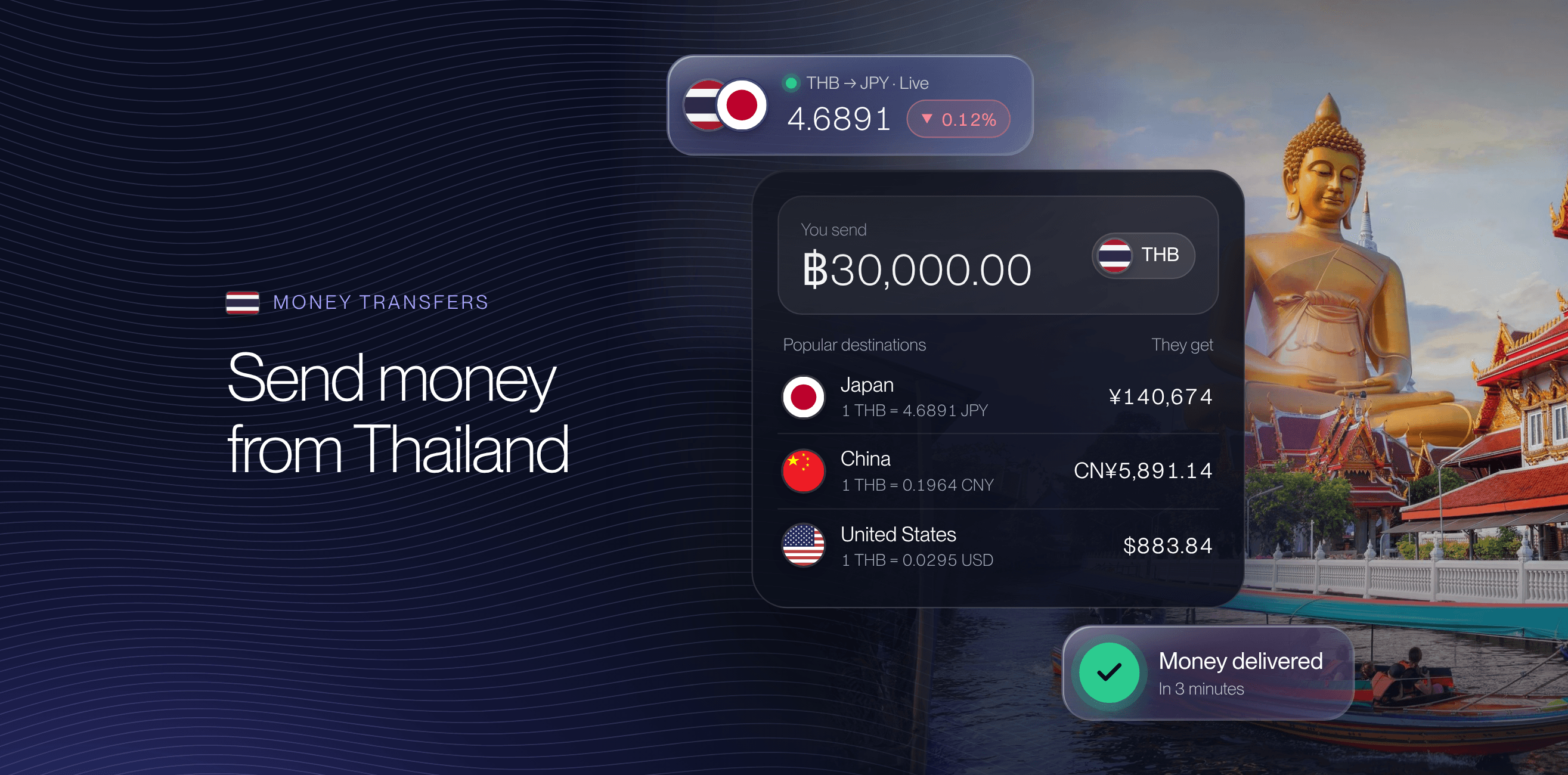
How to Send Money From Thailand

To send money from Thailand, a Thai bank app charges a fixed fee of 250 to 400 baht and converts your baht at its own selling rate, which includes a margin it does not show as a fee. Bangkok Bank charges 300 baht through its app and 1,150 baht if you pay the foreign bank's charges, and Kasikornbank charges 250 baht through K PLUS.
The quick answer: for a money transfer from Thailand to a bank account in India, the Philippines, the US or Europe, Wise usually shows the clearest price, with a visible fee and the mid-market rate. For Myanmar, Laos and Cambodia, where most migrant workers send money, a Thai bank app or a licensed agent is often the only regulated option.
This page sets out what Thai banks charge, which providers serve senders in Thailand, what a 45,000 baht transfer really costs, how long it takes, and the Bank of Thailand rules on limits, documents and cash.
Who sends money from Thailand
Thailand is one of the largest sources of remittances in Asia. The World Bank puts personal remittances paid from Thailand at about $8.03 billion in 2024, up from $6.31 billion in 2022. Most of that money is sent by migrant workers from neighbouring countries, with expats, retirees and international staff sending smaller but often larger individual amounts.
Myanmar workers
Workers from Myanmar are by far the largest group. Department of Employment figures reported in November 2026 showed 4,225,503 valid work permits in September 2026, of which about 3.33 million were held by Myanmar nationals. Many work in factories, construction, fishing and farming, and send part of every wage home. Families in Myanmar often need cash or a local bank deposit in kyat, and political and banking disruption there makes the route harder than most.
Lao and Cambodian workers
Laos had 364,785 workers with valid permits and Cambodia 279,854 in September 2026. Cambodian numbers fell sharply after border tensions in 2025. Both groups send small, frequent amounts, often to rural families who use cash or a mobile wallet. A fixed bank fee of 250 to 400 baht takes a large share of a 3,000 or 5,000 baht payment, which is why many use agents or bank partner services that pay out in local currency.
Expats and retirees
Thailand is home to many retirees and long stay residents from the UK, Europe, the US and Australia. Most bring money into Thailand, but they also send money abroad to pay for property, family, insurance or tax at home, or when they move away. These transfers are larger and less frequent, so the exchange rate margin matters far more than the fixed fee.
International staff and students
Engineers, teachers, healthcare workers and students from India, the Philippines, China and elsewhere work or study in Thailand. Many transfer money from Thailand to support parents, repay loans or move savings home. Their salaries are paid in baht, so every payment home is a currency conversion, and a monthly routine makes a cheap and predictable provider worth setting up once.
What Thai banks charge to send money abroad
Banks in Thailand charge a fixed fee for each overseas transfer through their apps, plus extra if you pay the foreign bank's charges or send in baht. The app fees are low by international standards, but every transfer is converted at the bank's own selling rate, and none of the big banks shows its margin on that rate as a fee.
Bank | App fee (recipient pays foreign charges) | Sender pays all charges | Other costs |
|---|---|---|---|
300 baht online, 400 baht at a branch | 1,150 baht | 0.25% (min 300 baht) extra when sending baht | |
250 baht through K PLUS | 950 baht | Face check needed for 50,000 baht or more | |
199 to 399 baht through SCB EASY | Not listed | 150 baht for PromptPay International |
Bangkok Bank
Bangkok Bank charges 300 baht to send money abroad through Bualuang iBanking or its mobile app when you pay only its own fee, and 400 baht at a branch. If you want the recipient to get the full amount, the fee rises to 1,150 baht, and the bank may charge more if the foreign bank's costs exceed that. Sending in baht instead of the recipient's currency adds a commission of 0.25%, with a minimum of 300 baht.
The app sends in 18 currencies to 135 countries, including the kyat, dong, rupee and peso, without registering the recipient in advance. The limit is 2,000,000 baht per transaction and per day, shared with PromptPay International and Western Union. Bangkok Bank converts at its selling TT rate on the day, which includes its margin. For transfers to Myanmar, you must also give an ITRS purpose code required by the Central Bank of Myanmar.
Kasikornbank
Kasikornbank charges 250 baht for a transfer through K PLUS, either through its partner network or by SWIFT with shared charges, and 950 baht if you pay all charges. Transfers to Myanmar in kyat through its partner network start at 20 baht. Through 31 December 2026, KBank waives its fee for workers who choose the purpose "Repatriated earnings of workers", and for students' overseas expenses.
K PLUS covers more than 150 destinations and 24 currencies. KBank asks for face verification on any international transfer of 50,000 baht or more, so register at a branch with your passport and passbook before your first large payment. The waived fee covers only KBank's own charge: intermediary and receiving bank charges and the margin on the rate still apply.
SCB and other banks
Siam Commercial Bank charges 199 to 399 baht per transfer through the SCB EASY app, and 150 baht to send through PromptPay International, which pays to a mobile number in linked countries such as Singapore. SCB asks foreign customers for documents showing their source of income when they send through SWIFT, and requires a foreign exchange transaction form for amounts of $50,000 or more.
Other banks, including Krungsri and Krungthai, offer similar SWIFT services with their own fees and forms. Whichever bank you use, compare the amount received with a specialist quote on the same day. For more on bank pricing, see our guide to international wire transfer fees.
Sending from a foreign currency account
If you already hold dollars, euros or another currency in a foreign currency deposit account, you can send that money without converting baht. Bangkok Bank's app sends from foreign currency accounts in 13 currencies, during business hours on bank business days. When the payment goes out in the same currency it came from, Bangkok Bank adds a commission in lieu of exchange of 0.25% for US dollars and yuan and 0.50% for euros, pounds and yen, with a minimum of 500 baht.
This route suits expats who are paid in a foreign currency or keep savings in dollars, because it avoids a second conversion. For a money transfer from Thailand in baht, though, the selling rate on the day is what decides the cost.
The exchange rate margin in the selling rate
The fixed fee is only part of the price. Thai banks convert your baht at their selling TT rate, which sits above the mid-market rate, and the gap is a cost you pay on every transfer. Bangkok Bank, Kasikornbank and SCB publish their selling rates but not the mid rate next to them, so the margin is hard to see.
As an illustration, a 1% margin on a 45,000 baht transfer would cost 450 baht on top of a 250 or 300 baht fee. The World Bank's price survey shows how much this adds up across the market: in early 2025 the average cost of sending the equivalent of $200 from Thailand was 12.44% to India, 12.29% to China, 11.84% to Laos and 11.78% to Vietnam, against a global average of 6.36%. Our guide to the exchange rate markup shows how to measure it.

Hidden extras on a bank transfer
A bank money transfer from Thailand by SWIFT can lose money on the way. With shared charges, intermediary banks and the receiving bank can take their fees from the amount, which is why Bangkok Bank charges 1,150 baht to cover them upfront. If you send baht or dollars to a country that uses another currency, the receiving bank converts it again at its own rate.
Corrections cost extra too, and payments to some countries need purpose codes or documents. The safest way to see the real cost is to compare the amount the recipient will get, not the fee. Our guide to the telegraphic transfer fee explains the charge options.
The best ways to send money from Thailand
The best way to send money from Thailand depends on where the money is going. For bank accounts in India, the Philippines, China, the US, the UK and Europe, Wise usually gives the clearest price. For Myanmar, Laos and Cambodia, a Thai bank app with local partners or a licensed agent is often the practical choice.

Wise
Wise is the cheapest way to send money from Thailand to a bank account on most international routes. It converts at the mid-market rate and charges a fee you see before you pay. On its Thai site in November 2026, sending 45,000 baht cost 383.36 baht to India, 411.64 baht to the Philippines and 356.91 baht to US dollars by bank transfer, and less from a Wise balance.
Customers with a Thai address are served by Wise's local Thai entity, which Wise says is fully licensed and regulated by the Bank of Thailand. You can send up to 800,000 baht a day abroad, paying from your Thai bank account by Thai QR code or bill payment. To verify, you need a visa, work permit or residence permit; Wise does not accept tourist visas. Wise says 77% of transfers arrive in under 20 seconds.
Worked example: an Indian engineer in Bangkok sends 45,000 baht to his parents every month. With Wise, paying by bank transfer, that costs 383.36 baht a transfer at the mid-market rate. Through a bank app the fee is 250 or 300 baht, but the margin in the selling rate decides which one delivers more rupees.
Wise does not offer cash pickup, and it does not cover every currency in the region. Read our Wise review and the guide on how to use Wise to transfer money internationally.
Thai bank apps for Myanmar, Laos and Cambodia
For the main migrant routes, Thai banks are often the most practical regulated choice. Kasikornbank sends kyat to Myanmar through its partner network from 20 baht, and Bangkok Bank's app sends kyat and dong without registering the recipient first. Bangkok Bank also has a lower fee for baht sent to Laos: 350 baht for amounts up to 30,000 baht.
Check the amount received in local currency before you confirm, because the margin in the rate matters more than the fee on these routes. Keep the recipient's name exactly as on their bank account, and have the purpose code ready for Myanmar. Our guide to remittance vs wire transfer explains the difference between partner networks and SWIFT.
Remitly, Xe and Western Union
Remitly and Xe do not accept senders who live in Thailand, so neither is an option for a money transfer from Thailand. Western Union operates through Bangkok Bank and other agents and pays out in cash at agent locations, which is useful when the recipient has no bank account.
Cash services are convenient but rarely cheap, so compare the amount the recipient will collect with a bank app or Wise quote. You will need a passport, Thai ID card or alien card to send at an agent. Our Remitly vs Wise comparison and Xe vs Wise comparison explain how these providers price transfers in the countries they serve.
Which option for which transfer
The right choice for a money transfer from Thailand depends on the destination and how the recipient wants the money. This table matches common situations to the option that usually fits best.
Situation | Best fit | Why |
|---|---|---|
Bank account in India, the Philippines or China | Wise | Mid-market rate and a visible fee |
Bank account in the US, UK or Europe | Wise | 356.91 baht on 45,000 baht to US dollars |
Family in Myanmar | Kasikornbank or Bangkok Bank app | Kyat payouts through bank partners |
Family in Laos | Bangkok Bank or Kasikornbank app | Baht or kip to Lao banks |
Recipient without a bank account | Western Union or a licensed agent | Cash pickup |
Transfer of $200,000 or more | Your bank, with documents | Supporting documents required by the Bank of Thailand |
How much a money transfer from Thailand costs
What a money transfer from Thailand really costs is the fee plus the margin in the rate. Thai bank fees are low, so on many routes the margin decides the outcome. The table compares published fees and Wise quotes on 45,000 baht.
Transfer | Wise (bank transfer) | Bangkok Bank app | Kasikornbank K PLUS |
|---|---|---|---|
45,000 baht to India | 383.36 baht at the mid-market rate | 300 baht plus margin | 250 baht plus margin |
45,000 baht to the Philippines | 411.64 baht at the mid-market rate | 300 baht plus margin | 250 baht plus margin |
45,000 baht to US dollars | 356.91 baht at the mid-market rate | 300 baht plus margin | 250 baht plus margin |
45,000 baht to Myanmar | Not available | 300 baht plus margin | From 20 baht plus margin |
Sending 45,000 baht
On a 45,000 baht transfer to India, Wise costs 383.36 baht by bank transfer, or 315 baht from a Wise balance, at the mid-market rate. Bangkok Bank charges 300 baht and Kasikornbank 250 baht before their margin. If the bank's selling rate sits more than about 0.2% to 0.3% above the mid-market rate, Wise delivers more rupees.
The only reliable test is to compare the rupees each option delivers at the same moment. Paying by card costs more than paying by bank transfer with every provider, so fund your transfer from your Thai bank account whenever you can.

Sending 5,000 baht
Small transfers are where fixed fees hurt most. On a 5,000 baht money transfer from Thailand, a 300 baht bank fee is 6% of the amount before any margin, and a 250 baht K PLUS fee is 5%. For workers who send small sums every week, KBank's fee waiver for repatriated earnings through 31 December 2026 makes a real difference.
Partner networks with low fees, such as KBank's kyat service from 20 baht, are usually cheaper than SWIFT for small amounts. Whatever you use, check the amount received in local currency, because a low fee can hide a weak rate.
Sending 1,000,000 baht
Large transfers change the rules as well as the cost. Wise caps outward transfers at 800,000 baht a day for Thai-address customers, so a million baht has to be split over two days. Bangkok Bank's app allows 2,000,000 baht a day. For amounts of $200,000 or more, banks must ask for supporting documents under Bank of Thailand rules.
On a large sum the margin matters most: a 1% margin on 1,000,000 baht is 10,000 baht. Ask your bank for its rate on the day and compare it with a Wise quote. Our guide on how to transfer large sums internationally covers rate locks and timing.
What the gap costs over a year
Monthly transfers add up quickly when you send money from Thailand. Twelve transfers of 45,000 baht to India cost about 4,600 baht in Wise fees. Through Bangkok Bank the fees are 3,600 baht, and a 1% margin on 540,000 baht would add 5,400 baht more.
How long a money transfer from Thailand takes
A bank transfer from Thailand by SWIFT usually takes one to four working days, and bank partner networks are often faster. Wise says most of its transfers arrive within seconds, but timing depends on the destination and the amount.
Method | Typical time | Notes |
|---|---|---|
Thai bank by SWIFT | 1 to 4 working days | Intermediary banks can add time |
Bank partner networks | Minutes to 1 day | Kyat, dong and other local currencies |
PromptPay International | Minutes | Mobile number payments to linked countries |
Wise | Seconds to 1 day | 77% in under 20 seconds |
Bank transfers by SWIFT
A bank payment from Thailand by SWIFT travels through one or more intermediary banks. One to four working days is common, and Thai and foreign public holidays add time. Bangkok Bank's foreign currency account transfers are only processed between 8:30 am and 5 pm on business days.
The first transfer can take longer if the bank asks for the purpose or documents, and payments to Myanmar without the right ITRS code can be held. Our guide on how long a money transfer takes explains each step.

Specialist providers and bank partners
Wise says 77% of its transfers arrive in under 20 seconds and 95% within a day, though larger amounts to the Philippines usually take one to two business days. Bank partner services, such as KBank's network, pay out in local currency without a SWIFT chain, which is why they are often quicker for regional routes.
For the fastest way to send money internationally, choose the payout method the recipient can use straight away and fund the transfer from your bank account.
What slows a transfer down
The main delays are identity checks, missing purpose codes, face verification on K PLUS for 50,000 baht or more, and documents on large payments. Holidays such as Songkran in April, and Thingyan in Myanmar at the same time, add days. Wrong account details cause the longest delays, so check them with the recipient before you send.
A payment that cannot be credited is sent back, and the returned money is converted to baht at the bank's buying rate on the day it comes back. Kasikornbank, for example, says returned funds are credited at its buying rate. That means you lose on both conversions as well as the fees, so a wrong digit can cost far more than the transfer fee itself.
How to send money from Thailand step by step
To send money from Thailand you need a Thai bank account, ID, the recipient's details and the purpose of the payment. With a specialist you open an account once and send from the app. With your bank you send straight from the app, but large amounts can need documents.
What you need
Thai banks need your account, your ID or passport and the purpose of the transfer, and foreigners may be asked for documents showing their source of income. Wise needs a Thai address and a visa, work permit or residence permit. For the recipient you need their full name as on the account and their bank details in the local format: an account number and SWIFT code for most countries, an IBAN for Europe, or the details for a partner network.
With Wise or another online provider
- Create an account and verify your identity with your passport and visa, work permit or residence permit.
- Enter the amount in baht and choose the currency the recipient should get. The quote shows the fee, the rate and the amount received.
- Add the recipient's bank details.
- Pay from your Thai bank account by Thai QR code or bill payment.
- Track the transfer in the app until it arrives.
After the first transfer, a repeat money transfer from Thailand takes a minute in the app.
From your Thai bank app
In the Bangkok Bank app, choose international funds transfer, pick the currency and enter the recipient's details; you do not need to register the recipient first. In K PLUS, choose international transfer, select the partner network or SWIFT, and pick the purpose that matches your payment. For 50,000 baht or more through K PLUS, register your face at a branch first.
Cash pickup for the recipient
If the recipient has no bank account, use Western Union through Bangkok Bank or another licensed agent and choose cash pickup. The recipient collects with photo ID and the reference number. Compare the amount they will collect with a bank partner service, because cash services often build a wider margin into the rate.
Limits, rules and documents when you send money from Thailand
Thailand has foreign exchange controls, but sending money abroad for family support, education or personal needs is allowed. What matters is the purpose, the amount and the documents. The Bank of Thailand sets the rules and banks apply them.
Checks on large and unusual payments
When you transfer money from Thailand, banks follow anti money laundering rules and may ask where the money came from and why you are sending it. Payments that do not match your usual pattern, such as a sudden large sum or many small transfers to new recipients, can be held while the bank checks them. Keep payslips, a sale contract or bank statements ready for a large money transfer from Thailand, and choose the purpose that matches the real reason for the payment.
Bank of Thailand rules on outward transfers
Under the Bank of Thailand's exchange control rules, gifts to people abroad are allowed up to $50,000 per person per calendar year. Transfers to family members or relatives who are permanent residents abroad, transfers of funds belonging to Thai emigrants and donations for public benefit have no limit. Banks may ask what the transfer is for, so choose the purpose carefully.
Documents for large transfers
For transactions of $200,000 or more, authorised banks must ask for supporting documents. Some banks, such as SCB and Krungsri, also ask for a foreign exchange transaction form from $50,000. Foreign customers sending through SCB may be asked for documents showing their source of income, such as a work permit and payslips. Have these ready before a large money transfer from Thailand.
Provider and bank limits
Wise caps outward transfers from baht at 800,000 baht a day for Thai-address customers. Bangkok Bank's app allows 2,000,000 baht per transaction and per day. K PLUS requires face verification for 50,000 baht or more per transaction. Check your own bank's limits in the app before a large payment.
Carrying cash out of Thailand
You can take up to 50,000 baht in cash to most countries, and up to 2,000,000 baht to countries bordering Thailand, Vietnam and China's Yunnan province. The Bank of Thailand says carrying more than 450,000 baht in banknotes, or foreign currency over $15,000, into or out of Thailand needs a customs declaration. A bank or provider transfer is safer for large amounts.
Is it safe to send money from Thailand?
Yes, if you use a bank or a provider licensed by the Bank of Thailand. Thai banks are supervised by the Bank of Thailand, and Wise serves Thai-address customers through a local entity that it says is fully licensed and regulated by the Bank of Thailand. The main risk is fraud, not the provider.
Who regulates money transfers in Thailand
The Bank of Thailand supervises banks and licenses payment and money transfer businesses under the Payment Systems Act, and it administers exchange control. Before you use any service that is not a bank, check that it holds a Bank of Thailand licence. Our guide to the safest way to send money internationally explains what to look for.
Scams that target senders in Thailand
Common scams include calls from people pretending to be police or bank staff who ask you to move money to a "safe account", fake job and investment offers that ask for a fee upfront, and romance scams that ask for money abroad. Fraudsters may also ask to rent or buy your bank account, which is illegal and can make you part of a money laundering case.
Simple rules that protect you
Only transfer money from Thailand to people you know and have verified. Confirm new bank details by phone on a number you already have, never share your passwords or one-time codes, and never install an app a caller asks you to. If something feels urgent and secret, it is usually a scam.
Top destinations for a money transfer from Thailand
The routes people use most for a money transfer from Thailand follow the largest migrant groups and expat communities: Myanmar, Laos, Cambodia, China, India, the Philippines, the US and the UK.
Thailand to Myanmar
Myanmar is by far the biggest route, driven by more than three million Myanmar workers in Thailand. Families need kyat in a bank account or as cash. Kasikornbank sends kyat through its partner network from 20 baht, and Bangkok Bank's app sends kyat by SWIFT with an ITRS purpose code. Wise does not cover this route. Compare the kyat received, not the fee, and avoid unlicensed agents. See the Thailand to Myanmar route for options.
Thailand to Laos
Laos is a short route with close links. Bangkok Bank charges 350 baht to send baht to Laos for amounts up to 30,000 baht, and K PLUS sends kip by SWIFT. Many Lao banks accept baht, but the receiving bank's conversion adds a margin if the family needs kip. The World Bank's survey put the average cost of sending $200 from Thailand to Laos at 11.84% in early 2025. Check the Thailand to Laos route.
Thailand to Cambodia
Cambodian workers send small, regular amounts, often to families who use cash or mobile wallets. Cambodia uses both riel and US dollars, so many transfers go in dollars. Bank SWIFT fees of 250 to 400 baht are heavy on small payments, so compare bank partner services and licensed agents on the amount received. Keep the recipient's name exactly as on their ID. Compare options on the Thailand to Cambodia route.
Thailand to China
Chinese workers, business owners and students send money home in yuan. Wise sends yuan to Chinese bank accounts at the mid-market rate, and Bangkok Bank and KBank send by SWIFT. The World Bank's survey put the average cost of sending $200 from Thailand to China at 12.29% in early 2025, so the provider you choose matters. Keep the purpose clear, because China has its own rules on incoming foreign currency. See the Thailand to China route.
Thailand to India
Indian professionals in Thailand send rupees home for family support and savings. Wise charged 383.36 baht on 45,000 baht by bank transfer in November 2026, at the mid-market rate, and pays into Indian bank accounts quickly. Bangkok Bank's app sends rupees for 300 baht plus its margin. The recipient needs the account number and IFSC code. See the Thailand to India route.
Thailand to the Philippines
Filipino teachers, nurses and other workers in Thailand send pesos home, often to bank accounts or mobile wallets. Wise charged 411.64 baht on 45,000 baht by bank transfer, and amounts up to 50,000 pesos usually arrive immediately. Bangkok Bank's app sends pesos for 300 baht plus its margin. Check the recipient's name and account details before you send. See the Thailand to Philippines route.
Thailand to the US and UK
Expats and retirees send money from Thailand to the US, the UK and Europe to pay bills, support family or move savings when they leave. Wise charged 356.91 baht on 45,000 baht to US dollars by bank transfer in November 2026, at the mid-market rate. Bangkok Bank charges 300 baht plus its margin, or 1,150 baht if you want the full amount to arrive. If you hold dollars or pounds in a foreign currency account, sending from that account avoids converting baht at all. See the Thailand to US route.
Bottom line
Thai bank apps have low fees and cover the regional routes that matter most to migrant workers, especially Myanmar and Laos. For a money transfer from Thailand to a bank account in India, the Philippines, China, the US or Europe, Wise usually gives the clearest price at the mid-market rate. Whatever you use, the margin in the rate decides the real cost.
The one rule: compare the amount received, not the fee, every time you send money from Thailand. Thai banks show their selling rate but not the mid rate next to it, so a quote is the only way to see the full cost. Before every transfer, check the cheapest international money transfer options and use the comparison tool on this page.
Related guides
- International money transfer comparison: how to compare providers on one transfer
- What is the mid-market exchange rate?: the benchmark every quote should be measured against
- What is a remittance?: how family transfers work
- Do banks charge for money transfers?: the fees behind a bank payment
- Send money from the Philippines: the same guide for senders in the Philippines
Sources
- Bangkok Bank: Bualuang iBanking fees
- Bangkok Bank: International funds transfer via mobile banking
- Bangkok Bank: Foreign exchange fees
- Bangkok Bank: Transfers to Myanmar and Vietnam
- Kasikornbank: International transfer via K PLUS
- SCB: International money transfer via SCB EASY
- SCB: PromptPay International
- SCB: SWIFT outward remittance
- Wise Thailand: Send money abroad, quotes captured November 2026
- Wise Thailand: Send money to India
- Wise Thailand: Send money to the Philippines
- Wise: Upcoming changes to your Wise account in Thailand
- Wise: Getting verified in Thailand
- Bank of Thailand: Exchange control regulation
- World Bank: Personal remittances paid
- World Bank: Remittance Prices Worldwide, Thailand to Laos
- World Bank: Remittance Prices Worldwide, Thailand to China
- Thailand Business News: Foreign workforce hits record
- Western Union Thailand: Frequently asked questions