Exchange Rate Markups: How Banks Hide Currency Fees (2026)

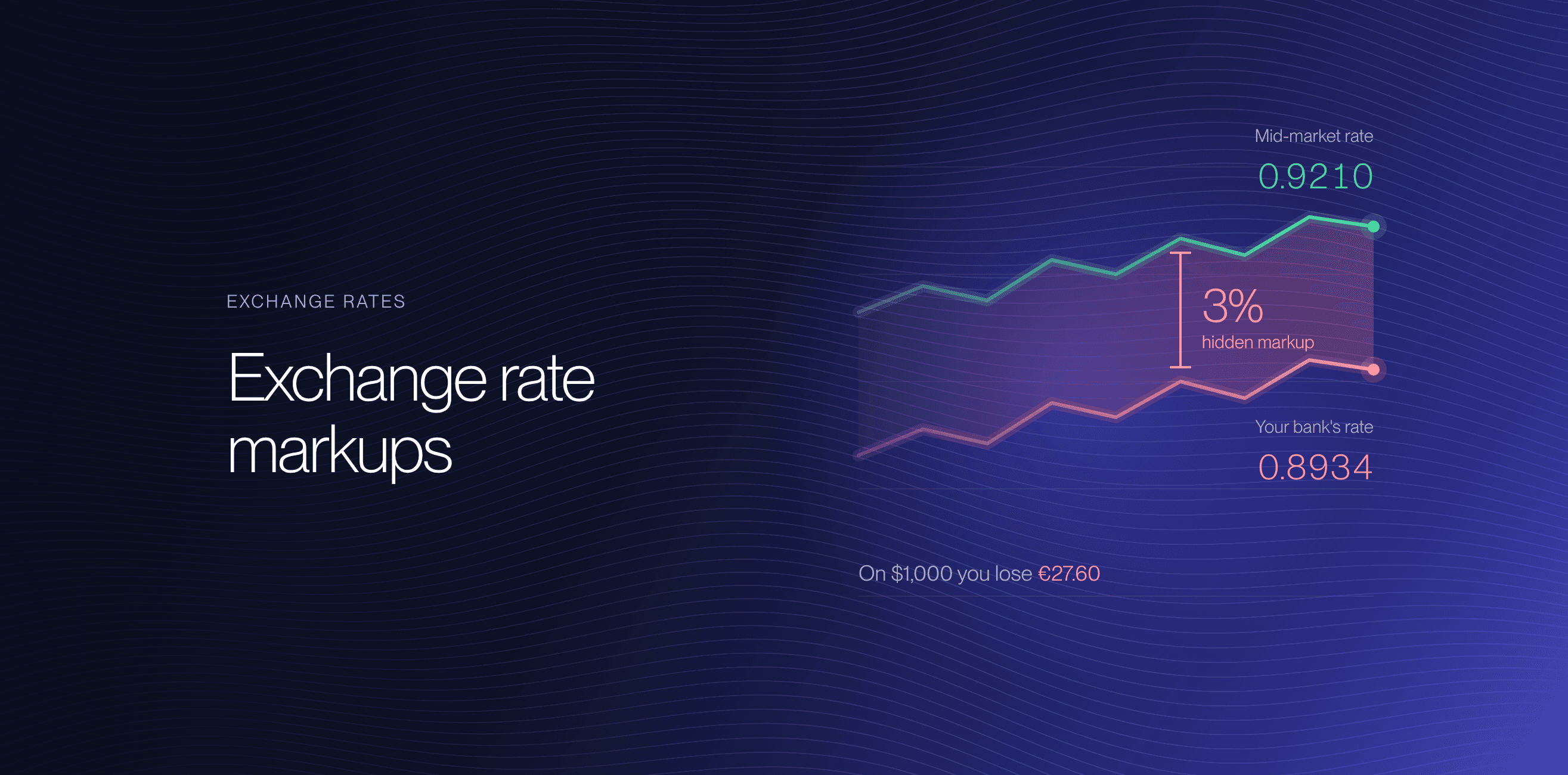
An exchange rate markup is the gap between the rate your bank gives you and the real mid-market rate. It is how most banks charge for changing currency without printing a fee, and it usually costs more than any fee on the receipt.
On £1,000 sent to euros, the published markups of the big UK banks cost £22 to £35.50. A US bank wire in a foreign currency carries roughly 3 percent, about $30 on $1,000, and a card adds its own foreign transaction fee on top of the network rate.
This guide shows how the exchange rate margin is built into the rate, how to calculate it from any quote in pounds or dollars, what named banks charge, and how card fees, dynamic currency conversion and PayPal add to it.
It also covers the rules that force banks to disclose these hidden currency fees, and the simplest ways to stop paying them. Bank and provider prices were checked on 5 November 2026.
Compare What a Transfer Really Costs Before You Send
A quote that hides its markup can only be judged against one that does not. The comparison below shows what specialist services deliver for the same amount, with the fee and the exchange rate included, so you can set it against the rate your own bank offers.
Then use the method in this guide to work out the markup on your bank's quote.
What Is an Exchange Rate Markup?
An exchange rate markup is the difference between the mid-market exchange rate and the rate a bank or provider actually gives you, expressed as a percentage. It is a currency conversion fee built into the rate rather than shown as a charge. A 3 percent markup on $1,000 costs $30, whatever the receipt says.
The Mid-Market Rate Is the Benchmark
The mid-market rate is the midpoint between the prices at which banks buy and sell a currency on the wholesale market, the rate shown on Google, Reuters or a currency converter. It is the fairest benchmark because no markup is built into it. Our guide to the mid-market exchange rate explains where to find it, and our guide on how exchange rates are set covers why it moves.
In Europe the legal benchmark is slightly different: the euro reference rates the European Central Bank publishes at around 16:00 CET every working day. They are a once-a-day snapshot rather than a live rate, and the ECB says they are for information only, but banks in the EU and UK must measure their card conversion markup against them.
Markup, Margin and Spread: One Cost, Several Names
Banks rarely call it a markup. Price lists use exchange rate margin, conversion charge, currency conversion mark-up, spread, commission or foreign exchange rate adjustment, and some simply say they make money on the conversion. A foreign exchange markup of 3 percent costs the same whatever it is called.
An exchange rate spread has a second meaning at a bureau de change: the gap between the price at which it sells a currency and the price at which it buys it back. Buy euros for a trip and sell the leftover notes back, and you pay a markup on each leg. Either way the result is the same: fewer euros or dollars than the mid-market rate would give you.
Why Banks Prefer Hidden Currency Fees
A fee shows up as a line on a statement. A markup does not, which is why it suits banks. Santander UK's own worked example of £1,000 sent to Spain says its 3 percent mark-up won't show separately on your statement. The recipient simply gets fewer euros.

Banks are also the dearest way to send money abroad once the markup is counted. In the World Bank's price survey for the third quarter of 2024, which counts the fee and the exchange rate margin together, banks averaged 13.64 percent on a $200 transfer against 5.40 percent for money transfer operators. Our guide to hidden fees in money transfers covers the other charges that never appear on a receipt, such as correspondent and receiving bank deductions.
How to Calculate an Exchange Rate Markup From Any Quote
To calculate the exchange rate markup, take the mid-market rate, subtract the rate you were offered, and divide the result by the mid-market rate. Multiply by 100 for a percentage, then apply that percentage to your amount to see the cost in money. It takes a minute on a phone calculator.
Calculate the Exchange Rate Markup in Four Steps
You need two numbers taken at the same moment: the rate on the confirmation screen and the mid-market rate. Write both the same way round, as units of the currency you receive for one unit of the currency you pay, then work through four steps.
- Note the offered rate on the last screen before you confirm, or divide the amount the recipient gets by the amount converted.
- Look up the mid-market rate at the same moment on Google, Reuters or a currency converter.
- Subtract and divide: the mid-market rate minus the offered rate, divided by the mid-market rate, is the markup.
- Turn it into money: multiply the markup by the amount you send to get the cost in pounds or dollars.
Add any visible fee to that figure and you have the full cost of the transfer, which is the only number worth comparing between providers.
Worked Example in Pounds: £1,000 to Euros
On 5 November 2026 the mid-market rate was 1.1983 euros per pound. Lloyds publishes an exchange rate margin of 3.55 percent on payments up to £10,000, so its rate on £1,000 works out at about 1.1558. The gap is 0.0425, and 0.0425 divided by 1.1983 is 0.0355, or 3.55 percent.
Step | Figure |
|---|---|
Mid-market rate | 1.1983 euros per pound |
Lloyds rate with its 3.55% margin | About 1.1558 |
Gap between the two rates | 0.0425 |
Markup: 0.0425 divided by 1.1983 | 3.55% |
Euros received on £1,000 | €1,155.78 instead of €1,198.32 |
Cost of the markup | £35.50 |
Lloyds fee on a euro payment | £0 |
Mid-market rate and Lloyds' published margin for payments up to £10,000, checked 5 November 2026. Lloyds charges no fee on euro payments.
So a payment with no fee at all costs £35.50, the price of the markup alone. Send dollars instead and Lloyds adds a £9.50 fee on top of the same margin.
Worked Example in Dollars: $1,000 to Euros
US banks publish no margin, so the only way to find a bank exchange rate markup in the US is a live quote. On a Chase international wire quote from the price comparison Wise publishes, measured on 5 November 2026, the mid-market rate was 0.8883 euros per dollar and Chase's rate 0.8627. The gap of 0.0256 divided by 0.8883 is 2.9 percent, about $29 on $1,000.
Chase also charges $5 for a foreign currency wire under $5,000, so the total came to about $34, of which the fee was barely a seventh. Its markup was much the same on pounds, pesos and rupees, and it fell on larger amounts, as the bank table below shows.
When the Quote Shows Only the Amount That Arrives
Many apps and banks show the amount the recipient gets rather than a rate. Divide that amount by the full sum you pay, fee included, and you get an effective rate. Compare it with the mid-market rate in the same way and the result is the all-in cost, fee and markup together, in one percentage.
Take Wise on £1,000 to euros on the same day: a £3.81 fee, then conversion at the mid-market rate, so €1,193.75 arrived. Divided by £1,000 that is 1.1938, about 0.4 percent below mid-market, and all of it is the visible fee. Run the same sum on a bank quote and the markup shows up, however the bank labels it.
Three Mistakes That Hide the Markup
The first is comparing against a stale rate. Rates move all day, so a mid-market figure from the morning can make an afternoon quote look better or worse than it is. Take both numbers within a minute of each other.
The second is reading the rate the wrong way round. When you pay dollars for euros, a rate quoted as dollars per euro rises as the deal gets worse, while one quoted as euros per dollar falls. If a screen shows 1.1592 dollars per euro, divide 1 by it to get 0.8627 euros per dollar before you compare. The third is judging by the fee alone, which is exactly what the markup relies on.
Which Banks Publish Their Exchange Rate Margin, and Which Do Not
The big UK banks publish an exchange rate margin for international payments, from 2.2 to 3.55 percent on ordinary amounts. The big US banks say their rates include a markup or spread but never say how much. Quotes we could measure put them at about 3 percent on $1,000.
Bank | Published margin | Cost on 1,000 | On larger amounts |
|---|---|---|---|
2.2% up to £50,000 | £22 | Falls in steps to 0.4% near £1 million | |
Up to 2.75% (personal and Premier) | Up to £27.50 | Cap of 2% for business customers | |
Santander UK | 3% up to £10,000 | £30 | 2% to £50,000, 1% above |
Up to 3.25% | Up to £32.50 | Varies with the amount | |
Lloyds | 3.55% up to £10,000 | £35.50 | Falls to 1.5% from £250,000 |
Chase | Not published; 2.9% to 3.2% measured | $29 to $32 | 2.4% to 2.7% on $10,000, 1.2% to 1.5% on $50,000 |
Not published; about 3% measured | About $30 | Not measured | |
Not published | Not measured | Not measured |
UK margins from each bank's international payments page, checked 5 November 2026. US figures from quotes for euros and other major currencies recorded on 3 November 2026 in the price comparison Wise publishes, measured against the mid-market rate on 5 November. We had no live Bank of America quote.
UK Banks That Publish a Percentage
HSBC UK has the lowest standard margin of the big five, 2.2 percent up to £50,000, falling to between 0.7 and 0.4 percent on payments from £500,001 to £1 million. Barclays caps its conversion charge at 2.75 percent for personal and Premier customers and 2 percent for business customers, and shows the charge before you confirm.
NatWest says its margin changes with the amount but will not be more than 3.25 percent, and its own example puts the cost at about £32.50 on £1,000 sent to Spain. Santander UK charges 3 percent up to £10,000, and Lloyds 3.55 percent, the highest standard margin of the five.
US Banks: A Foreign Exchange Markup With No Number
Wells Fargo's fee schedule says its rate includes a markup designed to cover its costs, its market risks and what it calls its desired return. Bank of America charges no wire fee to send foreign currency and its schedule adds that exchange rate markups apply. Chase says its rate includes a spread and will be less favorable than rates quoted online or in publications.

None of them gives a number. The quotes we could measure put Chase at 2.9 to 3.2 percent on $1,000 and Wells Fargo at about 3 percent on $1,000 to euros. Without a published foreign exchange markup, the amount the recipient gets is the only fair comparison. Our roundup of international wire transfer fees sets the flat wire fees of seven US banks beside these markups.
How a Bank Exchange Rate Markup Falls as the Amount Rises
Most bank margins shrink in steps as the payment grows. Lloyds charges 3.55 percent up to £10,000, then between 3.55 and 2.40 percent up to £50,000, and 1.50 percent from £250,000. Santander UK drops from 3 to 2 to 1 percent, and Chase's measured markup on euros fell from 2.9 percent on $1,000 to 2.4 percent on $10,000 and 1.2 percent on $50,000.
A smaller percentage on a bigger amount is still a bigger bill. A bank exchange rate markup of 2.4 percent on $10,000 is $240, and 1.2 percent on $50,000 is $600. That is why the markup matters most on house deposits, tuition and savings moved home, exactly the payments people tend to leave with their bank.
Card Foreign Transaction Fees vs the Exchange Rate Markup
A foreign transaction fee is a separate percentage your card issuer adds when you pay or withdraw cash in another currency: 3 percent at Chase, Bank of America and Wells Fargo, and 2.75 percent on most HSBC UK debit cards. It sits on top of the Visa or Mastercard rate, so the all-in markup ends up a little higher.
How a Card Converts a Foreign Payment
When you pay €100 with a UK or US card, the card network converts it at its own rate, which sits close to the mid-market rate, and your bank then adds its fee. Barclays says it calculates its rate from the Visa reference rate, and Bank of America says Visa or Mastercard converts the payment before its 3 percent international transaction fee is applied.
Unlike a transfer markup, the card fee is printed in the price list, which makes it easier to compare. It still applies at home: Bank of America's schedule notes the fee is charged when an online shop in the US processes your payment in a foreign currency.
Card | Fee on a purchase in a foreign currency | Fee on cash in a foreign currency |
|---|---|---|
Chase debit card | 3% | 3% |
Bank of America debit card | 3% | 3% |
Wells Fargo debit card | 3% | $5 per withdrawal |
HSBC UK debit card | 2.75% | 2.75% plus a 2% cash fee (min £1.75, max £5) |
Barclays debit card | 2.75% or 2.99% | 2.75% or 2.99% |
Wise card | About 0.3% to convert major currencies | Free up to £250 or $250 a month |
From each bank's fee schedule or card page and Wise's card pricing, checked 5 November 2026. Barclays lists two rates for its debit cards. Bank fees are added to the Visa or Mastercard rate, and ATM owners may add their own charge.
What the All-In Card Markup Looks Like
Thanks to the disclosure rules covered below, HSBC UK publishes its full markup over the ECB reference rate for each card and EEA currency. On 5 November 2026 a euro purchase on its standard Visa debit card carried 3.02 percent, against a 2.75 percent fee, because the Visa rate itself differs slightly from the ECB rate. Cash costs far more.
In euros | Visa debit, Premier or Advance | Visa debit, standard Bank Account | Visa credit card |
|---|---|---|---|
Purchase in a shop or restaurant | 3.02% | 3.02% | 3.26% |
Cash withdrawal | 3.02% | 5.03% | 6.26% |
HSBC UK's indicative markups over the latest ECB euro reference rate for personal cards, last updated 5 November 2026.
On €200 of cash, worth about £166.79 at the ECB rate, 5.03 percent is about £8.39 in one withdrawal. A €100 dinner on the same debit card costs about £2.52 in markup.
Cards That Cut the Markup
A debit card that converts at the mid-market rate with a small visible fee removes most of the markup. The Wise card has no foreign transaction fee, converts major currencies from about 0.3 percent, and spends currencies you already hold for free. Our Wise card review runs real trips through it against high street debit cards.

Some credit cards also charge no foreign transaction fee, which leaves only the network rate. Their cost is elsewhere: interest if you do not clear the balance, and cash advance fees on withdrawals, so they suit purchases better than cash.
Dynamic Currency Conversion: The Markup You Accept at the Till
Dynamic currency conversion is when a card machine, ATM or website abroad offers to charge you in your home currency at a rate it sets itself. You skip your bank's conversion but take the operator's markup, which is usually larger. Choosing the local currency is almost always the cheaper answer.
How Dynamic Currency Conversion Works
The terminal shows the bill in the local currency and in pounds or dollars, often with the home currency highlighted. Choose pounds or dollars and the operator converts the payment at its own rate before it reaches your bank. Choose the local currency and your card converts it later at the network rate plus your bank's fee.
Hotels, car hire desks and online checkouts ask the same question at payment, and ATMs ask it before they dispense cash. The screen may present the home currency option as the safe or familiar choice. It is the one that carries the operator's markup.
What Dynamic Currency Conversion Costs
Since 19 April 2020, an operator in the EU or UK offering conversion must show its markup over the ECB reference rate, both amounts and the option to pay in the local currency before you choose. That lets you compare it with your own card: 3.02 percent on an HSBC UK debit card purchase in euros, or about 0.3 percent on a Wise card.
The evidence is that conversion at the till rarely wins. A Norwegian savings bank checked 1,500 ATM withdrawals made abroad in 2016 and found customers lost out in 99.7 percent of cases, with the worst margin 12.4 percent above Visa's rate. The Norwegian Consumer Council passed the study to the European Commission when the current rules were drafted.
How to Say No
Choose the local currency on every card machine and ATM, even when the screen or the staff recommend the other option. If a terminal has already converted, ask for the payment to be cancelled and run again in the local currency before you sign.
Online, pay in the seller's currency when a foreign website offers to bill you in pounds or dollars. At a hotel, ask for the bill in the local currency before you hand over the card, because nobody can undo a conversion the hotel has already made.
Bureaux de Change and PayPal: Markups Outside the Bank
Bureaux de change, airport desks and PayPal all earn their money in the rate. Travelex's best online rate for euros sat about 2.5 percent below mid-market on 5 November 2026, and its rates in store differ. PayPal's US fee page sets a spread of 3 to 4 percent whenever it converts currency.
Airport Bureaux and the Exchange Rate Spread
A bureau de change quotes two prices for each currency, the rate at which it sells and the rate at which it buys back, and the gap between them is its exchange rate spread. On 5 November 2026, Travelex's UK website offered 1.1691 euros per pound for cash ordered online, against a mid-market rate of 1.1989 at the same moment, a markup of about 2.5 percent.
Its dollar rate of 1.3144 sat about 2.3 percent below mid-market. Travelex says online orders get its best rates and that rates in store vary, so a walk-up rate at an airport desk is no better. On £500 of euros, 2.5 percent is about £12.40, and selling leftover notes back costs a second spread.
PayPal's Currency Conversion Fee
.png) PayPal6.0
PayPal's US fee schedule sets a currency conversion spread of 4.00 percent when you pay for something priced in another currency or send money to someone who receives a different currency, and 3.00 percent on other conversions. PayPal charges around 3 to 4 percent above the mid-market rate. Wise charges a small fixed fee with no markup.
In practice the spread ran a little wider: on every route we priced on 5 November 2026, PayPal's rate sat about 4 to 4.7 percent below mid-market, and $1,000 to a euro account cost about $46 against $5.47 with Wise. Our guide to PayPal international transfer fees explains who pays the spread and when.
Money Transfer Services Price the Rate Too
Specialists are not all markup-free. Xe says the rate it applies when you send money differs from the mid-market rate on its converter and includes a margin, which forms part of its return. Remitly also takes part of its price through the rate on many routes.
Their markups are usually far smaller than a bank's, but they vary by currency and amount, so a fee of zero tells you as little at a specialist as it does at a bank. The next section prices them in the same units as the banks.
The Rules That Force Banks to Disclose the Markup
In the EU and UK, card issuers and currency conversion operators must state their conversion charge as a percentage markup over the ECB reference rate before you pay, and banks must show estimated conversion charges before an online transfer. In the US, Regulation E requires the exchange rate and the amount received, not the markup.
EU: A Percentage Over the ECB Rate
The rules began with Regulation (EU) 2019/518 and now sit in Regulation (EU) 2021/1230 on cross-border payments. Article 4 makes card issuers, and anyone offering conversion at an ATM or point of sale, express the total currency conversion charges as a percentage markup over the latest ECB euro reference rates, disclose it before the payment and publish it online.
Card issuers must also send an electronic message with that markup when you pay or withdraw in another EU currency, then once a month for that currency, and you can opt out. Article 5 covers transfers made in a bank's website or app: before you confirm, it must show the estimated conversion charges, the total in your currency and the amount the recipient gets. The card rules applied from April 2020 and the messages from 19 April 2021.
UK: The Same Rules, Plus the Consumer Duty
The UK kept these disclosure rules after Brexit in its own version of the Cross-Border Payments Regulation, still measured against the ECB reference rate but without the monthly electronic message. That is why HSBC UK publishes its card markups over the ECB rate for every EEA currency.
The FCA has also turned to transfers under its Consumer Duty. Its May 2025 review of international payment pricing criticised firms that did not make clear their rate contained a markup, and firms that advertised a zero cost transaction while charging one. Good practice, it said, is to present the markup as a cost, with wording such as: our exchange rate includes a 3% markup charge.
US: Regulation E Shows the Rate, Not the Markup
In the US, the remittance rule in Regulation E requires a provider to show, before you pay for an international transfer, the transfer amount, its fees and taxes, the total, the exchange rate it will use, any covered third-party fees and the amount the recipient will get. The rate must be rounded consistently to between two and four decimal places.
Nothing requires the markup itself. You get the rate and the amount received, which is enough to calculate the exchange rate markup with the formula above, but you have to look up the mid-market rate yourself, at the same moment, to see what the conversion really costs.
What the Markup Costs, and How to Avoid Paying It
On £1,000 to euros, the big UK banks' published margins cost £22 to £35.50 and PayPal about £45, against £3.81 with Wise at the mid-market rate. On $1,000, a US bank wire loses about $30 to the markup. The fix is a provider that converts at or near mid-market, judged by the amount received.
Provider | Fee | Markup | Total cost |
|---|---|---|---|
Lloyds | £0 | 3.55% | £35.50 |
NatWest | £0 | Up to 3.25% | Up to £32.50 |
Santander UK | £0 | 3% | £30.00 |
Barclays | £0 | Up to 2.75% | Up to £27.50 |
HSBC UK | £0 | 2.2% | £22.00 |
PayPal | £2.99 | About 4.2% | £45.20 |
Remitly | £1.99 | About 0.9% | £10.51 |
Xe, standard rate | £0 | About 0.8% | £8.34 |
Wise | £3.81 | None | £3.81 |
Total cost of £1,000 to a euro account, fee plus markup against the mid-market rate, 5 November 2026. Bank rows use each bank's published or maximum margin on a SEPA payment; PayPal and Remitly from the price comparison Wise publishes; Xe from its own calculator at its standard rate; Wise from its own price for a UK bank transfer.
Wise
 Wise9.5
Wise converts every transfer at the mid-market rate and charges one fee, shown before you pay, so the fee is the entire cost. On 5 November 2026 that was £3.81 on £1,000 to euros by bank transfer, $5.47 on $1,000 to euros paid by ACH bank debit and $46.68 on $10,000. Wise says 78 percent of transfers arrived instantly, in under 20 seconds, in the quarter to 30 September 2026.
Paying by card costs more, about 1.6 percent from a US account, so fund transfers from your bank. Wise is authorised by the FCA in the UK and is a licensed money transmitter in the US. Our Wise review covers its limits, card and safety record.
Remitly
.jpeg) Remitly8.5
Remitly is built for money sent home to family, paying out to bank accounts, mobile wallets and cash pickup points. Its price combines a fee and a margin that varies by route: on £1,000 to euros it charged £1.99 with a rate about 0.9 percent below mid-market, £10.51 in all, while $1,000 to British pounds cost under $2 in total.
Remitly refunds its fees if a transfer arrives later than promised. Compare its standard rate rather than the first-transfer offer, because that is the price you pay from the second transfer onward.
Xe
.webp)
Xe charges no transfer fee on many transfers and earns its return in the rate. Its standard rate on $1,000 to euros sat about 1.9 percent below mid-market on 5 November 2026, narrowing to about 1.4 percent on $10,000, and on £1,000 to euros about 0.8 percent. New customers are offered a better welcome rate when they start.
That makes Xe worth a quote on larger transfers, where its margin narrows and the rate is fixed when you confirm. It sends to more than 170 countries in more than 100 currencies.
Check Today's Price for Your Transfer
Markups move with the market and with the amount. Enter yours below to see what the specialists deliver today, then hold it against your bank's quote using the formula above.
Whichever you pick, compare the amount the recipient gets rather than the fee.
Habits That Keep the Markup Small
Pay in the local currency on cards and at ATMs, use a card without a foreign transaction fee, buy travel money online rather than at the airport, and send large sums in one transfer rather than many small ones, since most bank margins fall with size. If you earn in one currency and spend in another, holding both lets you convert only when you choose.

Over a year the habits add up. Send $1,000 a month to euros at a 3 percent markup and the rate takes about $360, against about $66 in Wise fees for the same twelve transfers. From the UK, £500 a month through Lloyds to a dollar account costs £9.50 plus £17.75 each time, about £327 a year.
Bottom Line
An exchange rate markup is a fee that does not look like one. UK banks publish theirs at 2.2 to 3.55 percent, US banks keep theirs private at around 3 percent on ordinary amounts, cards add 2.75 to 3 percent, and dynamic currency conversion and PayPal usually cost more.
You can measure any of them in a minute: compare the rate you are offered with the mid-market rate at the same moment, or divide the amount that arrives by what you paid. Then use the provider that delivers the most, which on major currencies usually means one that converts at or near the mid-market rate.
Frequently Asked Questions
What is an exchange rate markup?
An exchange rate markup is the gap between the mid-market rate and the rate a bank or provider gives you, as a percentage. It is a currency conversion fee built into the rate, so it rarely appears as a separate charge. Big UK banks publish margins of 2.2 to 3.55 percent on ordinary payments, while live quotes put Chase at about 3 percent on $1,000. On £1,000, a 3 percent markup means £30 less for the recipient.
How do you calculate the exchange rate markup on a transfer?
Subtract the rate you are offered from the mid-market rate at the same moment, then divide by the mid-market rate. If the mid-market rate is 1.1983 euros per pound and your bank offers 1.1558, the gap is 0.0425, which divided by 1.1983 is 3.55 percent. Multiply that by your amount to get the cost in money, £35.50 on £1,000. If a quote shows only the amount received, divide it by what you pay to get the effective rate first.
What is a normal exchange rate margin for a bank?
For ordinary amounts, 2 to 3.5 percent is typical. HSBC UK publishes 2.2 percent up to £50,000, Barclays up to 2.75 percent, Santander UK 3 percent, NatWest up to 3.25 percent and Lloyds 3.55 percent. US banks do not publish theirs, but live quotes put Chase at 2.9 to 3.2 percent on $1,000 and Wells Fargo at about 3 percent. Margins usually fall on larger payments, to 1.5 percent or less on large sums.
Is a foreign transaction fee the same as an exchange rate markup?
Not quite. A foreign transaction fee is a separate percentage your card issuer adds to a payment in another currency, such as 3 percent at Chase, Bank of America and Wells Fargo or 2.75 percent on HSBC UK debit cards. It is charged on top of the Visa or Mastercard rate, which itself sits slightly away from the benchmark. HSBC UK's published all-in figure for a euro purchase on its standard debit card was 3.02 percent over the ECB rate. Both are a foreign exchange markup in practice.
Should I pay in local currency or my home currency abroad?
Pay in the local currency. Choosing your home currency triggers dynamic currency conversion, where the terminal's operator converts at its own rate and markup. A Norwegian study of 1,500 ATM withdrawals found customers lost out in 99.7 percent of cases, with margins up to 12.4 percent above Visa's rate. Paying in local currency leaves the conversion to your card, which costs about 3 percent on a typical bank card and about 0.3 percent on a Wise card.
Do banks have to disclose their exchange rate markup?
In the EU and UK, yes for cards and dynamic currency conversion: the charge must be shown as a percentage markup over the ECB reference rate before you pay, and banks must show estimated conversion charges before an online transfer. The FCA also expects UK firms to present any markup as a cost. In the US, Regulation E requires the exchange rate and the amount received on an international transfer, but not the markup itself, so you have to calculate it.
Why does a no-fee international transfer still cost money?
Because the cost sits in the exchange rate. Most UK banks send euros to the EEA with no fee, and Bank of America and Wells Fargo charge nothing for an online wire in a foreign currency. Each still converts at a rate with a markup, 2.2 to 3.55 percent at the big UK banks and about 3 percent on the US wires we measured. Santander UK even notes that its mark-up won't show separately on your statement. Compare the amount the recipient gets, not the fee.
Which UK bank has the lowest exchange rate margin?
Among the big five, HSBC UK publishes the lowest standard margin at 2.2 percent on payments up to £50,000, falling to 0.4 percent near £1 million. Barclays caps its conversion charge at 2.75 percent for personal customers, Santander UK charges 3 percent up to £10,000, NatWest up to 3.25 percent and Lloyds 3.55 percent. Even at 2.2 percent, £1,000 to euros costs £22, against £3.81 with Wise at the mid-market rate.
Does PayPal charge a currency conversion fee?
Yes. PayPal's US schedule sets a currency conversion spread of 4 percent when you pay in another currency or the recipient gets a different currency, and 3 percent on other conversions. It is built into PayPal's exchange rate rather than shown as a line, and on the routes we priced on 5 November 2026 its rate sat about 4 to 4.7 percent below mid-market. On $1,000 to euros that cost about $46 including the fee.
How can I avoid hidden currency fees when sending money abroad?
Use a provider that converts at or near the mid-market rate and shows the amount received before you pay, such as Wise, and compare it with your bank's quote using the markup formula. Pay in the local currency on cards and at ATMs, use a card without a foreign transaction fee, and buy travel money online rather than at the airport. For large sums, get several quotes, because even a 1 percent margin is $500 on $50,000.
Sources
- Lloyds Bank: Send an international payment, fees and exchange rate margin
- Barclays: International payments and conversion charge
- HSBC UK: International payments, fees and exchange rates
- NatWest: Send money abroad
- Santander UK: Making international payments
- Chase: Additional Banking Services and Fees for Personal Accounts
- Bank of America: Personal Schedule of Fees
- Wells Fargo: Consumer Account Fee and Information Schedule
- HSBC UK: Cross-Border Payments Regulation, card markups over the ECB rate
- HSBC UK: Using your card abroad, fees and charges
- Barclays: Using your debit card abroad
- Capital One: Quicksilver card, no foreign transaction fees
- European Central Bank: Euro foreign exchange reference rates
- EUR-Lex: Regulation (EU) 2021/1230 on cross-border payments in the Union
- Central Bank of Malta: Cross-Border Payments Regulation and currency conversion charges
- Banco de España: Foreign exchange, how to compare the options
- legislation.gov.uk: UK Cross-Border Payments Regulation, Article 3a
- legislation.gov.uk: UK Cross-Border Payments Regulation, Article 3b
- FCA: Consumer Duty, international payment pricing transparency
- Consumer Financial Protection Bureau: Regulation E, 1005.31 remittance transfer disclosures
- Norwegian Consumer Council: Input to the European Commission on dynamic currency conversion
- World Bank: Remittance Prices Worldwide
- World Bank: Remittance Prices Worldwide report, costs by provider type
- Travelex UK: Travel money and online exchange rates
- PayPal: US consumer fees
- Wise: Pricing for sending money from the UK
- Wise: Pricing for sending money from the US
- Wise: Card fees for UK residents
- Wise: Card fees for US residents
- Wise: Price comparison of banks and providers
- Wise: How Wise is regulated in each country
- Wise Group plc: Q2 FY27 results, quarter to 30 September 2026
- Wise: Mission update on speed, instant means under 20 seconds
- Xe Help Centre: What rate will I get when sending money?
- Xe: Send money online
- Xe: Transfer fees and currency conversion fees explained
- Remitly: Sending limits and on-time delivery promise
- Remitly: Send money online from the US
Mo is the founder of MoneyTransferStore. As an expat who has experienced the challenges of sending money across borders himself, he set out to help others like him avoid hidden fees and unfair exchange rates on international transfers. With a background spanning fintech, payments, and Web3, Mo brings years of practical experience to building a platform focused on transparency and trust.