 Compare money transfers from the UAE
 INR




 GBR










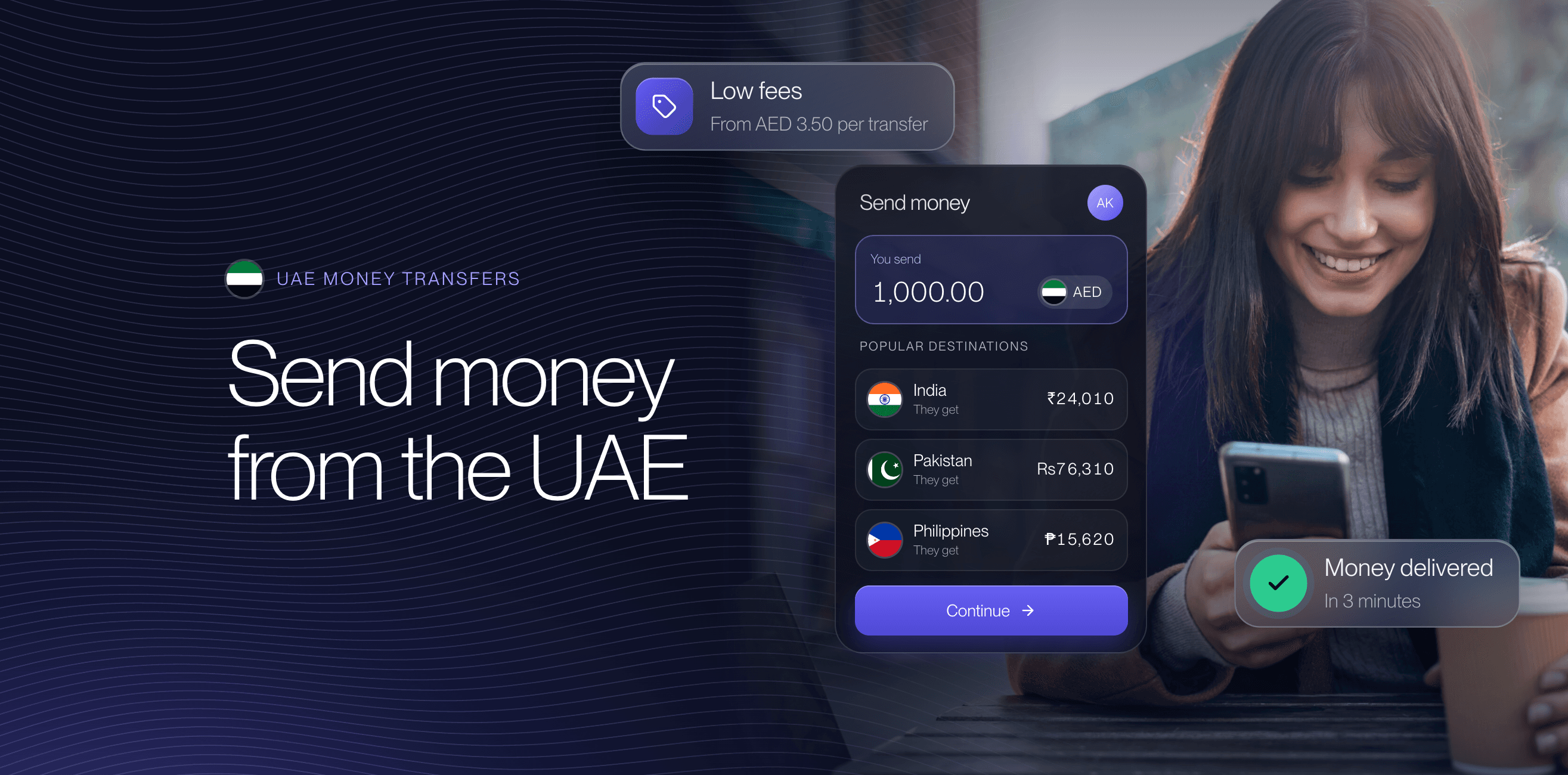
How to Send Money From the UAE

Sending money from the UAE is cheap by global standards and still easy to overpay. The country has one of the most competitive remittance markets in the world, yet the same transfer can cost a few dirhams through one channel and well over AED 50 through another, depending on how you send it.
Most of that gap comes from two things people rarely compare: the flat fee on a SWIFT transfer from a bank account, and the exchange rate margin hidden inside the rate. Exchange houses, bank remittance products and online apps all price those two parts differently.
This guide covers every common way to make an international money transfer from the UAE: what banks and exchange houses charge in AED, which online services work for residents, how long each option takes, and the rules on limits, tax and ID.
Who Sends Money From the UAE
The UAE is one of the largest sources of remittances in the world. People living there sent US$62.1 billion abroad as personal remittances in 2025, according to World Bank data, and exchange houses alone handled AED 188.8 billion of outward transfers that year. Most of it is wages sent home by the country's large expatriate workforce.
The Central Bank of the UAE breaks the exchange house figure down further: AED 115.7 billion of the 2025 total were personal remittances, with the rest tied to trade and investment. The flow grows every year as the population grows, and it moves on a monthly rhythm that follows payday. That rhythm shapes what most senders care about, which is a low fee on a modest amount, a decent rate and money that arrives within the day.
Workers sending wages home
The largest group by far is workers in construction, retail, hospitality, transport and domestic work who send part of every salary to family. Their transfers are regular and usually range from a few hundred to a few thousand dirhams. Many recipients collect cash or use a mobile wallet rather than a bank account, which is why cash pickup and wallet payouts still matter so much from the UAE.
For this group, a flat fee of AED 25 on a transfer of AED 1,000 is a cost of 2.5 percent before the rate is counted. Over a year of monthly transfers that adds up quickly, so the fee structure matters more than any other feature. Our explainer on what a remittance is and how it works covers the basics of how these transfers are priced.
Professionals and families with commitments abroad
Salaried professionals send money for different reasons: a mortgage or rent at home, school fees for children studying elsewhere, savings moved to an account in their home currency, or support for parents. Their transfers are often larger and less frequent, which shifts the cost from the fee to the exchange rate margin.
This group is also more likely to send in a major currency such as pounds, euros or US dollars, where UAE banks charge their highest SWIFT fees. A single transfer of AED 20,000 at a margin of 2 percent costs AED 400, far more than any fee on the receipt.
Property buyers, investors and business owners
The third group moves large one-off sums: the proceeds of a property sale, a deposit on a home abroad, an investment, or a payment to a supplier. For these transfers, the margin on the rate decides almost the entire cost, and the provider's limits and verification steps matter as much as the price.
Large transfers also draw more questions about where the money came from, so having a salary certificate, a sale agreement or bank statements ready saves days. Our guide to transferring large sums internationally explains how to handle five and six figure amounts without losing money on the rate.
What UAE Banks Charge to Send Money Abroad
UAE banks charge between nothing and about AED 50 to send money abroad from a mobile app, and up to AED 105 at a branch. The fee depends on the destination currency and the channel: instant remittance products are free or cheap to a handful of countries, while a SWIFT transfer in euros, pounds or dollars costs the most.
Exchange houses sit alongside the banks and handle most of the country's remittances. Their published fees to the main routes home are capped at around AED 25 before VAT, but they rise sharply for major currencies sent by SWIFT. The table shows what the main banks and two of the largest exchange houses publish for personal customers.
Provider | How you send | Fee to send abroad | Watch out for |
|---|---|---|---|
Emirates NBD | DirectRemit and other online transfers | Free to India, Pakistan, Egypt, Sri Lanka, the Philippines and the UK; up to AED 26.25 elsewhere | Branch transfers in foreign currency cost far more |
First Abu Dhabi Bank (FAB) | Online SWIFT transfer | AED 25 to AED 50 by currency | AED 100 extra to pay all charges in full (OUR) |
ADCB | Online SWIFT transfer | AED 21 online, AED 78.75 at a branch | AED 105 extra for OUR; intermediary deductions estimated at US$0 to US$50 |
Mashreq | NEO international wire, or Quick Remit | AED 26.25 per wire; Quick Remit charges a per-transaction fee | Zero-fee Quick Remit to some countries is a limited offer |
Abu Dhabi Islamic Bank (ADIB) | App or online banking | AED 25 per international transfer | Intermediary and beneficiary bank charges may apply |
Al Ansari Exchange | Branch, app or kiosk | AED 0 to AED 25.24 plus VAT to South Asia; AED 57.50 to AED 100 to the US and UK | Back-end charges on some routes, such as PHP 100 to PHP 225 to the Philippines |
Al Fardan Exchange | Branch or app | AED 0 to AED 25.24 plus VAT to South and Southeast Asia; AED 57.62 to AED 120 for major currencies | Fees exclude 5 percent VAT |
Fees from each provider's published schedule of charges or key facts statement, checked 4 November 2026. Bank fees include VAT where the bank says so; exchange house fees are quoted before VAT.
Emirates NBD
Emirates NBD, one of the country's largest banks, sends most of its international transfers through DirectRemit, an instant service that now reaches more than 40 countries. Since September 2025 it charges up to AED 26.25 per online international transfer, including DirectRemit, but transfers to six countries stay free: India, Pakistan, Egypt, Sri Lanka, the Philippines and the UK. Priority and Private Banking customers keep free transfers everywhere.
The bank also stopped passing correspondent bank charges to customers at the same time, which removes one of the most annoying surprises of a SWIFT transfer. DirectRemit has caps per currency, such as INR 1,000,000, PHP 50,000 and EUR 15,000, so larger amounts go through a standard transfer.
First Abu Dhabi Bank (FAB)
FAB prices its online SWIFT transfers by currency. Transfers in Indian rupees, Pakistani rupees and Philippine pesos cost AED 25, pounds AED 30, and euros, US dollars and Egyptian pounds AED 45, with Australian and Singapore dollars at AED 50. Asking FAB to pay every charge along the way, the OUR option, adds AED 100 on top.
FAB also publishes its foreign exchange rates online, which few UAE banks do. On the day we checked, its selling rates for the main remittance currencies sat roughly 2 to 4 percent below the mid-market rate. That margin, not the fee, is usually the larger part of what a bank transfer costs.
ADCB
ADCB charges AED 21 for a SWIFT transfer made through its app or internet banking, and AED 78.75 at a branch on standard accounts. Premium segments get several free transfers a month. The OUR charge option costs another AED 105.
ADCB is also unusually open about the deductions that follow a SWIFT payment. Its fee schedule estimates intermediary and beneficiary bank charges at US$0 to US$50 per transfer, deducted from the amount on the way unless you pay for OUR. On a small transfer home, that range can cost more than the fee itself.
Mashreq
Mashreq's digital NEO account charges AED 26.25 for an international wire. Its Quick Remit service covers about 40 destinations with instant or same-day credit and a single per-transaction fee. Zero-fee transfers on some of the busiest routes are offered as a limited-period promotion rather than a standing price.
As with every bank on this list, the fee you see is only part of the cost. Mashreq does not publish the margin in its transfer rate, so compare the amount the recipient gets rather than the fee line.
Exchange houses: Al Ansari, LuLu and Al Fardan
Exchange houses handle most remittances from the UAE, and their pricing is built for the routes home. Al Ansari and Al Fardan both publish fees of zero to AED 25.24 before VAT for bank transfers to India, Pakistan, Bangladesh, Sri Lanka and Nepal, and Al Ansari states that it adds no back-end charges on those routes. Its cash payouts start at AED 15 before VAT.
The picture changes for major currencies. Al Ansari charges AED 57.50 to AED 100 to send US dollars or pounds, and AED 69 to AED 100 plus VAT for euros, with delivery taking three to seven working days. LuLu Exchange, the third large network, runs a similar mix of branches and the LuLu Money app.
The exchange rate margin they do not show
No UAE bank or exchange house prints its exchange rate margin on the receipt. The margin is the gap between the rate you get and the mid-market rate, the one you see on Google or Reuters. On AED 1,000, every 1 percent of margin is AED 10 that never reaches the recipient, on top of the fee.
Published bank rates suggest how wide it can be. A margin of 2 to 4 percent on AED 5,000 is AED 100 to AED 200, against a fee of AED 25 to AED 50. When we checked, Remitly priced the main routes home within about 1 percent of mid-market, which is why a specialist's total comes out so much lower. Our guide to the mid-market exchange rate shows how to work out any provider's margin from a quote in under a minute.

The simplest check is to divide the amount the recipient gets by the amount you pay, then compare that rate with the mid-market rate at the same moment. If the difference is more than about 1 percent on a route home, there is usually a cheaper option.
The extras: OUR, SHA and receiving bank charges
A SWIFT transfer can lose money in three more places. With the SHA option, the default at most UAE banks, intermediary banks can take their fee from the amount on the way. With OUR, you pay up front, often AED 100 or AED 105, to stop that. The receiving bank may then charge its own fee to credit the money.
Two card charges catch people too. Paying for a transfer with a credit card can be treated as a cash advance by the card issuer, with a fee and interest from day one. And when an app or website offers to charge you in dirhams for a payment in another currency, the conversion it applies is usually worse than your bank's. Our guide to international wire transfer fees explains each of these charges in more detail.
The Best Ways to Send Money From the UAE
The best way to send money from the UAE is usually a specialist app such as Remitly, or a bank's own instant remittance service where the route is free. Both price the main routes home at a fraction of a SWIFT transfer. Exchange houses remain the best choice for cash payments and for people who prefer a branch.
Not every global app lets you transfer money from the UAE. We checked each provider's own site on 4 November 2026: Wise lists the dirham only as a currency you can send to, not from, and Xe only registers senders who live in Europe, the US, Canada, Australia and New Zealand. Remitly does send from the UAE, through a Dubai International Financial Centre company.
Remitly
Remitly is the online specialist that works best for UAE residents. You send from the app or website, pay with a UAE-issued debit or credit card, and choose bank deposit, cash pickup, mobile wallet or, on some routes, UPI or home delivery. Remitly says more than 90 percent of funded transfers arrive within an hour.
Its fees on the main routes are a few dirhams, and on several routes there is no fee at all. On the day we checked, its standard rates sat within about 0.2 to 1.1 percent of the mid-market rate, with the widest margins on pounds and euros. New customers usually get the first transfer fee-free with a better rate on part of the amount. Read our full Remitly review for its limits, delivery promise and customer service record.
Route | Remitly fee on AED 1,000 | Rate against mid-market |
|---|---|---|
Indian rupees | AED 5 | About 0.3% below |
Pakistani rupees | No fee | At or slightly above mid-market |
Philippine pesos | AED 5 | About 0.7% below |
Bangladeshi taka | AED 9 | About 0.2% below |
Sri Lankan rupees | AED 8 | About 0.2% below |
Egyptian pounds | AED 6 | Close to mid-market |
British pounds | AED 7 | About 1.1% below |
Euros | No fee | About 1.1% below |
US dollars | AED 15 | About 0.5% below |
Remitly standard fees and rates for a returning customer paying by debit card, checked 4 November 2026 against the mid-market rate at the same time. First-transfer offers are excluded.
Bank instant remittance services
If you already bank with Emirates NBD or Mashreq, their instant services are worth checking first for the routes they make free. DirectRemit sends to India, Pakistan, Egypt, Sri Lanka, the Philippines and the UK without a fee, with near real-time credit, and Quick Remit covers about 40 destinations at a flat per-transaction fee.
The catch is the rate. Neither bank publishes the margin in its remittance rate, and a zero fee does not mean zero cost. Check what the recipient gets against a specialist on the same day, especially on larger amounts.
Exchange house branches and apps
Exchange houses are still the default for many people in the UAE, and for cash they are hard to beat. Al Ansari, LuLu and Al Fardan run hundreds of branches, accept cash, cheques, bank transfers and WPS salary cards, and pay out through partner networks in most countries. A money transfer from Dubai, Abu Dhabi or Sharjah works the same way at any of them, with the same ID check. Their apps let you send from your phone and pay by card or bank transfer.
Their fees to South Asia are low, but they charge much more for transfers in major currencies, and some routes carry back-end charges deducted at the receiving end. Their rates move with promotions, so compare the final amount rather than assuming the branch near you is the cheapest.
Wallet apps
A newer group of licensed apps lets you send money abroad from a phone without a bank account at all. e& money, Botim and FAB's Payit all offer international transfers to the main routes home, with an Emirates ID as the minimum requirement. Limits on these apps are typically lower, often around AED 10,000 per transfer.
They suit people paid onto a salary card or who do not have a full bank account. Fees and rates vary by app and by country, and several advertise free transfers on selected routes, so compare the amount received before you commit.
Which option for which transfer
The right service depends on how the money needs to arrive and how much you are sending. This is how the options line up on the transfers people actually make from the UAE.
Transfer | Best fit | Why |
|---|---|---|
Bank deposit on a main route home | Remitly, or DirectRemit if you bank with Emirates NBD | Low or no fee and a rate close to mid-market |
Cash pickup | Remitly or an exchange house | Large agent networks in every main home country |
Mobile wallet | Remitly or a wallet app | Direct credit to wallets such as GCash, bKash and Easypaisa |
Large transfer | Compare Remitly with your bank's best rate | The margin decides the cost, so a fraction of a percent matters |
Euros, pounds or dollars | Remitly | Exchange houses and banks charge their highest fees on these currencies |
Paying in cash | Exchange house branch | The only option that takes cash over the counter |
Whatever you choose, run the same transfer through two services on the day you send. On the routes home the gap between the best and the rest changes from week to week, and checking takes a minute. Our comparison of Remitly and Wise explains how the two differ for readers who also send from countries where both work.

If you send often, keep both a bank remittance product and one specialist app set up and verified, so you can switch on the day without waiting for checks.
How Much Does It Cost to Send Money From the UAE?
On AED 1,000, sending money from the UAE through a specialist app usually costs under AED 20 all in on the main routes, and often under AED 10. A SWIFT transfer from a bank at its published rate can cost AED 45 to more than AED 90 once the margin is counted. Exchange houses fall in between on routes home.
The table shows the total cost of the same AED 1,000 sent on several routes, counting the fee plus the gap between the rate and the mid-market rate. It sets Remitly against FAB, the only large UAE bank that publishes its exchange rates online, so the bank figure uses real published numbers rather than an estimate.
Destination currency | Remitly, total cost | FAB online SWIFT, total cost |
|---|---|---|
Indian rupees | About AED 8 | About AED 55 |
Pakistani rupees | Under AED 1 | About AED 55 |
Philippine pesos | About AED 12 | About AED 48 |
Sri Lankan rupees | About AED 10 | About AED 77 |
Egyptian pounds | About AED 6 | About AED 92 |
British pounds | About AED 18 | About AED 64 |
Euros | About AED 11 | About AED 83 |
US dollars | About AED 20 | About AED 50 |
Total cost on AED 1,000, fee plus exchange rate margin against the mid-market rate, collected 4 November 2026. Remitly at its standard fee and rate; FAB at its online SWIFT fee and its published selling rate, which may differ from the rate shown in the app. Excludes the OUR option and any intermediary deductions.
A typical transfer of AED 1,000
On a typical transfer the pattern holds across every route: a specialist costs roughly 0.5 to 2 percent in total, while a bank SWIFT transfer costs roughly 5 to 9 percent. The fee drives most of the bank's cost on small amounts, because AED 25 to AED 50 is a large share of AED 1,000.
Exchange houses usually land between the two on the routes home, with fees of up to about AED 26 including VAT and margins they do not publish. World Bank data puts the average cost of sending money from the UAE at about 3 percent of the amount, one of the lowest of any major sending country, lower than Saudi Arabia, the UK or the US.

That average hides a wide spread. The cheapest options on a route can cost under 1 percent while the dearest cost several times as much, so the provider you pick matters more than the country you send from.
A large transfer of AED 10,000 or more
On large amounts the fee stops mattering and the margin takes over. At FAB's published rates, a margin of 2 to 4 percent on AED 10,000 is AED 230 to AED 380, against a fee of AED 25 to AED 50. At Remitly's standard rates, the margin on the same amount ranged from about AED 20 to just over AED 100, depending on the currency.
For sums like this, ask your bank for its rate on the day and compare the amount received, not the fee. A fraction of a percent on a property deposit or a savings transfer is worth a phone call. Our guide to the cheapest international money transfer lists the levers that cut the cost on big amounts.
What the gap adds up to over a year
Take a monthly transfer of AED 2,000 home, a common pattern for workers in the UAE. At a total cost of 3 to 5 percent, typical of a bank SWIFT transfer at a published rate, that is AED 60 to AED 100 a month, or AED 720 to AED 1,200 a year.
At under 1 percent with a specialist, the same twelve transfers cost less than AED 240 a year. On one regular remittance home, switching saves several hundred dirhams a year, and more for anyone who sends larger amounts or sends more often.
How Long Does It Take to Send Money From the UAE?
Most transfers from the UAE on the main routes home arrive within minutes when you use an app, a bank's instant remittance service or an exchange house. A SWIFT transfer in pounds, euros or dollars takes much longer, typically one to seven working days, depending on the provider and the correspondent banks involved.
Speed depends more on the type of transfer than on the provider. Instant remittance networks to South Asia and Southeast Asia credit accounts within minutes, while payments in major currencies still travel through the SWIFT network and its correspondent banks.
Method | Typical delivery time |
|---|---|
Remitly, paid by debit card | Minutes; more than 90 percent of funded transfers arrive within an hour |
Emirates NBD DirectRemit | Near real-time to covered countries |
Mashreq Quick Remit | Instant or same day |
Exchange house, bank deposit to South Asia | Instant to 2 working days |
Exchange house, cash payout | Instant to 1 working day |
Exchange house, euros by SWIFT or SEPA | 3 to 5 working days |
Exchange house, US dollars or pounds | 3 to 7 working days |
Bank SWIFT transfer | 1 to 5 working days, longer through several correspondent banks |
Delivery estimates from each provider's own site or key facts statement, checked 4 November 2026.
How long each option takes
For a bank deposit on a main route home, every modern option is fast: Remitly, DirectRemit and the exchange houses' instant products usually credit the account within minutes. Cash pickup is just as quick once the transfer is approved, and wallet transfers land almost immediately.
Major currencies are where time stretches. An exchange house quotes three to seven working days for US dollars or pounds, and a bank SWIFT transfer can take several days if it passes through more than one correspondent bank. If a payment abroad has a deadline, send it early in the week. Our guide on how long a money transfer takes explains why some routes are slower than others.

An online money transfer from the UAE is only fast if the money is funded and approved. A debit card payment clears immediately, while a bank transfer to fund an app or an exchange house can add a day.
What slows a transfer down
Most delays come from the same few causes. The first is timing: the UAE moved to a Saturday and Sunday weekend in 2022, while some receiving countries rest on other days, and public holidays such as Eid close banks at both ends. The second is identity checks on a new account or an unusual transfer, which can hold the money until you upload a document.
The third is size. Large transfers often trigger a request for proof of the source of funds, and the clock stops until you answer. The last is the receiving bank, which may hold an incoming payment for its own checks. Sending a small first transfer to a new recipient, with the name exactly as it appears on the account, avoids most of these problems.
How to Send Money From the UAE, Step by Step
To transfer money from the UAE you need a valid Emirates ID or a passport with a current UAE visa, the recipient's full name and account or wallet details, and a way to pay. The steps differ slightly between an app, a bank and an exchange house branch, as set out below.
Whichever route you take, the recipient's name must match their bank or wallet account exactly, and you should keep the reference number until the money arrives.
What you need before you start
Every licensed provider in the UAE checks your identity before your first transfer. Exchange houses ask for your Emirates ID, or a passport with a valid UAE visa, on every transaction. Apps verify your ID when you sign up and may ask for proof of address, such as a utility bill or tenancy contract, as your transfers grow.
For larger amounts, expect questions about the source of funds. A salary certificate, recent bank statements, a property sale agreement or an end-of-service settlement letter answers most of them. Having these ready before a big transfer saves days.
Sending online with an app
An online money transfer from the UAE with Remitly takes a few minutes once your account is verified. Choose the destination country and amount, pick how the money should arrive, enter the recipient's details and pay with a UAE-issued debit card. The app shows the fee, the rate and the exact amount the recipient will get before you confirm.
Debit cards are the best way to pay. A credit card works too, but your card issuer may treat it as a cash advance, with an extra fee and interest from the day of the payment.
Sending from your UAE bank account
In your bank's app, look first for the instant remittance option, such as DirectRemit at Emirates NBD or Quick Remit at Mashreq, before choosing a standard international transfer. If you need a SWIFT transfer, you will need the recipient's IBAN or account number, the bank's SWIFT code and the bank name and address.
Choose the SHA option unless the recipient must receive an exact amount, in which case OUR prevents deductions along the way at a cost of around AED 100. Check the rate the app shows against the mid-market rate before you confirm.
Sending cash at an exchange house
At an exchange house branch, you hand over your Emirates ID, the cash and the recipient's details, and the cashier gives you a receipt with a reference number. The recipient can collect cash or receive the money in a bank account or wallet, depending on the route. Many branches also accept payment from a WPS salary card.

Cash is convenient but usually the most expensive way to send, because the branch adds its fee and its own rate, and cash payouts on some routes carry an extra charge. If you are paid into a bank account or onto a salary card, sending from an app is usually cheaper.
Limits, Tax and Reporting When You Send Money From the UAE
The UAE has no currency controls, so there is no legal cap on sending money overseas from the UAE and no tax on the money you send. Limits come from each provider instead, and VAT of 5 percent applies to transfer fees. Large or unusual transfers draw extra checks under anti-money laundering rules.
The rules that matter most are the provider's own limits and its checks on where the money came from, both of which grow stricter as amounts rise.
How much you can send
Remitly's maximum from the UAE is AED 110,000 per transfer, although your own limit can be lower until you complete extra verification. Emirates NBD caps DirectRemit by currency, at INR 1,000,000, PKR 1,000,000, PHP 50,000 and EUR 15,000. Wallet apps usually cap transfers at around AED 10,000.
For larger sums, a standard bank SWIFT transfer has no fixed upper limit beyond your account balance and the bank's checks, but it is also where the margin costs the most.
Is money sent abroad from the UAE taxed?
No. The UAE does not tax money sent abroad and has no personal income tax. The only tax on a transfer is VAT at 5 percent on the provider's fee, which is why exchange houses quote fees plus VAT. The exchange rate margin itself is not shown and is not separately taxed.
The receiving country may see it differently. Some countries expect large gifts or transfers to be declared, and money sent to your own account abroad can count as income or savings there, so check the rules where the money lands.
What triggers extra checks
Under UAE anti-money laundering rules, licensed providers must verify every customer and ask more questions when a transfer looks unusual for them. Large amounts, a sudden change in pattern, transfers paid in cash and payments to new recipients in higher risk countries are the usual triggers.
Cash carried across the border is treated separately. Travellers leaving the UAE with more than AED 60,000 in cash or its equivalent must declare it to customs, which is one more reason to send large sums through a licensed provider rather than in a suitcase.
Is It Safe to Send Money From the UAE?
Sending money from the UAE is safe when you use a licensed bank, exchange house or app. Banks, exchange houses and payment companies are licensed by the Central Bank of the UAE, and firms based in the Dubai International Financial Centre are regulated by the Dubai Financial Services Authority.
The main risk is not the provider failing but a scam that persuades you to send money yourself, or an unlicensed agent who disappears with it.
Who regulates money transfers in the UAE
The Central Bank of the UAE licenses and supervises banks, exchange houses and stored value providers, and sets the consumer protection rules that require key facts statements like the ones quoted in this guide. Al Ansari Exchange, for example, states that it is licensed and regulated by the Central Bank.
Remitly operates through Remitly (DIFC) Limited, licensed by the DFSA since November 2022 to provide money services, reference F006633 on the DFSA public register. In July 2026 Remitly also received a stored value facilities licence with exchange business approval from the Central Bank of the UAE. Our guide to the safest way to send money internationally explains what a licence does and does not protect.
Scams that target senders in the UAE
The most common scams in the UAE start with a call or message from someone posing as your bank, the police or a government office, asking for a one-time password or a card number. No real bank asks for either. Others offer a better exchange rate through a private agent, or promise a job or visa abroad once a fee is paid.
Treat any request to move money quickly, to a stranger or through an unfamiliar channel as a red flag. Money paid out abroad is almost impossible to recover, so check the recipient and the request before you send rather than after.
The Routes People Send on Most From the UAE
India, Pakistan and the Philippines together received more than half of the money sent through UAE exchange houses in the Central Bank's last published breakdown, with India alone taking about 30 percent. Bangladesh, Egypt, Sri Lanka and Nepal follow, and each route has its own delivery habits.
These are the routes where the choice of provider makes the most difference when you send money from the United Arab Emirates, and where the recipient's needs vary the most.
India
India is the largest route from the UAE by a wide margin. Recipients mostly want money in a bank account, and transfers can now arrive through UPI as well as bank deposit and cash pickup. Emirates NBD's DirectRemit and Remitly both charge little or nothing on this route, so the rate decides the cost. Compare the options on our page to send money from the UAE to India.
Pakistan
Zero-fee transfers are common on the route to Pakistan, and on the day we checked Remitly's rate was at or slightly above the mid-market rate. Recipients can collect cash, receive money in a bank account or use a mobile wallet such as Easypaisa. Our page to send money from the UAE to Pakistan compares the providers on this route.
The Philippines
Money sent to the Philippines often goes to a mobile wallet or a cash pickup point rather than a bank account. Remitly pays out to wallets such as GCash and Maya, to cash pickup points and, in some areas, by home delivery, while exchange houses may add a back-end charge in pesos on bank transfers. Our guide to sending money to GCash covers wallet transfers, and our page to send money from the UAE to the Philippines compares every option.
Bangladesh
Remittances to Bangladesh increasingly land in mobile wallets such as bKash, Nagad and Rocket, alongside bank deposits and cash. Exchange houses publish low fees with no back-end charges to Bangladeshi bank accounts, and Remitly charges a modest flat fee with a rate close to mid-market. See our page to send money from the UAE to Bangladesh for the full comparison.
Bottom Line
Sending money overseas from the UAE is among the cheapest anywhere in the world, but only if you avoid the most expensive habit: a standard SWIFT transfer from a bank account at the bank's own rate. For regular transfers home, a specialist app such as Remitly or a bank's free instant remittance service costs a fraction of that, and arrives within minutes.
Compare the amount the recipient gets, not the fee, use a licensed provider every time, and keep your documents ready for larger sums. Those three habits cover almost every saving available when you send money from the United Arab Emirates.
Sources
- World Bank: personal remittances paid, United Arab Emirates
- World Bank: average cost of sending remittances from a country
- Khaleej Times: UAE outward remittances jump 28 percent to AED 188.8 billion (CBUAE Financial Stability Report 2025)
- Khaleej Times: India, Pakistan and the Philippines account for over half of UAE outward remittances (CBUAE data)
- Emirates NBD: DirectRemit
- Khaleej Times: Emirates NBD remittance fees and the six exempt countries
- FAB: SWIFT transfer charges by currency
- FAB: foreign exchange rates
- ADCB: personal banking schedule of fees
- Mashreq: Quick Remit
- Mashreq: NEO Simple account schedule of charges
- ADIB: banking services and tariff board
- Al Ansari Exchange: remittance key facts statement
- Al Fardan Exchange: fees and charges
- Remitly: sending limits from the UAE
- Remitly: sending large amounts from the UAE
- DFSA public register: Remitly (DIFC) Limited
- Fintech News Middle East: Remitly receives CBUAE stored value licence
- Wise: currencies you can send to and from
- Xe: countries you can register to send money from
- Gulf News: how to send money without a bank account in the UAE
- UAE Government portal: customs rules for travellers carrying cash