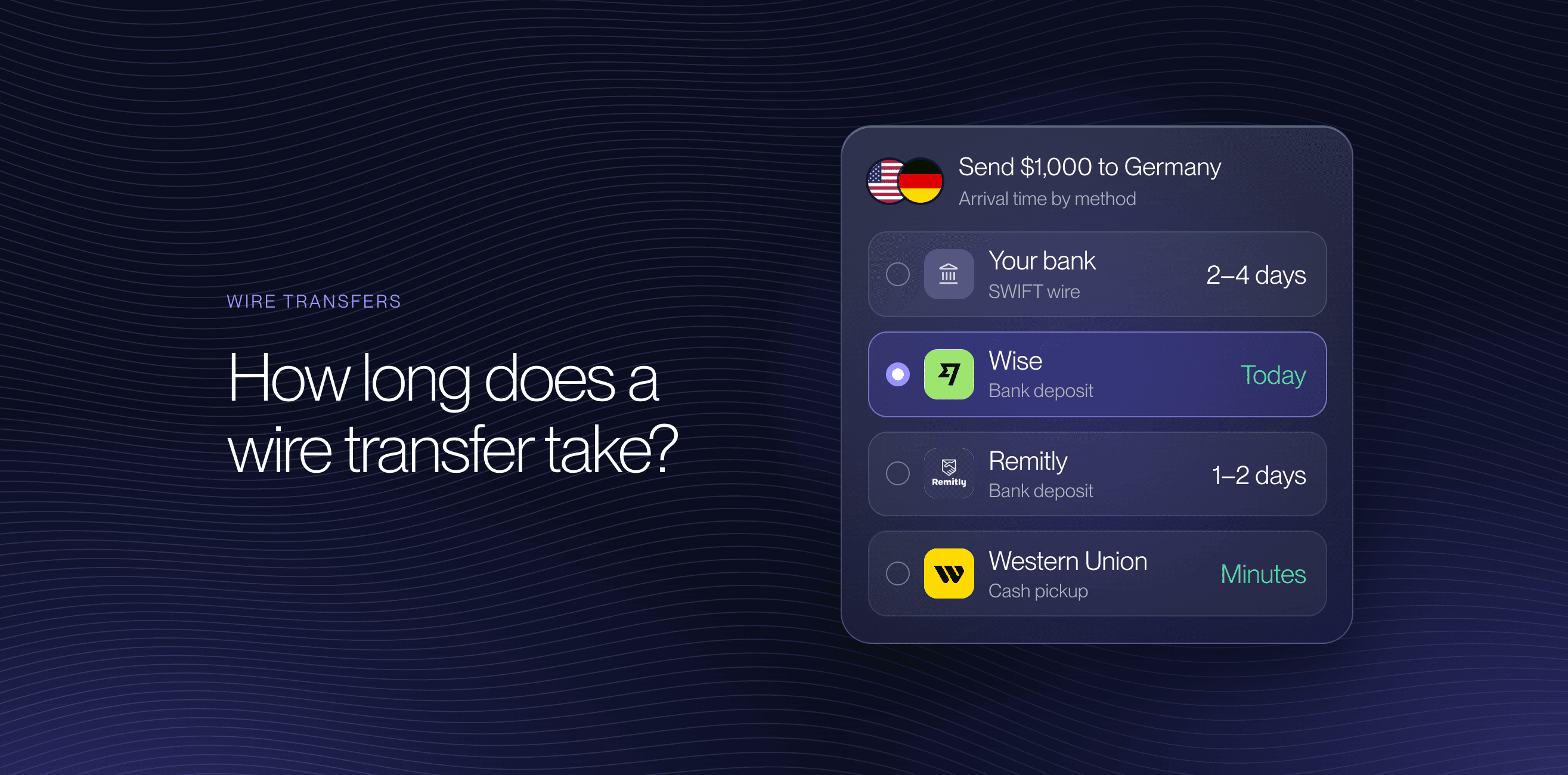
How Long Does a Wire Transfer Take? (2026)

A domestic wire transfer usually lands the same business day, often within minutes of leaving your bank, as long as you send it before your bank's cut-off. The international wire transfer time is longer: big US banks quote 1 to 5 business days, one of them up to 10, and UK banks 1 to 4 working days for most currencies.
The network itself is rarely the slow part. SWIFT says 90 percent of cross-border payments on its network reach the destination bank within an hour. The days come from everything around it: your bank's cut-off, weekends and public holidays in both countries, compliance checks, correspondent banks and the receiving bank's own processing.
This guide is built on published timings: Fedwire and CHAPS operating hours, SWIFT's own speed data, and each named bank's wire cut-off and stated delivery time. It then walks through real calendar dates, including a wire sent at 4 pm on a Friday before a holiday, and shows how to get money there faster.
Compare Delivery Times Before You Send a Wire
Your bank tells you the delivery date once you have started the wire. The comparison below shows what specialist services deliver for the same amount, with the fee and exchange rate included, so you can check a faster or cheaper route before you fill in your bank's wire form.
Then read on for how long each kind of wire really takes, and why.
How Long Does a Wire Transfer Take? The Short Answer
A domestic wire transfer takes minutes to a few hours and arrives the same business day if you send it before your bank's cut-off. An international wire usually takes 1 to 5 business days from a US bank and 1 to 4 working days from a UK bank, while euro payments inside Europe arrive the same or next working day.
Type of wire | How it travels | Published timing |
|---|---|---|
US domestic wire | Fedwire, run by the Federal Reserve | Same business day |
UK same-day payment | CHAPS, run by the Bank of England | Same working day |
Euro payment from a UK bank to Europe | SEPA | Same or next working day |
International wire from a US bank | SWIFT, often through correspondent banks | 1 to 5 business days at most big banks, up to 10 at one |
International payment from a UK bank | SWIFT | 1 to 4 working days for most currencies, up to 5 to some countries |
Wise, Remitly or Xe | Local payment systems in most countries | Seconds to 3 business days, depending on how you pay |
From the Federal Reserve, the Bank of England and each bank's and provider's published wire and payment pages, checked 5 November 2026.
How Long Does It Take to Wire Money at Home?
Inside one country, a wire is fast once it leaves. A wire transfer moves money one payment at a time through the central bank's settlement system, so a US domestic wire transfer settles over Fedwire within moments of your bank releasing it. The Federal Reserve describes those payments as immediate, final and irrevocable once processed.
The UK equivalent, CHAPS, settles each payment individually at the Bank of England on the day it is submitted. In both countries the wait is almost never the network. It is the time before your bank releases the payment, which depends on its cut-off, its fraud checks and whether today is a business day.
International Wire Transfer Time: One to Five Business Days
An international wire travels as a SWIFT message, often through one or two correspondent banks, and is then credited by a bank in another country, time zone and set of rules. That is why the international wire transfer time banks quote is a range of days rather than hours.

The slowest routes set the range. A wire between big banks in major currencies often arrives within a day, while a payment into a country with capital controls or extra paperwork can take the full five days. Your bank shows the expected date before you confirm, and that is the date to plan around.
The Legal Deadlines Banks Work To
In the UK, the Payment Services Regulations 2017 require a sterling payment within the UK, and a euro payment through a scheme covering the UK and the EEA such as SEPA, to reach the recipient's bank by the end of the next business day. Payments in other currencies to the rest of the world have no statutory deadline, which is why HSBC says "up to 4 working days or longer".
The US sets no delivery deadline, but federal rules make a provider print the date the money will be available on the receipt for a consumer international wire, as covered further down.
Fedwire and CHAPS: The Hours Behind a Domestic Wire Transfer
Fedwire, which carries US domestic wires, runs from 9 pm ET the evening before to 7 pm ET on each business day and accepts customer payments until 6:45 pm ET. CHAPS, its UK counterpart, opens at 6 am and closes at 6 pm, with customer payments due by 5:40 pm. Your own bank's cut-off is earlier than both.
Fedwire Operating Hours and Holidays
Every day that is not a Saturday, a Sunday or a Federal Reserve holiday is a funds-transfer business day. Each opens at 9 pm ET the evening before, so Monday's starts at 9 pm on Sunday, and ends at 7 pm ET. Customer transfers, the kind you send from a personal account, must be in by 6:45 pm ET.
The holidays matter as much as the hours. Fedwire is closed on Veterans Day, Wednesday 11 November 2026, Thanksgiving on 26 November and Christmas Day, then New Year's Day, Martin Luther King Jr. Day on 18 January 2027 and the other federal holidays. The Federal Reserve Board plans to open it Sunday to Friday, including weekday holidays, but no earlier than 2028.
CHAPS Operating Hours and UK Bank Cut-Offs
The Bank of England runs CHAPS from 6 am to 6 pm, Monday to Friday, excluding bank holidays in England and Wales. Customer payments must be in by 5:40 pm, there is no minimum or maximum amount, and each payment is final once settled, which is why conveyancers use it for house completions.
Each bank sets its own CHAPS cut-off well before 5:40 pm, and several only send one in a branch:
Bank | How you send a CHAPS payment | Same-day cut-off |
|---|---|---|
Online, by phone or in a branch | 5 pm | |
By phone, in a branch or by post | Not published on its CHAPS page | |
Branch only, £25 | 4:25 pm | |
Branch, or by phone for Premier customers | 3:59 pm in branch, 2 pm by phone | |
Branch or contact centre | 3 pm in branch, 1 pm by phone |
Personal accounts, from each bank's CHAPS or payments page, checked 5 November 2026. Working days only.
Domestic Wire Transfer or a Cheaper Rail?
Most money moved between banks at home does not need a wire. US ACH transfers are free at most banks but take one to three business days, and UK Faster Payments arrive in seconds but are capped by your bank, typically at £20,000 to £50,000 a day. A domestic wire transfer earns its fee when a large sum has to land today and cannot be pulled back, such as a house closing. Our guide to bank to bank transfer times covers the other rails.
Wire Transfer Cut-Off Times at US and UK Banks
Your bank's wire transfer cut-off time decides which day the money leaves. Bank of America takes wires until 5 pm ET, Wells Fargo until 2:20 pm PT for international wires, and Capital One until 2 or 3 pm ET. UK cut-offs run from 6:30 am to 6 pm UK time, depending on the bank and the currency.
US Banks: Wire Transfer Cut-Off Times and Delivery Times
US banks publish a cut-off for each type of wire, and the delivery times they state differ as much as the cut-offs:
Bank | Domestic wire cut-off | International wire cut-off | Stated delivery time |
|---|---|---|---|
Bank of America | 5 pm ET | 5 pm ET | Domestic: same day. International: typically 1 to 5 business days |
Wells Fargo | 3 pm PT (6 pm ET) | 2:20 pm PT (5:20 pm ET) | Sent same day; international delivery varies by country |
Capital One | 2 pm ET online, 3 pm ET by phone | 3 pm ET, branch only | Domestic: same day. International: up to 10 business days |
Personal accounts, from each bank's wire transfer pages, checked 5 November 2026. Business days only, excluding Federal Reserve holidays.
Wells Fargo's international cut-off is 40 minutes earlier than its domestic one, and Capital One does not send international wires online at all. Time zones work against the west: at 4 pm in Los Angeles it is 7 pm in New York, after every cut-off here and after Fedwire's own 6:45 pm ET deadline.
How Long Does It Take to Wire Transfer Money Internationally From a UK Bank?
UK banks publish both a cut-off and a delivery time. Euro payments into Europe arrive the same or the next working day almost everywhere. Other currencies take one to four working days, and Lloyds allows five for countries outside its main regions:
Bank | Cut-off for online payments | Euros to Europe | Other currencies |
|---|---|---|---|
Barclays | Not published; the app shows the arrival date before you send | Within one working day | Most within 1 to 2 working days |
HSBC UK | Set per currency: 3:30 pm for euros, 6 pm for US dollars | Next working day | Up to 4 working days or longer outside the EEA |
Lloyds | 3 pm (2 pm for euros in a branch or by phone) | No later than the next working day | Up to 4 working days to North America and other main regions, up to 5 elsewhere |
NatWest | 2 pm for euros, 4 pm for other currencies | Same business day (SEPA) | 1 to 3 business days |
Santander UK | 3 pm for most payments, 11:30 am for urgent euros | Same working day (urgent) or next (SEPA) | Up to 4 working days |
Personal accounts, from each bank's international payments page or cut-off document, checked 5 November 2026. UK times, working days only.
Why the Currency Changes the Cut-Off
HSBC UK publishes a cut-off for every currency, and the spread follows the destination's working day. Payments in UAE dirhams, Pakistani rupees or Hong Kong dollars must be in by 6:30 am UK time, South African rand by 11 am, Indian rupees and Philippine pesos by 2 pm, euros by 3:30 pm and US dollars by 6 pm.
By early afternoon in London, the business day in Mumbai and Manila is over, so a rupee payment booked at 3 pm on a Friday starts on Monday. A dollar payment booked at the same moment is still in time, because New York has most of its day left.

Banks also skip days the destination is closed. Santander UK states that it does not process payments on non-working days, and that this includes non-working days in the recipient's country, so a cut-off you beat at home can still meet a holiday at the other end.
How Long Does an International Wire Transfer Take Over SWIFT?
On the network itself, not long. SWIFT says 90 percent of cross-border payments reach the destination bank within an hour, and nearly 60 percent of payments tracked through SWIFT gpi are credited to the recipient within 30 minutes. The days banks quote come from cut-offs, holidays, checks and the receiving bank.
How Long a SWIFT Transfer Spends Between Banks
SWIFT's October 2024 figures split the journey in two. Ninety percent of cross-border payments over its network reached the destination bank within an hour, but only 43 percent reached the end customer's account in that time.
The gap is the last leg, inside the receiving country. SWIFT puts it down to regulatory controls and domestic processing there, and says the countries already meeting the G20 target of one-hour end-to-end processing for 75 percent of payments by 2027 run 24-hour back offices without significant capital controls. For SWIFT gpi payments, the tracked service used by hundreds of the world's leading banks, it says almost 100 percent are credited within 24 hours.
Correspondent Banks and the Last Leg
Your bank rarely holds an account with the recipient's bank, so the payment passes through one or two correspondent banks that do. Each screens it against sanctions lists and processes it in its own working hours, and each handoff can add a fee as well as time.

At the far end, some banks check that a payment is expected before crediting it. Barclays tells customers sending Japanese yen that the payment can only go to a company and that the recipient must tell their bank to expect it. Details like that rarely show in the estimate, and they often explain a wire that lands a day or two late.
Why Banks Quote Days When the Network Takes an Hour
In the US, the remittance transfer rule in Regulation E requires the receipt for a consumer international wire to show the date the money will be available. The provider may not give a range or an estimate. If it cannot be sure, it may give the latest date the money will be available and add that it may arrive sooner.
So the date on your receipt is a ceiling built to cover the slowest route. If the money is not available by then, you can report an error within 180 days, unless the delay came from events such as war or natural disaster, or from a sanctions or fraud review the provider could not have foreseen.
What Delays a Wire Transfer
Five things add days to a wire: missing the cut-off, weekends and public holidays in either country, compliance and fraud checks, wrong or incomplete details, and currencies whose markets close early. None of them is visible when you press send, which is why a wire quoted at one day can take a week.
Weekends and Holidays in Both Countries
Fedwire closes on Saturdays, Sundays and Federal Reserve holidays, and CHAPS at weekends and on bank holidays in England and Wales. The calendars do not line up: Thanksgiving on 26 November 2026 is US-only, Boxing Day on Monday 28 December 2026 is UK-only, and on Good Friday, 26 March 2027, UK banks shut while Fedwire is open.
Then add the recipient's calendar. Wise warns that a transfer sent on a Friday or before a holiday might not move until the next working day, in both the sending and the receiving country. Festivals such as Diwali, Eid or Lunar New Year can close banks at the far end for days.
Compliance, Sanctions and Fraud Checks
Every bank screens outgoing wires, and some are held for a closer look. Wells Fargo shows a wire as under review while it is verified and may call you before sending it. HSBC UK warns that a euro payment for a property or an investment can take longer than the next working day because of extra security checks.
Since 30 October 2024, a UK bank with reasonable grounds to suspect fraud can delay a sterling payment within the UK until the end of the fourth business day, as long as it tells you why. In the US, a delay caused by a sanctions match, such as a recipient whose name resembles a blocked person, is not the provider's error.
Wrong or Missing Details
A wrong digit costs the most time, because the payment is rejected and sent back rather than corrected. Bank of America warns that some banks use different routing numbers for wires and ACH, and that the wrong one can delay, reject or return a wire. Abroad, the usual culprits are a mistyped IBAN or SWIFT code, a name that does not match, or a missing purpose of payment, which Barclays requires for India and China.
A returned wire is slow and can come back short: Wells Fargo says other banks may deduct fees, and a foreign currency wire is converted back at a new rate. Our guide to what happens when you send money to a closed account explains the return journey.
Currency, Time Zones and Weekend Rates
Some currencies are slow because their banks keep different hours or weekends, and payments into countries with currency controls can wait while the receiving bank collects paperwork from the recipient.
Timing can change the price too. Wells Fargo says it adds extra markup to its exchange rates outside market hours and at weekends, so a foreign currency wire booked on a Saturday can cost more as well as wait longer. For the cost side, see our guide to international wire transfer fees.
How Long Do Wire Transfers Take Over a Holiday? Three Worked Timelines
A wire that misses the cut-off on the Friday before a Monday holiday does not move until Tuesday, four calendar days later. Even a wire that beats the cut-off can sit at the receiving bank over the weekend and the holiday. These three examples use real 2026 and 2027 dates and each bank's published cut-off.
A Domestic Wire at 4 pm ET on Friday 15 January 2027
Monday 18 January 2027 is Martin Luther King Jr. Day, a Federal Reserve holiday. A domestic wire for a Friday house closing sent at 4 pm ET from Bank of America, cut-off 5 pm ET, leaves that afternoon and reaches the title company's bank the same day. Wells Fargo's 3 pm PT cut-off, 6 pm in New York, is also met.
Book it online at Capital One, cut-off 2 pm ET, and it waits for Tuesday 19 January, so the closing slips four calendar days. Send at 4 pm in California and Fedwire itself has stopped taking customer payments, so no bank can send it before Tuesday.
A US to UK Wire at 4 pm ET on Friday 28 May 2027
Monday 31 May 2027 is Memorial Day in the US and the spring bank holiday in the UK. Wells Fargo, cut-off 5:20 pm ET, and Bank of America, 5 pm ET, both send the wire on Friday. But it is already 9 pm in London, and the UK bank will not credit it before Tuesday 1 June.
At Capital One the 3 pm ET branch cut-off has passed, so the wire leaves on Tuesday, with up to 10 business days allowed for deposit. Nobody gets the money before Tuesday. The difference is whether it is waiting at the UK bank on Tuesday morning or only just leaving the US.
A UK Payment at 4 pm on Thursday 24 December 2026
Christmas Day is a Friday and the Boxing Day holiday moves to Monday 28 December. A US dollar payment booked at Lloyds at 4 pm on Christmas Eve misses its 3 pm cut-off and starts on Tuesday 29 December. Lloyds allows up to four working days to North America, and New Year's Day is another holiday, so the latest date is Tuesday 5 January 2027.
HSBC UK's cut-off for dollars is 6 pm, so the same payment would start on 24 December, with a latest arrival of Monday 4 January. All six cases side by side:
Wire | Bank and cut-off | Leaves the bank | Arrives by |
|---|---|---|---|
Domestic US, Fri 15 Jan 2027, 4 pm ET | Bank of America, 5 pm ET | Fri 15 Jan | Fri 15 Jan |
Domestic US, Fri 15 Jan 2027, 4 pm ET | Capital One online, 2 pm ET | Tue 19 Jan | Tue 19 Jan |
US to UK, Fri 28 May 2027, 4 pm ET | Wells Fargo, 5:20 pm ET | Fri 28 May | Tue 1 Jun at the earliest |
US to UK, Fri 28 May 2027, 4 pm ET | Capital One branch, 3 pm ET | Tue 1 Jun | Up to 10 business days |
UK to US, Thu 24 Dec 2026, 4 pm | Lloyds, 3 pm | Tue 29 Dec | Tue 5 Jan 2027 at the latest |
UK to US, Thu 24 Dec 2026, 4 pm | HSBC UK, 6 pm for dollars | Thu 24 Dec | Mon 4 Jan 2027 at the latest |
Cut-offs and delivery windows from each bank's published pages, holidays from the Federal Reserve and GOV.UK calendars, checked 5 November 2026. Assumes no checks or errors.
The pattern holds for any holiday weekend. Beating the cut-off often saves only a day, because the receiving bank is closed too. Sending on Wednesday instead of Friday saves the whole weekend.
How to Make a Wire Transfer Arrive Faster
Send early in the day and early in the week, check the holidays in both countries, use the recipient's exact details, and tell the recipient to expect the money. If it has to land abroad today, a bank wire is rarely the fastest route: a specialist that pays out locally often delivers in seconds.
Send Before Noon, Monday to Wednesday
A cut-off is a deadline for a payment that has already cleared your bank's checks, so aim for hours before it. Morning wires leave room for a call from the fraud team, and a wire sent Monday to Wednesday has time to recover from a problem before the weekend. If your bank only sends in a branch, as Capital One does for international wires, book the visit for the morning.
Get Every Detail Right the First Time
Ask the recipient to copy their details from their banking app: full name exactly as on the account, account number or IBAN, the bank's SWIFT or BIC code and address, and any local code such as an IFSC in India or a CLABE in Mexico. For a US recipient, ask for the wire routing number, not the ACH one.
Make any purpose of payment specific, such as "tuition fees for spring 2027", and tell the recipient the amount, date and reference in advance, since some receiving banks hold a large incoming payment until their customer confirms it.
Use a Specialist When the Deadline Is Tight
If the money has to arrive abroad today, a bank wire is the wrong tool. Specialist services pay out through local payment systems in most countries and show the delivery time before you pay. Paying by card gets your money to them instantly, at a slightly higher fee.
How to Track a Wire Transfer That Has Not Arrived
Ask your bank for the payment's UETR, the unique reference every SWIFT payment carries from start to finish, and for the payment confirmation many banks still call an MT103. Give both to the recipient, whose bank can use them to find the money. In the US, your receipt also shows the date the funds must be available.
The UETR and the MT103 Confirmation
The UETR, short for unique end-to-end transaction reference, is created by the first bank in the chain and kept by every bank after it, which is what lets SWIFT gpi show where a payment sits and which bank holds it now.
The MT103 is the old name for the payment instruction. Since November 2025, banks on SWIFT have sent cross-border payments in the newer ISO 20022 format, but the confirmation still shows the date sent, the amount, the banks involved and the reference. Our guide to tracking a money transfer goes through the steps with your bank and with a provider.
When a Wire Is Officially Late
In the US, the date on your receipt is the line. Once it has passed, call the provider with the confirmation code and report an error. Bank of America says it will decide whether an error occurred within 90 days of your call and tell you the result within three business days after that, and federal rules give you 180 days from the disclosed date to report it.
In the UK, ask your bank to trace the payment once it passes the delivery time it showed you. For sterling and SEPA euro payments the deadline is the end of the next business day, so a delay beyond that is a question for your bank.
How Long Specialist Services Take Instead of a Wire
Specialist services usually beat a bank wire on time because they pay out through local payment systems rather than a chain of banks. Wise says 78 percent of its transfers completed instantly in the quarter to 30 September 2026. Remitly refunds its fees if a transfer arrives late, and Xe says most of its transfers arrive in minutes.
Wise
 Wise9.5
Wise counts a transfer as instant when it completes in under 20 seconds, and in the quarter to 30 September 2026 it said 78 percent of its transfers did, up from 74 percent a year earlier. It holds money in local accounts and pays out through domestic systems in most major currencies, so most transfers avoid a correspondent chain altogether.
How you pay still matters. Wise's own help page lists card payments as usually instant to reach it, bank transfers as 1 to 4 working days and SWIFT payments as 1 to 6 working days, though a UK bank transfer usually reaches it in seconds. Its estimates count working days only. For speed, pay by card or from a Wise balance. Our Wise review covers its limits, fees and safety in detail.
Remitly
.jpeg) Remitly8.5
Remitly is built for money sent home to family, and it backs its estimates with a promise: if a transfer arrives later than promised, Remitly refunds its fees. The fastest option is Express, paid by card where available. Economy, paid from a bank account, costs less and takes longer.
Some bank-funded routes are quick too: Remitly says US to India transfers paid by bank arrive instantly in a bank account or UPI. It also pays out to cash pickup points and mobile wallets. Our Remitly vs Wise comparison shows which is quicker and cheaper by route.
Xe
.webp)
Xe says most of its transfers arrive in minutes, and the payment method sets the pace. Card payments are processed almost instantly for a small extra fee, while bank transfers and ACH payments take up to two business days to reach Xe, which then allows one to three business days to reach the recipient.
Xe suits large one-off sums with a few days to spare, and shows the delivery estimate before you confirm.
Which Route Fits Your Deadline
Each option wins a different kind of deadline:
What you need | Fastest sensible route |
|---|---|
A large payment at home, today | Domestic wire or CHAPS, before your bank's cut-off |
Money in a bank account abroad today | Wise, paid by card |
Money home to family by cash or wallet | Remitly Express |
A large one-off sum abroad within a few days | Xe or Wise, compared on the day |
A payment abroad due on a fixed date | A bank wire sent five business days early, or a specialist's dated estimate |
A bank wire still makes sense when the recipient insists on a bank-to-bank payment. For anything time-critical, compare the delivery estimate before you commit.

The first transfer with any specialist takes longest, because each checks your identity once, so open the account a few days before you need it.
Check the Delivery Time for Your Route
Delivery estimates change by currency, amount and payment method. Enter your transfer below to see what each provider delivers right now, then set it against the date on your bank's wire form.
Bottom Line
A domestic wire arrives the same business day if it leaves before your bank's cut-off, 5 pm ET at Bank of America and as early as 2 pm ET at Capital One. An international wire takes 1 to 5 business days from a US bank and 1 to 4 working days from a UK bank, though SWIFT moves 90 percent of payments between banks within an hour.
The calendar decides the date. Send early in the week, before the cut-off, with every detail checked and both countries' holidays in mind. If the money must land abroad today, use a specialist that pays out locally.
Frequently Asked Questions
How long does a wire transfer take?
A domestic wire transfer usually arrives the same business day, often within minutes of leaving your bank, as long as you send it before your bank's cut-off. In the US that is 5 pm ET at Bank of America and 3 pm PT at Wells Fargo for domestic wires. An international wire takes 1 to 5 business days at most big US banks and 1 to 4 working days from most UK banks. Weekends and public holidays in either country add to both.
How long does an international wire transfer take?
Bank of America quotes 1 to 5 business days, Capital One up to 10, and UK banks such as HSBC and Lloyds up to 4 working days for most currencies, while euro payments inside Europe arrive the same or next working day. The SWIFT network itself is quick: SWIFT says 90 percent of payments reach the destination bank within an hour. The rest of the time goes on cut-offs, holidays, compliance checks and the receiving bank.
How long does it take to wire transfer money internationally from a UK bank?
Most UK banks send euro payments to Europe the same or the next working day. For other currencies, Barclays says most payments arrive within one to two working days, NatWest quotes 1 to 3 business days, and HSBC, Lloyds and Santander allow up to 4 working days, with Lloyds allowing 5 to some countries. Cut-offs run from 6:30 am for some currencies at HSBC to 6 pm for its US dollar payments, and most fall between 2 pm and 4 pm. Miss one and the payment starts the next working day.
How long do wire transfers take on weekends and holidays?
They do not move at all. Fedwire is closed on Saturdays, Sundays and Federal Reserve holidays, and CHAPS is closed at weekends and on bank holidays in England and Wales. Santander UK says it does not process payments on non-working days in the recipient's country either. A wire sent after the cut-off on the Friday before a Monday holiday therefore leaves on Tuesday, four calendar days later.
What is the wire transfer cut-off time at most banks?
It depends on the bank, the channel and the currency. Bank of America takes domestic and international wires until 5 pm ET, Wells Fargo until 3 pm PT for domestic wires and 2:20 pm PT for international ones, and Capital One until 2 pm ET online. In the UK, Lloyds stops at 3 pm, NatWest at 2 pm for euros and 4 pm for other currencies, and HSBC sets a cut-off for each currency, from 6:30 am to 6 pm. A wire submitted after the cut-off goes the next business day.
How long does a domestic wire transfer take?
Once your bank releases it, a US domestic wire settles over Fedwire almost immediately and is final, and the receiving bank usually credits it the same business day. The limit is your bank's cut-off, which comes before Fedwire's 6:45 pm ET deadline for customer payments. In the UK, a CHAPS payment made before your bank's cut-off arrives the same working day. Neither system runs at weekends or on bank holidays.
How long does it take to wire money if the bank runs extra checks?
Usually a few hours to a few days. Wells Fargo warns that a wire may go through an internal review before it is sent and that it may call you to verify the payment. In the UK, a bank that suspects fraud can delay a sterling payment until the end of the fourth business day, and must tell you why. Large first payments, property deposits and payments to new recipients are the most likely to be held, so answer your bank's calls promptly.
How can I track a SWIFT transfer?
Ask your bank for the UETR, the unique reference that every payment on SWIFT carries from start to finish, and for the payment confirmation, often still called an MT103. Your bank can use the UETR to see where the payment sits, and the recipient's bank can use it to find incoming money. If a US consumer wire is not available by the date on your receipt, you can report it as an error within 180 days.
What happens if I miss the wire transfer cut-off time?
Your bank holds the wire and sends it the next business day, so a wire submitted at 5:30 pm ET on a Friday at Bank of America leaves on Monday, or Tuesday if Monday is a holiday. Nothing is lost except time, but the delivery date moves by at least one day and often three or four. If the money must arrive sooner, a specialist paid by card can still move it, because card payments reach Wise and Xe almost instantly.
Is there a faster option than an international wire transfer?
Usually, yes. Wise says 78 percent of its transfers completed instantly in the quarter to 30 September 2026, and it counts a transfer as instant when it completes in under 20 seconds. Remitly promises on-time delivery or refunds its fees, and Xe says most transfers arrive in minutes. All three pay out through local systems in most countries rather than a chain of correspondent banks, and each shows a delivery estimate before you pay.
Sources
- Federal Reserve Financial Services: Fedwire Funds Service and National Settlement Service operating hours
- Federal Reserve Financial Services: Holiday schedules
- Federal Reserve Board: Expanded operating days for Fedwire Funds Service (9 October 2025)
- Federal Reserve Board: About the Fedwire Funds Service
- Bank of England: CHAPS
- GOV.UK: UK bank holidays
- SWIFT: Cross-border payment processing speed stretches further ahead of G20 target (17 October 2024)
- SWIFT: Swift GPI
- Bank of America: Wire transfers
- Bank of America: Cutoff times for deposits, transfers and payments
- Wells Fargo: Digital wires FAQs
- Capital One: Wire transfer support
- Barclays: International payments
- Barclays: CHAPS payments
- HSBC UK: International money transfers
- HSBC UK: Cut-off times for international payments (PDF)
- Lloyds Bank: Send an international payment
- Lloyds Bank: Pay by CHAPS
- NatWest: Send money abroad
- NatWest: How can I make a CHAPS payment?
- Santander UK: Making international payments
- legislation.gov.uk: Payment Services Regulations 2017, regulation 86
- Consumer Financial Protection Bureau: Regulation E, 1005.31 remittance disclosures
- Consumer Financial Protection Bureau: Regulation E, 1005.33 error resolution
- J.P. Morgan: ISO 20022 FAQs
- Wise: Why is my transfer taking longer than the estimate?
- Wise: Q1 2025 mission update on speed
- Wise Group plc: Q2 FY27 results (15 October 2026)
- Remitly: Send money to India from the US
- Remitly: Send money to Mexico from the US
- Xe: Send money
Mo is the founder of MoneyTransferStore. As an expat who has experienced the challenges of sending money across borders himself, he set out to help others like him avoid hidden fees and unfair exchange rates on international transfers. With a background spanning fintech, payments, and Web3, Mo brings years of practical experience to building a platform focused on transparency and trust.