 Compare money transfers from Pakistan
 GBP




 GBR










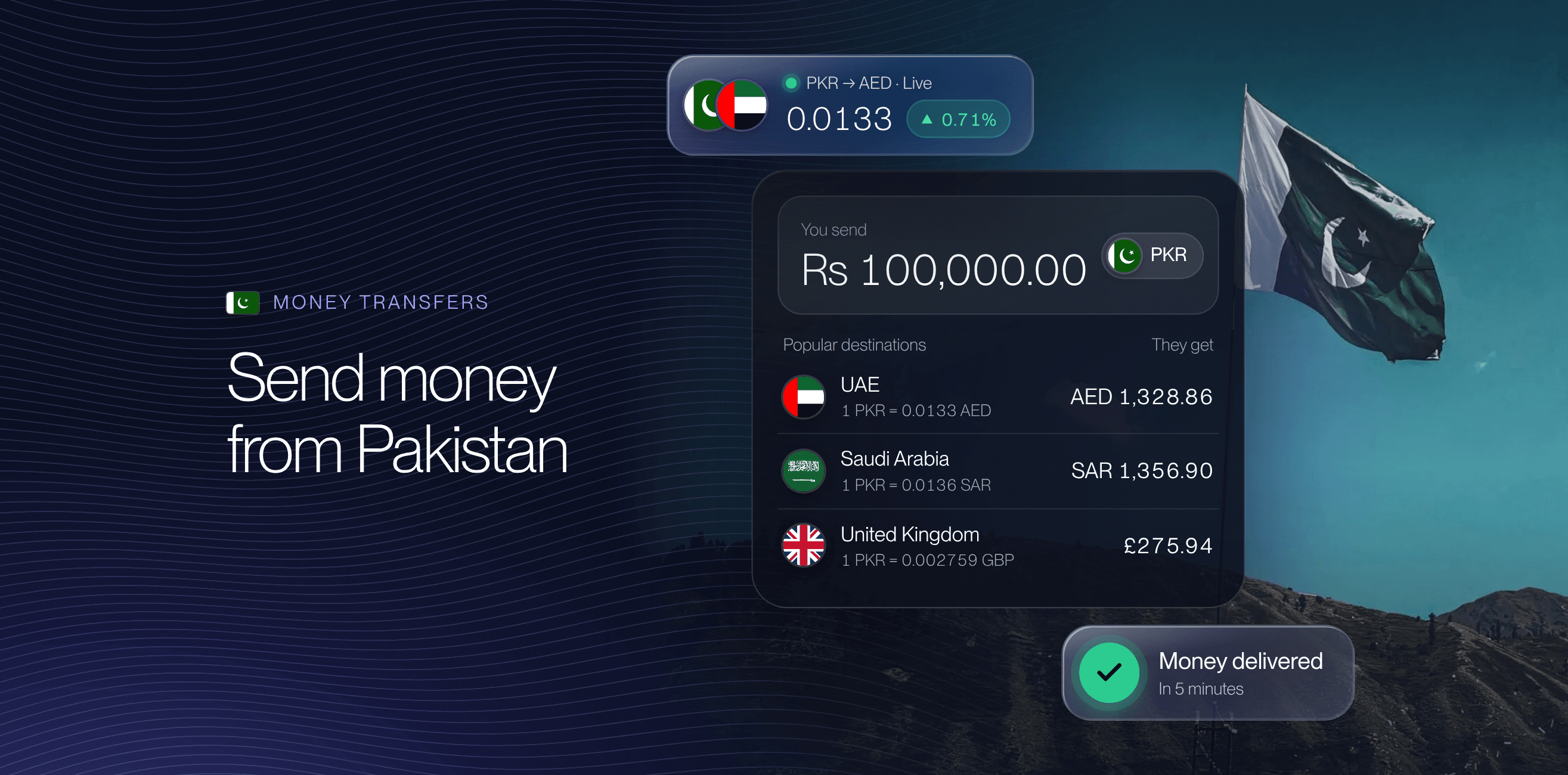
How to Send Money From Pakistan

To send money from Pakistan, you go through a bank or an exchange company licensed by the State Bank of Pakistan, and most banks charge a flat fee per transfer plus a SWIFT charge. Meezan Bank's schedule lists US$35 for a foreign telegraphic transfer plus Rs 600 for SWIFT, so a PKR 100,000 payment loses about a tenth of its value to fees.
The quick answer: Wise, Remitly and Xe do not accept payments in Pakistani rupees, so the choice is between your bank, an exchange company and, for travel, a card. Fees are mostly fixed, so fewer, larger transfers are much cheaper than many small ones. Tuition and medical bills go through banks under their own State Bank limits.
This page sets out the rules on how much you can send, what Pakistani banks charge, what PKR 100,000, PKR 500,000 and PKR 5 million really cost, how long a transfer takes, and how to stay clear of hundi and hawala.
Who sends money from Pakistan
Pakistan is far better known for receiving remittances than sending them, but many households still need to send money from Pakistan every year. The World Bank puts personal remittances paid from Pakistan at about $352 million in 2024. On top of that sit tuition, medical bills, travel and pilgrimage costs, which banks handle under separate rules and which are often larger than family transfers.
Families paying for study abroad
Education is the biggest reason most households need to send money from Pakistan. The US Department of Commerce reports that over 114,000 Pakistani students studied abroad in 2023. The UK hosted 34,690 Pakistani students in 2022/23 according to ICEF Monitor, and China, the UAE, Australia, the US and Germany are also popular.
Tuition is usually paid once or twice a year in a large amount straight to the university, while living costs go to the student's own account. Both are allowed under the State Bank's education rules, up to US$70,000 per student each calendar year.
Patients and families paying for treatment abroad
Some patients travel to the UK, the UAE, Turkey or elsewhere for treatment that is hard to get at home. Banks can remit up to US$50,000 per invoice for medical expenses abroad, paid to the hospital against its estimate. These payments are usually urgent, so having the documents ready matters more than the fee.
Pilgrims and travellers
Hajj and Umrah payments, and travel more generally, are a large source of outward foreign exchange. Hajj and Umrah operators remit through banks on behalf of pilgrims, while individual travellers buy currency, carry cash within the limits or use cards abroad.
Foreign nationals working in Pakistan
Engineers, consultants and other foreign staff working in Pakistan are paid in rupees but can remit part of their savings to the country of their domicile. The State Bank's foreign exchange manual sets out family remittance facilities for foreign nationals who are resident and earn income in Pakistan, through permits issued by banks.
This group includes staff on infrastructure and energy projects, diplomats' household staff and teachers at international schools. Their transfers are regular and modest, so the fixed fee per transfer decides most of the cost.
Overseas Pakistanis moving money back out
Pakistanis who live abroad often bring money home to buy property, support parents or invest, and later need to send money from Pakistan back to their country of residence. Funds that arrived from abroad into a Roshan Digital Account or a foreign currency account can be sent out again, so keeping the paper trail of the original inward transfer makes the return trip simple.
Sale proceeds of property bought with money brought from abroad are a common case. Ask your bank which documents it needs before the sale completes, because proving the original inward remittance is easier while the records are fresh.
The rules behind every money transfer from Pakistan
Pakistan controls the sale of foreign exchange, so the purpose of a payment decides how much you can send and which route you must use. The State Bank of Pakistan sets the rules under the Foreign Exchange Regulation Act 1947, and banks and exchange companies apply them at the counter.
The exchange company limits
Exchange companies may not sell an individual more than US$10,000 a day or US$100,000 a calendar year, in cash or as an outward remittance. The State Bank says these limits are meant to cover travel, family maintenance abroad and other personal needs. Exchange companies may only make outward remittances for personal transactions, not business payments.
The limits apply across all exchange companies combined, so splitting a payment between two of them does not get around them. Exchange companies check your CNIC and record each sale.
Education and medical limits at banks
Banks can send up to US$70,000 per student each calendar year for application fees, tuition and living expenses, and up to US$50,000 per invoice for medical treatment abroad. Tuition and other dues payable to the institution must go directly to the institution's account, not to the student.
Above these limits, or for other purposes, your bank forwards the case to the State Bank's Foreign Exchange Operations Department. Every bank also runs an online foreign exchange portal where you can submit a request.
Rules for foreign nationals
Foreign nationals working in Pakistan are paid in rupees and may remit part of their savings home under family remittance permits issued by banks. When they leave Pakistan for good, the manual sets out how they can transfer their remaining assets, with a certificate from the employer showing their salary for each year.
Ask your bank's foreign exchange desk for the permit before your first transfer, and keep your employer's salary certificate and tax records. Banks keep the documents for inspection by the State Bank.
Purpose codes and forms
Every money transfer from Pakistan is reported to the State Bank under a purpose code, and the bank asks you to complete the matching form. Since April 2026 the State Bank has required banks to use revised formats for these forms and to collect the information from customers digitally by the end of June 2026.
In practice this means the bank's app or portal asks you to choose a purpose and upload documents before it will sell the currency. Choose the purpose that matches your paperwork exactly, because a mismatch is the most common reason a payment is held.
What Pakistani banks charge to send money abroad
Pakistani banks publish a schedule of charges every six months. Most charge a fixed fee for a foreign telegraphic transfer, plus a SWIFT charge, and add federal excise duty or provincial sales tax on top. A few charge a percentage with a minimum and a maximum instead.
Bank | Outward transfer fee | SWIFT and extras | Notes |
|---|---|---|---|
US$35 per foreign telegraphic transfer | Plus SWIFT, Rs 600 | Schedule for July to December 2025, taxes extra | |
Meezan Bank demand draft | US$15 including SWIFT | Cancellation US$10 plus SWIFT | Slower than a wire |
0.1% to another bank (min US$5, max US$50) | Plus SWIFT, US$10 | Inclusive of sales tax and FED, OUR adds US$50 |
Meezan Bank
Meezan Bank, Pakistan's largest Islamic bank, lists US$35 for a foreign telegraphic transfer plus SWIFT charges of Rs 600 in its July to December 2025 schedule. A foreign demand draft costs US$15 including SWIFT. Government levies such as FED and provincial sales tax are charged on top.
Meezan also adds 0.50% on amounts sent by wire or draft within 15 days of depositing foreign currency cash. That rule is common across Pakistani banks and is meant to discourage cash dollars being moved straight out.
ICBC Pakistan and percentage pricing
ICBC's Pakistan branches price outward transfers as a percentage. For a payment to an account at another bank, the fee is 0.1% with a minimum of US$5 and a maximum of US$50, plus US$10 for SWIFT, inclusive of sales tax and FED. If you want the recipient to get the full amount, the OUR option adds US$50.
Percentage pricing with a low minimum is cheaper on small and mid-sized payments than a flat US$35 fee. Ask your own bank which model it uses before you transfer money from Pakistan, because the difference on a PKR 100,000 payment is several thousand rupees.
Other large Pakistani banks
HBL, MCB, UBL, Allied Bank, Bank Alfalah and Bank AL Habib all publish their charges for outward remittances in their schedules of bank charges, usually a fixed fee in US dollars plus a SWIFT charge in rupees. The amounts change every six months, so check the latest schedule on your bank's website before you send money from Pakistan.
The exchange rate margin Pakistani banks do not show
Banks sell US dollars for an outward transfer at their TT selling rate. On 26 November 2026 Allied Bank quoted Rs 276.50 for a dollar when selling by telegraphic transfer and Rs 276.00 when buying, so its selling rate sat only about 0.09% above the midpoint. Spreads on transfers are narrow in Pakistan because the interbank market sets them closely.
Cash is different. The same day, Allied Bank sold dollar notes at Rs 278.44 and bought them at Rs 274.07, a selling rate about 0.8% above the midpoint. Exchange companies quote their own cash rates, so compare a few before you buy notes.

Hidden extras on a bank transfer
A SWIFT payment can pass through intermediary banks, and each may take a fee from the amount before it arrives. ICBC Pakistan's schedule notes that correspondent bank charges are recovered at actual. If the recipient must get an exact sum, such as a tuition invoice, ask for the OUR option and the price of it.
Taxes are the other extra. Most schedules exclude FED and provincial sales tax, which are added to the fee. Advance tax under Pakistan's income tax law also applies to some payments abroad, so ask the bank for the all-in cost.
The best ways to send money from Pakistan
The routes open to you depend on why you are sending and how much. For most people, the real choice is which bank product to use, not which app.

Your bank's foreign telegraphic transfer
A bank wire is the standard way to send money from Pakistan to an account abroad. It covers tuition, medical bills, family maintenance and foreign nationals' savings. You fill in the bank's form for the purpose, attach the documents and the bank sells you the currency at its TT rate.
Banks are at their worst on small payments, where a flat fee of US$35 or so takes a big share. They are reasonable on large payments, where the fee shrinks as a share and the rate margin is narrow.
Exchange companies
Exchange companies licensed by the State Bank can make outward remittances for individuals' personal transactions, within the limits of US$10,000 a day and US$100,000 a year. They are also where most people buy foreign currency notes for travel. Check that the company is on the State Bank's list before you hand over any money, because thousands of unlicensed dealers operate in the open market.
A foreign currency account
Many Pakistanis hold a foreign currency account. Money in it that came from abroad can be sent out again by wire without buying currency at the TT rate, though the bank's transfer fee still applies. Overseas Pakistanis with a Roshan Digital Account can repatriate their funds without State Bank approval.
Watch the cash deposit rule. Moving foreign currency notes out by wire within 15 days of depositing them can cost an extra 0.50% at Meezan Bank and similar charges elsewhere.
Roshan Digital Account for overseas Pakistanis
The Roshan Digital Account lets Pakistanis living abroad hold rupees or foreign currency in a Pakistani bank and move money in and out online. HBL, for example, offers rupee and foreign currency versions. For overseas Pakistanis it is often the simplest way to transfer money from Pakistan back abroad, because money that came in through the account is repatriable.
Cards for spending abroad
Pakistani debit and credit cards can be used abroad up to US$30,000 a year for international transactions. Banks collect advance tax on card payments abroad, which the Finance Act 2026 cut from 5% to 0.5%. Cards suit travel and online purchases but are not a way to move savings.
Wise, Remitly and Xe
Wise, Remitly and Xe are widely used to send money to Pakistan, but none of them accepts payments in rupees from senders in Pakistan. If you have money in an account abroad, you can use them from there, for example to pay a university in another currency from your own UK or UAE account.
Which option for which transfer
Situation | Best fit | Why |
|---|---|---|
Tuition to a university abroad | Your bank | Pays the institution directly under the US$70,000 education limit |
Hospital bill abroad | Your bank | Up to US$50,000 per invoice against the hospital's estimate |
Small personal transfer to family abroad | Exchange company or a bank with percentage pricing | Lower fixed cost than a flat US$35 wire |
Foreign national sending savings home | Your bank with a family remittance permit | The route the State Bank sets for foreign workers |
Travel money | Card or foreign currency notes within the limits | Card advance tax is now 0.5% |
Read our guide to international wire transfer fees for how bank wires are priced around the world.
How much a money transfer from Pakistan costs
Because most banks charge a fixed fee, the cost to send money from Pakistan depends heavily on the amount. The table uses Meezan Bank's and ICBC Pakistan's published fees and Allied Bank's TT selling rate of Rs 276.50 on 26 November 2026, before FED, sales tax and intermediary fees.
Amount sent | Meezan Bank fees and margin | Share | ICBC Pakistan fees and margin | Share |
|---|---|---|---|---|
PKR 100,000 | About Rs 10,370 | 10.4% | About Rs 4,240 | 4.2% |
PKR 500,000 | About Rs 10,730 | 2.1% | About Rs 4,600 | 0.9% |
PKR 5,000,000 | About Rs 14,780 | 0.3% | About Rs 12,260 | 0.25% |
Sending PKR 100,000
PKR 100,000 buys about US$361.66 at the TT selling rate. A flat US$35 fee plus Rs 600 for SWIFT takes about Rs 10,278, and the rate margin about Rs 90, so roughly a tenth of the amount goes in charges before tax. At ICBC Pakistan's minimum of US$5 plus US$10 for SWIFT, the charges come to about Rs 4,150 plus the same margin.
Small payments are where a money transfer from Pakistan is least efficient. If you support a relative abroad, send every two or three months instead of every month.

Sending PKR 500,000
PKR 500,000 is about US$1,808. Meezan's flat fee is now about 2.1% of the amount. ICBC Pakistan's percentage fee would be US$1.81, so the US$5 minimum applies, and with SWIFT the total is around 0.9%. This is a typical size for a semester's living costs or a hospital deposit.
Sending PKR 5 million
For a large tuition payment of PKR 5 million, about US$18,083, the flat fee shrinks to about 0.2% and the rate margin adds about Rs 4,500. ICBC Pakistan's 0.1% fee is US$18.08, plus US$10 for SWIFT. At this size the banks are close, and intermediary deductions or an OUR charge can matter more than the headline fee. For tuition, choose OUR if the university needs the exact invoice amount, because a shortfall can delay enrolment. Our guide to transferring large sums internationally covers what else to check.
Taxes on top
Bank fees in Pakistan are usually quoted without FED or provincial sales tax, which are added at the rates in force. Payments abroad by card carry advance tax of 0.5% since the Finance Act 2026. Bank Alfalah notes that advance tax under current tax law applies to remittances for studies abroad, so ask your bank for the total including tax.
Sending from a foreign currency account
If you already hold US dollars or pounds in a foreign currency account, a money transfer from Pakistan in that currency skips the conversion, so the TT spread does not apply. The bank's wire fee and SWIFT charge still do. Remember the cash deposit rule: wiring out notes deposited in the last 15 days can add 0.50% at Meezan Bank.
What the gap costs over a year
For a foreign worker who sends PKR 100,000 home every month, a flat US$35 fee plus SWIFT comes to about Rs 123,000 a year. Sending PKR 300,000 every quarter instead, the same flat fee comes to about Rs 41,000 a year for the same total. Fewer, larger transfers save more than any other change.
How long a money transfer from Pakistan takes
Timing depends on how quickly the bank processes the purpose documents and on the route the payment takes abroad. The checks happen before the money leaves, so a missing document delays a transfer more than the transfer itself.
Method | Typical time | Notes |
|---|---|---|
Bank telegraphic transfer | 1 to 3 business days | Longer through intermediary banks |
Foreign demand draft | Days to weeks | The recipient must deposit it |
Exchange company remittance | Depends on the partner | Within the personal limits |
Card payment | Instant | Advance tax collected by the bank |
Bank telegraphic transfers
A SWIFT payment from a Pakistani bank usually reaches a major currency account within one to three business days. Payments made after the cut-off, on Friday afternoons, or around Eid and other public holidays take longer. The receiving country's holidays count too.

Demand drafts
A foreign demand draft is cheaper at some banks but much slower, because it has to be couriered or carried and then deposited by the recipient. The State Bank's manual says banks should normally avoid issuing drafts for outward remittances, so a wire is the usual choice.
What slows a transfer down
The usual causes are a missing document, a purpose code that does not match the paperwork, a name that does not match the account, or a request above the limits that needs State Bank approval. Our guide to how long a money transfer takes explains the other common delays.
If tuition is due in September, start the money transfer from Pakistan in July or early August. A request for one more document can push a payment past the university's deadline.
Tracking a payment
Ask your bank for the SWIFT reference, often called the UETR, once the payment is sent. The recipient's bank can use it to find the payment, and your bank can trace it through the intermediary banks if it has not arrived after three business days.
How to send money from Pakistan step by step
The steps differ a little between a bank and an exchange company, but the preparation is the same: your CNIC, the recipient's full details, and documents that prove the purpose.
What you need
- Your CNIC, or passport and work permit if you are a foreign national
- The recipient's full name, bank name, account number or IBAN, and the SWIFT code
- Documents for the purpose: admission letter and fee voucher for tuition, hospital estimate for treatment
- A foreign national's family remittance permit and salary certificate where needed
Check the bank details twice. Read what an IBAN is if the recipient is in Europe or the UK.
From your Pakistani bank
- Log in to your bank's foreign exchange portal or visit a branch with foreign exchange dealing.
- Choose a foreign telegraphic transfer and the purpose, such as education or medical.
- Enter the recipient's details and SWIFT code, and choose SHA or OUR for the charges.
- Upload the supporting documents and the Form M or other form the bank asks for.
- Approve the debit from your rupee or foreign currency account.
- Keep the transaction reference and the bank's advice in case you need to trace it.
Ask the bank to confirm the exchange rate and all fees before you approve. If you plan to transfer money from Pakistan regularly, save the recipient as a beneficiary so later payments only need the purpose and documents.
Paying tuition with a money transfer from Pakistan
Universities publish their own international payment instructions, usually a SWIFT transfer with the student's ID in the reference. Pay only to the account shown on the university's official website, and keep the bank's payment advice, because the university may ask for proof.
Living costs can go to the student's own account abroad, within the same US$70,000 yearly limit. If the student has a bank account abroad already, sending a larger sum less often keeps the fixed fees down.
With an exchange company
- Choose an exchange company on the State Bank's list and visit its branch.
- Show your CNIC and state the purpose of the payment.
- Give the recipient's details and pay in rupees.
- Keep the receipt and reference number.
Exchange companies record each sale against your daily and yearly limits. For a regular money transfer from Pakistan to the same person, use the same licensed company each time, so the records match and the checks are quicker.
Sending money from Pakistan as a foreign national
Foreign staff working in Pakistan should set up the family remittance permit with their bank before the first transfer. The bank checks your employment, salary and residence, then lets you remit part of your savings to your home country each month without going to the State Bank. Keep your payslips and tax deductions on file.
When you leave Pakistan for good, the remaining savings can be transferred under the rules for foreign nationals retiring from Pakistan, with your employer's certificate of net salary for each year. Start the process a few weeks before you leave.
Limits, cash and tax when you send money from Pakistan
Beyond the exchange company and education limits, a few more rules apply to anyone who wants to send money from Pakistan, carry cash or pay by card.
Taking cash out of Pakistan
Adults can take foreign currency worth up to US$5,000 per visit and US$30,000 a year out of Pakistan, and minors half that. For travel to Afghanistan the limit is US$1,000 per visit and US$6,000 a year. Anyone taking foreign currency out must declare it to customs when leaving.
Cash is rarely a good way to move savings. Notes cost about 0.8% more than a transfer at the bank's selling rate, they are easy to lose, and the yearly limit is low. For anything beyond travel money, a bank transfer to an account in your own name abroad is cheaper and safer.
Card spending abroad
The same US$30,000 annual limit applies to international transactions on Pakistani debit and credit cards. Banks collect advance tax on these payments, now 0.5% after the Finance Act 2026, adjustable against your income tax.
How to transfer money from Pakistan above the limits
For amounts above the US$70,000 education limit, the US$50,000 medical invoice limit or the exchange company limits, your bank forwards the request to the State Bank's Foreign Exchange Operations Department with your documents. Allow extra time for approval.
Is it safe to send money from Pakistan?
Yes, when you use a bank or a licensed exchange company. Both are supervised by the State Bank of Pakistan, and payments through them are recorded and traceable.
Who regulates money transfers in Pakistan
The State Bank of Pakistan authorises banks as dealers in foreign exchange and licenses exchange companies. It sets the purposes and limits for outward payments, and banks report each outward remittance to it by purpose code.
Scams that target senders in Pakistan
Common scams include fake study agents who ask for tuition to be paid to their own account, fake job offers abroad that ask for visa or processing fees, and callers posing as bank staff who ask for one-time PINs. Romance and investment scams that ask for transfers abroad are also common.
No bank will ask for your PIN or OTP. If a call is urgent and secret, hang up and call your bank on the number on your card.
Simple rules that protect you
Only send money from Pakistan to accounts you know. Pay tuition directly to the university, not to an agent, and confirm new account details by phone on a number you already have.
What to do if a transfer goes wrong
If money has not arrived after three business days, ask your bank to trace it with the SWIFT reference. If you sent it to the wrong account, contact the bank at once, because a recall only works before the receiving bank credits the money. Keep every receipt, form and message, since banks need them to investigate.
Top destinations for a money transfer from Pakistan
The routes people use most for a money transfer from Pakistan follow study, treatment, pilgrimage and family ties: the UK, China, Australia, the US, Saudi Arabia, Germany and Afghanistan.
Choosing a route for your money transfer from Pakistan
Most outward payments fit one of a handful of routes, and each has its own rules. Tuition, medical bills and family support go through a bank under their purpose codes. Personal amounts within the daily and yearly limits can also go through a licensed exchange company. Pilgrimage costs go through a licensed operator.
Whatever the route, a money transfer from Pakistan to a bank account abroad works best when you send in the currency of the recipient's account. Sending dollars to a euro account means the receiving bank converts them at its own rate, which can cost more than the fee you saved.
Pakistan to the UK
The UK is the most popular study destination for Pakistani students and a common destination for treatment. Tuition goes by SWIFT straight to the university in pounds, within the US$70,000 yearly education limit. Choose OUR if the exact invoice amount must arrive. See the Pakistan to UK route.
Pakistan to China
China hosted more than 28,000 Pakistani students before the pandemic, many on scholarships linked to the China-Pakistan Economic Corridor, and trade ties are close. Families send money from Pakistan to China by SWIFT in US dollars or yuan. Chinese banks can deduct fees on incoming payments, so check with the recipient. See the Pakistan to China route.
Pakistan to Australia
Australia hosted 23,380 Pakistani students in 2023 according to ICEF Monitor. Tuition is paid to the university's Australian dollar account by SWIFT. Some Australian banks charge to receive international payments, so ask the student what their bank takes for living cost transfers. See the Pakistan to Australia route.
Pakistan to the US
US student visas for Pakistanis have been rising, and many families also pay medical or family costs there. Dollar payments go by SWIFT, often through a US correspondent bank, which may deduct a fee unless you pay OUR. See the Pakistan to US route.
Pakistan to Saudi Arabia
Saudi Arabia is the destination for Hajj and Umrah, and many Pakistani families have relatives working there. Pilgrimage costs are usually paid through licensed operators, which remit through banks. Families who send money from Pakistan to relatives there use SWIFT in riyals or US dollars. See the Pakistan to Saudi Arabia route.
Pakistan to Germany
Germany has become a popular study destination thanks to low or no tuition at public universities, though students must show funds for living costs, often in a blocked account. A blocked account deposit is a large one-off payment, so the fixed fee matters little and the rate matters more. See the Pakistan to Germany route.
Pakistan to Afghanistan
Many families have ties across the border. Cash limits for travel to Afghanistan are lower than for other countries, at US$1,000 per visit and US$6,000 a year. Use a bank or a licensed exchange company rather than an informal dealer, and keep the receipt for every money transfer from Pakistan to Afghanistan. See the Pakistan to Afghanistan route.
Bottom line
No online specialist takes rupees from senders in Pakistan, so a money transfer from Pakistan goes through a bank or a licensed exchange company. Rate spreads on bank transfers are narrow, so the fixed fee decides most of the cost: a flat US$35 wire takes about a tenth of PKR 100,000 but only a fraction of a percent of PKR 5 million.
The one rule: send fewer, larger transfers, and compare fee structures between banks. Ask for the full cost including SWIFT, tax and intermediary fees, and use the international money transfer comparison guide and the comparison tool on this page before you send money from Pakistan.
Related guides
- What is the mid-market exchange rate?: the benchmark every quote should be measured against
- Telegraphic transfer fee: the fixed charge on every bank wire
- Do banks charge for money transfers?: the fees behind a bank payment
- What is a remittance?: how family transfers work
- Send money from China: the same guide for senders in China
Sources
- Meezan Bank: Schedule of service charges, July to December 2025
- ICBC Pakistan: Schedule of charges, July to December 2026
- Allied Bank: Foreign exchange rates, 26 November 2026
- State Bank of Pakistan: FAQs on sale of foreign exchange by exchange companies
- State Bank of Pakistan: Press release on exchange company limits
- State Bank of Pakistan: Remittances for medical treatment and studies abroad
- State Bank of Pakistan: Foreign exchange manual, chapter 16 private remittances
- State Bank of Pakistan: Foreign exchange manual, chapter 10 inward and outward remittances
- State Bank of Pakistan: Revised foreign currency cash carrying limits
- Federal Board of Revenue: SRO on foreign currency limits for travellers
- Bank Alfalah: Remittances for studies abroad
- KPMG: Pakistan Finance Bill 2026 tax measures
- Dawn: SBP cuts limits on travelling cash
- US International Trade Administration: Pakistan higher education opportunities
- ApplyBoard: How Pakistani students will shape global student mobility
- ICEF Monitor: Market snapshot, Pakistan
- World Bank: Personal remittances paid