 Compare money transfers from China
 USD




 GBR










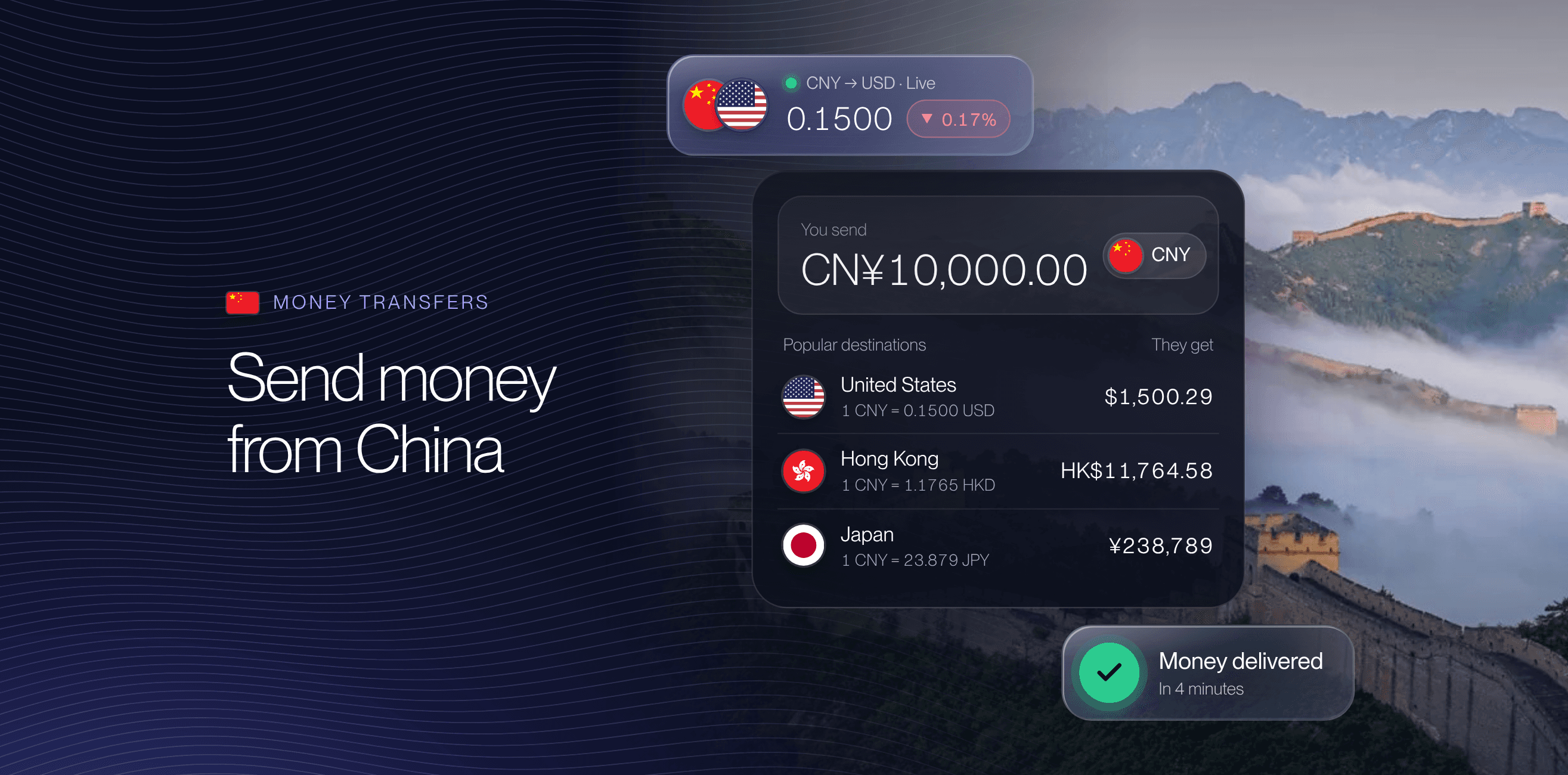
How to Send Money From China

To send money from China, most people use their bank, which charges a commission of 0.1% with a minimum, a telegraphic fee per payment and a margin in the exchange rate. Bank of China charges 0.1% with a minimum of CNY 50 and a maximum of CNY 260, plus CNY 150 for a payment outside Hong Kong, Macao and Taiwan, so a CNY 10,000 transfer costs at least CNY 200 before the rate.
The quick answer: if you are a foreign national or a Hong Kong, Macao or Taiwan resident with taxed income in China, Wise lets you move your own salary to your account abroad for under 1% on a typical amount. Chinese citizens use their bank within the USD 50,000 annual foreign exchange quota. Remitly and Xe do not take payments in yuan from China.
This page sets out the rules that decide who can send what, what Chinese banks charge, what CNY 2,000, CNY 10,000 and CNY 100,000 really cost, how long a transfer takes, and how to stay inside the law on quotas and cash.
Who sends money from China
The people who send money from China fall into a few clear groups, and the rules treat them differently. China's seventh national census in 2020 counted 845,697 foreigners living on the mainland, up from 593,832 a decade earlier, plus about 585,000 residents from Hong Kong, Macao and Taiwan. On top of them sit millions of Chinese families paying for study, travel and relatives abroad. The World Bank puts personal remittances paid from China at about $15.07 billion in 2024.
Foreign workers and expats
Teachers, engineers, managers and other foreign staff are usually paid in yuan and want to move part of their salary home, pay a mortgage or build savings in their own currency. For them a money transfer from China is a monthly or quarterly routine, so a small difference in fees adds up quickly.
The law allows foreigners to buy foreign currency with income they earned legally in China and paid tax on. The catch is paperwork: a Chinese bank will usually ask for a passport, a work permit, an employment contract, payslips and a tax record every time, and often in person at a branch.
Guangdong, Yunnan, Shanghai, Fujian and Beijing have the most overseas residents, so banks there see the most of these requests. If you are new, ask your employer's HR team which branch they use, because staff there handle salary remittances often.
Hong Kong, Macao and Taiwan residents
The census counted 371,380 residents from Hong Kong, 55,732 from Macao and 157,886 from Taiwan living on the mainland. Many work in Guangdong and Shanghai and send money home to their own accounts. Wise treats them the same as foreign nationals for sending from yuan, so they can use it with a valid Chinese tax record.
Chinese families paying for study abroad
Tuition is one of the largest reasons to transfer money from China. Open Doors counted 265,919 Chinese students in the United States in the 2024/25 academic year, the second largest group of international students there. The UK, Australia, Canada and Japan also host large numbers. Parents usually pay tuition and living costs by bank transfer from a Chinese bank, within the personal quota or with the school's documents for larger amounts.
Because tuition is paid once or twice a year in a large sum, the exchange rate on the day matters more than the commission. Many families split the year's costs between two parents' quotas or pay in instalments that match the school's invoices.
Chinese citizens supporting family or travelling
Families also send money from China to relatives abroad, to pay medical bills, or to cover travel and living costs. These payments go through banks under the USD 50,000 annual quota for each person. The quota is not an investment allowance, and buying property or shares abroad with it is not allowed, which is covered in detail below.
The rules behind every money transfer from China
China controls the conversion of yuan into foreign currency, so the rules shape a money transfer from China more than fees do. The State Administration of Foreign Exchange, known as SAFE, sets the rules, and banks apply them at the counter. Knowing them before you start saves wasted trips and rejected payments.
The USD 50,000 annual quota
Every individual in China has an annual facilitation quota to buy foreign currency equal to USD 50,000. SAFE set it in 2007 when it raised the old USD 20,000 limit, and it resets on 1 January each year. Within the quota you can buy currency at a bank with your ID, and since 2017 you must fill in a form that states the purpose of the purchase.
Holders of a Chinese foreign permanent resident ID card get the same USD 50,000 quota as citizens. Above the quota, the bank needs documents that show the payment is a genuine current account item, such as tuition, medical treatment or a salary.
What the quota cannot be used for
SAFE says the quota cannot be used to buy property, securities, life insurance or investment type insurance abroad. Since 2017 buyers sign a pledge to that effect when they buy currency. A Han Kun Law Offices note from July 2026 makes the same point: the quota is for current account uses such as travel and study, not an outbound investment allowance.
Pooling relatives' quotas to move a large sum for a property purchase abroad is a known pattern that SAFE has targeted since 2017. Banks watch for it, and transfers that look split to dodge the quota can be refused or reported.
Rules for foreigners sending their salary
A foreigner can convert yuan earned legally in China and send it abroad once tax has been paid. Banks ask for the labour contract, work permit, payslips and an individual income tax record to prove it. Some cities offer extra help: Shanghai lists salary foreign exchange as a service for holders of a foreigner's work permit.
The tax record is the key document. You can download it from the Individual Income Tax app, or get a printed copy at the tax office with your passport. It shows how much tax you paid, and both banks and Wise use it to set how much of your income you can send out.
What Chinese banks charge to send money abroad
Banks in China charge a percentage commission with a minimum and a maximum, plus a fixed telegraphic fee for the SWIFT message. The currency is converted at the bank's own selling rate, which sits above the midpoint. Intermediary banks abroad may take a further fee from the amount.
Bank | Commission | Telegraphic fee | Other costs |
|---|---|---|---|
0.1% (min CNY 50, max CNY 260) | CNY 150 international, CNY 80 to Hong Kong, Macao and Taiwan | Rate margin, intermediary fees | |
Bank of China online and app | Same price list, app discounts can apply | Same | Payments within the BOC group can be free |
0.1% (CNY 100 to 500) for standard clients | CNY 120 | CNY 200 if you pay all overseas fees |
Bank of China
Bank of China's 2025 personal price list charges 0.1% of the amount for a cross-border remittance, with a minimum of CNY 50 and a maximum of CNY 260. A telegraphic fee of CNY 150 applies to international payments and CNY 80 to payments to Hong Kong, Macao and Taiwan. Changing a payment costs up to CNY 50 and a returned payment CNY 20, each plus any telegraphic fee.
Because of the minimum, a small payment pays at least CNY 200 in fees. Because of the maximum, the commission on a large payment stops growing at CNY 260. That structure makes a bank transfer expensive on small amounts and competitive on large ones.
Other large Chinese banks
ICBC, China Construction Bank, Agricultural Bank of China and Bank of Communications use the same model: a commission of about 0.1% with a minimum and a cap, plus a telegraphic fee, with lower prices for payments made in the app or online banking. The exact minimums and caps differ by bank and sometimes by branch, so check your bank's published price list before you send money from China.
Foreign banks in China, such as Standard Chartered and HSBC, follow the same rules on quotas but set their own prices. Standard Chartered China charges 0.1% with a minimum of CNY 100 and a maximum of CNY 500 plus CNY 120 for standard personal clients, and waives both for its priority clients.
The exchange rate margin Chinese banks do not show
Every bank in China publishes a buying rate and a selling rate for each currency. When you buy dollars to send abroad, you pay the selling rate. On 26 November 2026 Bank of China quoted CNY 668.73 for USD 100 when selling and CNY 665.93 when buying, so its selling rate sat about 0.2% above the midpoint of the two.
That gap is narrow compared with banks in many other countries, because the yuan trades in a managed band. Spreads are wider on less traded currencies: the same day, Bank of China's pound selling rate sat about 0.4% above the midpoint. On CNY 100,000 that is CNY 400 hidden in the rate.

Hidden extras on a bank transfer
An outward SWIFT payment can pass through one or more intermediary banks, and each may deduct a fee before the money arrives. Bank of China notes that the recipient may receive less than you sent for this reason. If the recipient must get an exact amount, ask for the OUR option, where you pay all charges upfront.
Sending from a cash account rather than a spot account can also cost extra. Banks keep foreign currency bought with cash notes separate, and moving it into a remittance can carry a conversion charge. Ask your bank which account to use before you transfer money from China.
The best ways to send money from China
Your choices depend on your passport as much as your amount. Foreign nationals with taxed income can use Wise or a bank. Chinese citizens rely on banks, and the online specialists that serve senders in most countries are not open to them for payments in yuan.

Wise for foreign workers
Wise has let foreign workers send money from China since July 2023. It works for people who are not mainland Chinese citizens, who work or have worked in China, and who have a tax record showing tax paid in the last three years. Residents of Hong Kong, Macao and Taiwan qualify too.
You pay in yuan from your own Chinese bank account by local bank transfer, or through Alipay. Wise allows up to CNY 300,000 per bank transfer and CNY 50,000 per Alipay payment. Your overall limit is based on your China salary minus the tax you paid, as shown in your tax records, and it does not expire.
The main limit is the recipient. Regulations only allow you to send to another account you own, either your bank account abroad or your Wise account, so you cannot pay a relative directly. The first transfer needs a one-time check that takes one to two working days.
On price, Wise quoted a fee of CNY 85.39 to send CNY 10,000 to US dollars on 27 November 2026, with the money due in about a day. That is 0.85% at the mid-market rate. On CNY 2,000 the fee was CNY 36.10. Read our Wise review for how its fees and safeguards work.
Your Chinese bank
A Chinese bank is the main route for citizens and the fallback for everyone else. It can pay any account abroad, including a relative's, within the rules on purpose and quota. It is also the only route for larger tuition payments that need the school's documents checked. Banks are at their best on large transfers, where the cap on commission keeps the fee small as a share. They are at their worst on small, regular payments, where the minimum commission and the telegraphic fee take a big bite.
Western Union and MoneyGram through agent banks
Some Chinese banks act as agents for Western Union or MoneyGram for outward transfers. These services can pay cash to a recipient without a bank account, which is useful in a few countries. They are usually paid in US dollars, so you buy dollars under your quota first, and the fee and rate margin are set by the operator. Ask for the full amount the recipient will get before you commit.
Remitly, Xe and other apps
Remitly and Xe are widely used to send money to China, but they do not accept payments in yuan from senders in China. Alipay and WeChat Pay are central to life in China, but for personal transfers abroad they work mainly as a way to fund a transfer through a licensed partner such as Wise, not as a stand-alone remittance service.
Which option for which transfer
Situation | Best fit | Why |
|---|---|---|
Foreign worker sending CNY 2,000 to CNY 50,000 of salary home | Wise | Lower fee than a bank's minimum plus telegraphic fee, no branch visit |
Foreign worker moving CNY 100,000 or more | Compare Wise and your bank | A bank's capped commission can cost less as a share |
Chinese parent paying tuition abroad | Chinese bank | Can pay the school directly with documents |
Chinese citizen supporting a relative abroad | A bank within the quota | The only legal route for most citizens |
Recipient without a bank account | Agent bank for Western Union or MoneyGram | Cash pickup in the destination |
Read our guide to how to use Wise to transfer money internationally for the steps on the Wise side.
How much a money transfer from China costs
The cost of a money transfer from China has three parts: the bank's commission, the telegraphic fee and the exchange rate margin. The table compares Bank of China's published fees and 26 November 2026 rates with live Wise quotes from 27 November 2026 for a transfer to US dollars.
Amount sent | Bank of China fees and margin | Share of amount | Wise fee | Share of amount |
|---|---|---|---|---|
CNY 2,000 | About CNY 204 | 10.2% | CNY 36.10 | 1.8% |
CNY 10,000 | About CNY 221 | 2.2% | CNY 85.39 | 0.85% |
CNY 100,000 | About CNY 460 | 0.46% | CNY 639.96 | 0.64% |
Sending CNY 2,000
On CNY 2,000, Bank of China's commission would be CNY 2, so the CNY 50 minimum applies, and the CNY 150 telegraphic fee comes on top. With about CNY 4 lost in the rate, the payment costs around CNY 204, more than a tenth of the amount. Wise charged CNY 36.10 to send the same amount, so the recipient got $294.85 in our test.
Small payments are where a Chinese bank is weakest. If you need to send money from China in small amounts often, either use a service with a lower fixed fee or save up and send less often.

Sending CNY 10,000
On CNY 10,000, the bank's total of about CNY 221 is 2.2%, while Wise's CNY 85.39 is under 1%. Wise delivered $1,488.51 for CNY 10,000 at its mid-market rate in our test, and the bank's fee comes out of your pocket separately. That is the typical size of a monthly salary transfer, and the gap is about CNY 135 each time.
Sending CNY 100,000
On CNY 100,000 the picture flips. Bank of China's commission hits its CNY 260 cap only at CNY 260,000, so here it is CNY 100, plus CNY 150 for the telegraphic fee and about CNY 210 in the rate, around CNY 460 in total. Wise charged CNY 639.96 for the same amount.
So for a large money transfer from China, a Chinese bank can be cheaper, as long as no intermediary bank takes a cut on the way. Ask the bank whether the payment will arrive in full, and compare the final dollar amount with a Wise quote on the same day. Our guide to transferring large sums internationally covers what else to check.
For tuition, there is one more factor: a bank can pay the university directly with the reference on the invoice, while Wise from yuan can only pay an account in your own name.
Fees on the receiving side
The cost of a money transfer from China does not stop when the money leaves. Many banks in the UK, Japan, Australia and elsewhere charge to receive an international payment, and an intermediary bank on a SWIFT route may deduct its own fee from a dollar payment. These charges vary by bank, so ask the recipient what their bank takes before you decide how much to send.
A transfer that arrives through a local payment system rather than SWIFT avoids most of these deductions. That is one reason the final amount on a Wise transfer is usually the amount quoted, while a bank wire can arrive a little short. When you compare a money transfer from China, compare the figure that lands in the account, not the figure that leaves yours.
What the gap costs over a year
For a foreign worker sending CNY 10,000 home every month, Bank of China's fees and margin come to about CNY 2,650 a year. Wise's fees at the same size come to about CNY 1,025. The difference is around CNY 1,600 a year, money that stays in your pocket for the same transfers.
How long a money transfer from China takes
Timing depends on the route and on how quickly the bank or provider clears its checks. Foreign exchange checks in China happen before the money leaves, so a missing document delays a payment more than the transfer itself.
Method | Typical time | Notes |
|---|---|---|
Bank SWIFT payment | 1 to 3 business days | Longer if an intermediary bank is involved |
Wise from yuan | About 1 day | First transfer needs a 1 to 2 day check |
Western Union or MoneyGram | Minutes for cash pickup | Paid in US dollars |
Bank SWIFT payments
A SWIFT payment from a Chinese bank usually reaches a major currency account within one to three business days. Payments sent after the bank's cut-off, on weekends or over Chinese public holidays such as Spring Festival and National Day wait for the next working day. Long holidays can add a week. The receiving country's holidays matter too. A payment sent on a Friday afternoon in Beijing reaches a US bank on Monday at the earliest.

Wise
Wise quoted delivery of about a day for a CNY to USD transfer on 27 November 2026. The first transfer takes longer, because Wise must verify your tax record, which takes one to two working days. After that, transfers paid by bank transfer or Alipay move faster.
If you transfer money from China every month, set up the first transfer well before you need the money. Once your tax record is verified, later transfers only need the payment from your Chinese account, and you can track each one in the app.
What slows a transfer down
The usual causes are a missing or expired document, a purpose that does not match the paperwork, a name that does not match the account, or a payment that looks split to avoid the quota. Banks can also hold a payment to ask more questions about the source of funds. Our guide to how long a money transfer takes explains the other common delays.
Plan around the calendar. If tuition is due in early September, do not leave it to the last week of August, because a request for one more document can push it past the deadline.
How to send money from China step by step
The steps differ depending on whether you use Wise or a Chinese bank, but the preparation is the same: have your ID, the recipient's full bank details and the documents that prove the purpose ready before you start.
What you need
- Your passport or Chinese ID card, and your residence or work permit if you are a foreign national
- Your tax record if you are sending salary as a foreign worker
- The recipient's full name, bank name, account number or IBAN, and the SWIFT code
- Documents for the purpose, such as an admission letter and fee notice for tuition
Check the bank details twice. Read what an IBAN is if your recipient is in Europe or the UK.
With Wise
- Download the Wise app and open a personal account with your passport.
- Upload your Chinese tax record and complete the one-time verification.
- Choose CNY as the currency you send and the currency your account abroad receives.
- Add your own bank account abroad, or your Wise balance, as the recipient.
- Pay in yuan from your own Chinese bank account or through Alipay.
- Confirm that you have paid and track the transfer in the app.
The name on the Chinese account you pay from must match your Wise account, or the payment will be returned.
From your Chinese bank
- Log in to your bank's app or visit a branch.
- Buy the foreign currency, stating the purpose, and confirm you will not use it for property or securities abroad.
- Choose a cross-border remittance and enter the recipient's details and SWIFT code.
- Choose who pays the charges: SHA to share, OUR to pay everything, or BEN for the recipient to pay.
- Upload or show supporting documents if the amount is above the quota or the bank asks.
- Keep the payment reference in case you need to trace it.
Foreign nationals sending salary usually need to do this at a branch, at least the first time.
Paying tuition with a money transfer from China
Universities abroad publish their own payment instructions, usually a SWIFT transfer with the student's ID number in the reference. Many also accept payments through approved platforms that let families pay in yuan, which can be simpler than a bank wire. Whichever you use, pay only to the account or platform shown on the university's official website.
If the year's costs exceed one parent's quota, the bank will ask for the admission letter and fee notice to sell more currency. Start the money transfer from China a few weeks before the deadline, so there is time to answer questions or send a missing document. Keep the remittance slip, because the university may ask for proof of payment if the money arrives late or short.
Getting your tax record
The tax record is the document most people lack. Download the Individual Income Tax app, register with your passport using a code from the tax office, and export your record of taxes paid. Or take your passport to the tax office for a printed, stamped copy. Ask for the longest period available, because Wise sets your limit from the tax you paid across all the records you upload.
Limits, cash and reporting when you send money from China
Beyond the annual quota, a few more rules apply to anyone who wants to send money from China, carry cash out, or move a large sum.
How to transfer money from China above the quota
Above USD 50,000 in a calendar year, the bank needs documents for a genuine current account purpose before it sells you more currency. HSBC China's guide for non-mainland individuals sets out the same split: within the quota with valid ID, above it with proof of a legitimate, verifiable purpose. For a foreign worker that means the tax record and payslips; for a parent, the school's fee notice.
Large value reporting
Banks report large transactions to the People's Bank of China. For individual cross-border transfers, the reporting line is RMB 200,000 or USD 10,000 equivalent and above. Reporting does not block a payment, but it means unusual patterns get noticed.
Taking cash out of China
Each traveller can carry up to RMB 20,000 in yuan cash and foreign currency up to the equivalent of USD 5,000 when leaving China. Above USD 5,000 you need a permit to take foreign currency out, issued by a bank, and you must declare it to customs.
Cash is rarely the best way to move savings. Notes are easy to lose, the limits are low, and you still pay a margin to buy the foreign currency.
Is it safe to send money from China?
Yes, when you use a bank or a licensed provider. China's banking and foreign exchange system is tightly supervised, and payments that follow the rules are traceable from start to finish.
Who regulates money transfers in China
The People's Bank of China supervises payment institutions and the anti-money laundering rules, and SAFE runs foreign exchange administration. Banks act as SAFE's front line: they check documents, record each purchase against your quota, and report large or suspicious payments. Wise's service from China runs in partnership with a third-party payment provider licensed in China.
Scams that target senders in China
Common scams include calls from people posing as police or bank staff who say your account is linked to a crime and must be "verified" by moving money, offers of cheap currency exchange from strangers on social media, and fake investment platforms that ask for transfers abroad. Students are often targeted by fake tuition agents.
Real banks and the police never ask you to transfer money to a "safe account". If a call creates panic and asks for secrecy, hang up and call your bank on the number on its website.
Simple rules that protect you
Only transfer money from China to accounts you know. Pay tuition straight to the university's account as shown on its official site, not to an agent. Keep your app passwords and verification codes private, and keep copies of every remittance slip and purpose form.
Top destinations for a money transfer from China
The routes people use most for a money transfer from China follow study, work and family ties: the United States, the UK, Hong Kong, Australia, Canada, Japan and Singapore.
China to the US
The US is the largest study destination for Chinese students and home to many of the foreign staff working in China. Tuition is usually paid by bank SWIFT transfer within the quota or with documents above it. Foreign workers moving salary to a US account can use Wise, which delivered $1,488.51 for CNY 10,000 in our test. See the China to US route.
China to the UK
The UK is a large study destination and home country for many expats in China. Pound spreads are wider than dollar spreads at Chinese banks, about 0.4% from the midpoint at Bank of China in our check, so the rate counts more here. Wise charged CNY 82.30 to send CNY 10,000 to pounds on 27 November 2026. See the China to UK route.
China to Hong Kong
Hong Kong is a separate jurisdiction for foreign exchange, so money sent there is a cross-border payment. Bank of China charges a lower telegraphic fee of CNY 80 for Hong Kong, Macao and Taiwan instead of CNY 150. Hong Kong residents working on the mainland often send salary back to their own accounts, and Wise charged CNY 82.68 to send CNY 10,000 to Hong Kong dollars. See the China to Hong Kong route.
China to Australia
Australia is a major destination for Chinese students and families. Payments go by SWIFT to Australian bank accounts, and tuition is usually paid directly to the university. Check whether your Australian bank charges for incoming international payments, which some do. See the China to Australia route.
China to Canada
Canada hosts many Chinese students and family members. Payments in Canadian dollars go by SWIFT, so the rate margin and any intermediary fees decide the cost. For tuition, follow the university's instructions for international payments exactly. See the China to Canada route.
China to Japan
Japan is close, popular with Chinese students and home to many Chinese workers. Yen spreads at Bank of China were about 0.4% from the midpoint in our check, wider than for dollars. Japanese banks often charge to receive an overseas payment, so ask the recipient what their bank deducts. See the China to Japan route.
China to Singapore
Singapore has close business and family links with China and many expats who move between the two. Transfers go by SWIFT in Singapore dollars or US dollars. Foreign workers moving salary there can compare a bank transfer with Wise on the same day. See the China to Singapore route.
Bottom line
How you send money from China depends on who you are. Foreign workers and residents of Hong Kong, Macao and Taiwan with taxed income can use Wise to move their own money at well under 1% on a monthly salary, with no branch visit. Chinese citizens use a Chinese bank within the USD 50,000 annual quota, and the bank's capped commission makes it competitive on large transfers.
The one rule: compare the amount that arrives, not the commission. Bank fees look small at 0.1%, but the minimum and the telegraphic fee make small transfers expensive, and the rate margin is never shown as a fee. Check the cheapest international money transfer options and use the comparison tool on this page before every money transfer from China.
Related guides
- What is the mid-market exchange rate?: the benchmark every quote should be measured against
- International wire transfer fees: what banks charge for SWIFT payments
- Telegraphic transfer fee: the fixed charge on every bank wire
- Fastest way to send money internationally: when speed matters most
- Send money from Japan: the same guide for senders in Japan
Sources
- Bank of China: Personal customer service fees 2025
- Bank of China: Electronic banking transfer and remittance fees
- Bank of China: Foreign exchange rates
- Standard Chartered China: Overseas remittance fees
- HSBC China: Foreign exchange services guide for non-mainland individuals
- Wise: Guide to CNY transfers
- Wise: Tips on sending money from China
- Wise: China foreign exchange control guide
- SAFE: Annual quota of USD 50,000 for individuals
- SAFE: Foreign permanent resident ID cards and the annual quota
- Han Kun Law Offices: The USD 50,000 quota is not an outbound investment allowance
- Shanghai government: Remuneration in foreign currency exchange
- National Immigration Administration: Currency rules for entry and exit
- National Bureau of Statistics of China: Seventh census, residents from Hong Kong, Macao, Taiwan and foreigners
- Open Doors: China fact sheet 2025
- World Bank: Personal remittances paid