 Compare money transfers from Kuwait
 INR




 GBR










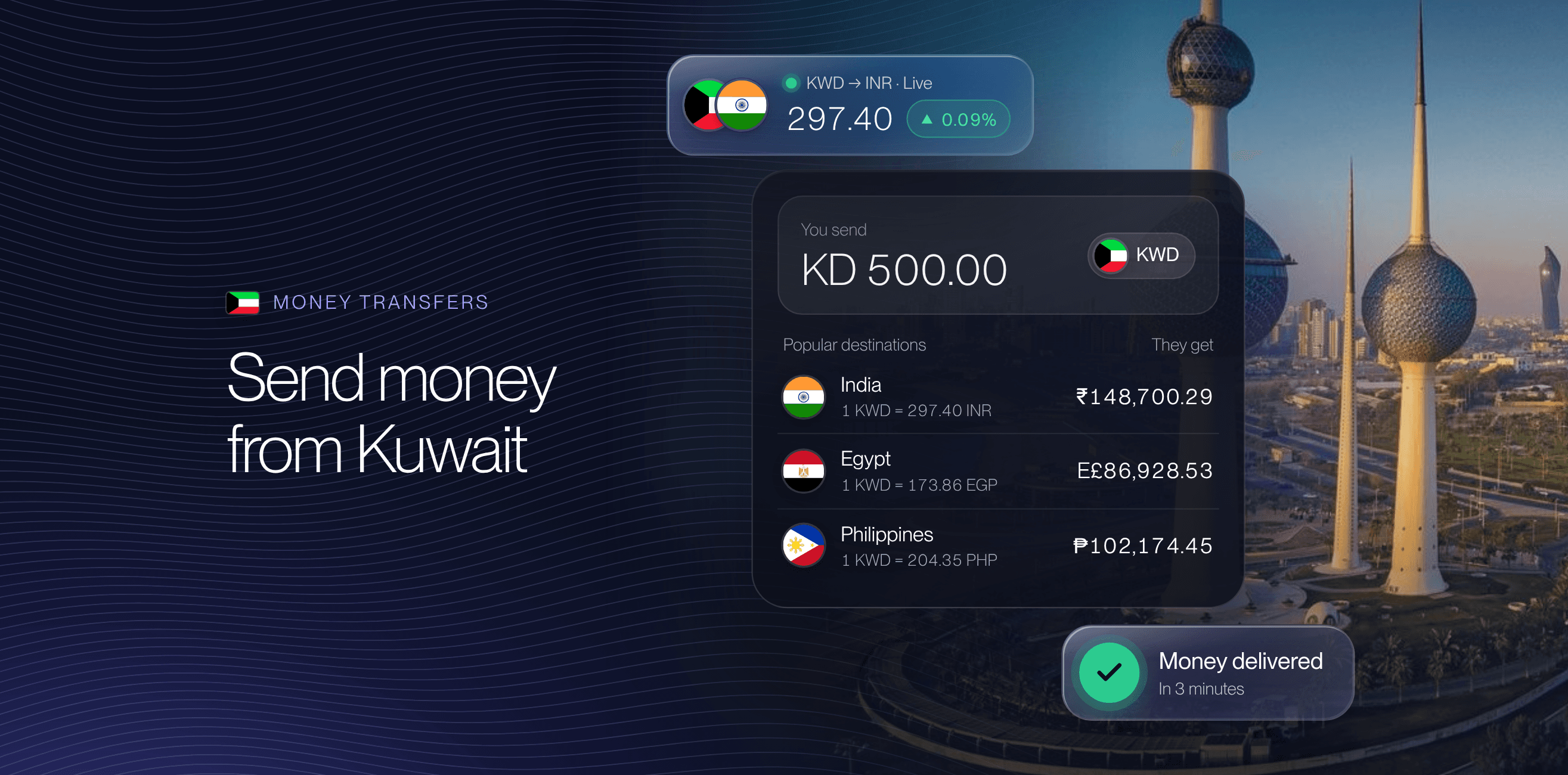
How to Send Money From Kuwait

To send money from Kuwait, most people use a licensed exchange company, which charges a fee of about KD 1 to KD 1.25 per transfer plus a small margin in the rate. In the World Bank's August 2025 survey, sending KD 65 from Kuwait to India cost an average of 2.37%, and Lulu Money was the cheapest at 1.65%. A bank SWIFT transfer costs far more on small amounts: Boubyan Bank charges KD 11.
The quick answer: Wise, Remitly and Xe do not accept payments in Kuwaiti dinar, so the choice is between an exchange company, usually through its app, and your bank. For regular family transfers, an exchange company app is almost always cheaper. Compare the rate, because on some routes, such as Bangladesh, the margin is far larger than the fee.
This page sets out what exchange companies and Kuwaiti banks charge, what KD 65, KD 300 and KD 1,000 really cost, how long a transfer takes, and the 2026 rules on cash limits and app verification.
Who sends money from Kuwait
Kuwait is one of the world's largest sources of remittances. The World Bank puts personal remittances paid from Kuwait at about $14.17 billion in 2024. Foreign residents made up about 70% of the population of 5.1 million in mid-2025, according to the Public Authority for Civil Information, and most of them send part of their pay home every month.
Indian workers
Indians are the largest community, at about 1.04 million people in mid-2025, or 29% of expatriates. They work in every sector, from construction and retail to health care and engineering, and many are household workers. Family transfers to India, often to Kerala, are the busiest route out of Kuwait.
Because so many people send money from Kuwait to India, the route is competitive, and the World Bank's survey found most exchange companies charging between KD 0.90 and KD 1.25 per transfer.
Egyptian workers
Egyptians are the second largest group, at about 661,000 in mid-2025, or 19% of expatriates. Many work in the private sector and in government roles such as teaching and health. Transfers to Egypt are usually to bank accounts or for cash pickup. The route costs a little more than India: in August 2025 the World Bank found an average fee of KD 1.50 and a margin of about 1%, so comparing two exchange companies before each money transfer from Kuwait to Egypt pays off.
Bangladeshi, Filipino and Sri Lankan workers
Bangladeshis, Filipinos and Sri Lankans are the next largest groups, many of them in household work. PACI counted about 822,800 domestic workers in mid-2025, 16% of the population, and Indians, Filipinos and Sri Lankans were the top nationalities. Domestic workers often send small amounts, so fixed fees matter most to them. A KD 1.25 fee on a KD 50 transfer is 2.5% before the margin, so choosing the cheapest exchange company on the route, and sending a little less often, makes a real difference over a year.
Professionals and Kuwaitis
Western and Arab professionals, and Kuwaiti citizens, also make a money transfer from Kuwait for tuition, property, investments or family abroad. These payments are larger and often go to bank accounts in Europe, the US or the UK, where a bank transfer becomes more competitive. For a money transfer from Kuwait of several thousand dinars, a bank's flat KD 11 fee is a small share, and the deciding factor is the bank's exchange rate against the market rate.
Families paying for study and treatment abroad
Kuwaiti families and long-term residents also transfer money from Kuwait for children studying in the UK, the US, Egypt or India, and for medical treatment abroad. These are larger, less frequent payments, usually to a university or hospital account, so the exchange rate and any intermediary bank fees matter more than the transfer fee.
The rules behind every money transfer from Kuwait
Kuwait has no exchange controls on personal transfers, so you can send your own money abroad freely. The Central Bank of Kuwait supervises banks and exchange companies, and in 2025 and 2026 it tightened the rules on cash, identity checks and how exchange companies operate.
Exchange companies are licensed by the Central Bank
Cross-border remittances are a core business of licensed exchange companies, which need a licence from the Central Bank. In January 2025 the Central Bank told exchange companies to stop commercial, real estate and industrial activities and keep to currency exchange and money transfers. Money exchange shops came under the Central Bank's supervision in 2025 as well.
The Central Bank also inspects how exchange companies set their rates and commissions, and publishes the penalties it imposes on firms that break the rules.
The KD 1,000 daily cash cap
In February 2026 the Central Bank cut the daily cash limit at exchange companies from KD 3,000 to KD 1,000 per customer. The cap covers all transactions, including remittances and currency exchange. It does not limit how much you can send: amounts above KD 1,000 a day must be paid by bank account debit or another non-cash method the Central Bank approves.
Kuwait Mobile ID for online transfers
In April 2026 the Central Bank directed exchange companies to verify customers through the Kuwait Mobile ID app for every online transfer abroad. Exchange companies must link electronically with PACI and keep a record of each verification. The aim is to stop fraudsters using stolen personal details to move money through remittance apps.
In practice, when you send money from Kuwait through an exchange company app, expect a prompt in the Kuwait Mobile ID app to approve the transfer.
A valid Civil ID
Exchange companies and banks need a valid Civil ID to process a transfer, and online transfers now also need Kuwait Mobile ID. If your residency has expired or is being renewed, you may not be able to send money from Kuwait until your Civil ID is valid again, so plan larger transfers around your renewal date.
Keeping records
Keep the receipt or app confirmation for every transfer. If a payment goes astray, the reference number is how the exchange company traces it, and if you are ever asked to show where money came from, a record of regular transfers that match your salary is the simplest proof. Most apps keep a full history, so download it before you change phones or leave Kuwait.
No remittance tax
Parliamentary committees have debated a tax on expatriate remittances several times since 2018, with proposed rates of up to 5%, but the proposals have not become law. There is no tax on sending money from Kuwait.
What exchange companies and banks charge
Exchange companies charge a flat fee per transfer, usually KD 0.90 to KD 1.25 for family amounts, plus a margin in their exchange rate. Banks charge much higher flat fees for SWIFT transfers, but can suit larger payments to bank accounts in Europe or North America.
Provider | Fee | Exchange rate margin | Total cost on KD 65 to India |
|---|---|---|---|
Lulu Money, agent | KD 0.90 | 0.27% | 1.65% |
Aman Exchange, online | KD 1.00 | 0.55% | 2.09% |
Al Mulla Exchange, online | KD 1.25 | 0.35% | 2.27% |
Western Union | KD 1.25 | 0.59% | 2.51% |
Al Muzaini Exchange, agent | KD 1.25 | 1.09% | 3.01% |
KD 1.17 | 0.57% | 2.37% |
Exchange companies
The World Bank's August 2025 survey of the Kuwait to India route found fees between KD 0.90 and KD 1.25 at every exchange company it checked, with margins from 0.27% to 1.09%. Lulu Money was the cheapest at 1.65% on KD 65, and Al Muzaini Exchange the most expensive at 3.01%, mainly because of its wider margin.
Many exchange companies also charge the same fee online and at the counter, but quote different rates on each, so check the rate in the app against the branch before you send.
Kuwaiti banks and SWIFT fees
Banks charge a flat fee for an international SWIFT transfer. Boubyan Bank charges KD 11 for a foreign currency transfer, plus KD 5 coverage fees where they apply. NBK's Weyay tariff lists KD 11 for a direct transfer in the same foreign currency. Gulf Bank charges KD 9, or KD 12 if you want the correspondent bank's fees covered.
On KD 65 a KD 11 fee is 17% of the amount. On KD 5,000 it is 0.2%. Bank transfers make sense for large payments to bank accounts, such as tuition or a property deposit, and little sense for small family transfers.
Paying by K-Net or bank debit
Exchange company apps take payment by K-Net debit card or by debit from your bank account. Paying online avoids the KD 1,000 daily cash cap and the branch queue. Your Kuwaiti bank does not usually charge for a K-Net payment to an exchange company, so the fee and margin you see in the app are the whole cost on the Kuwait side.
The exchange rate margin
Every exchange company and bank converts dinar at its own rate. The World Bank measures the margin against the market rate: on the India route it averaged 0.57% in August 2025, but on the Bangladesh route it averaged 4.84%. The fee is shown upfront, but the margin is not, so compare the amount the recipient will get.

Hidden extras
For cash pickup, check whether the receiving agent charges anything. For bank transfers, intermediary banks can deduct fees, which is why Gulf Bank prices the OUR option at KD 12 instead of KD 9. Some exchange companies offer faster delivery for a higher fee, so check the speed you are paying for before you transfer money from Kuwait.
The best ways to send money from Kuwait
For most people, the best way to send money from Kuwait is a licensed exchange company's app. A Kuwaiti bank is the better choice only for large transfers to bank accounts.

Exchange company apps
Most large exchange companies, including Al Mulla Exchange, Bahrain Exchange Company, Al Muzaini, Lulu Money and Aman Exchange, offer apps that send to bank accounts, mobile wallets and cash pickup. The head of the Kuwait Federation of Exchange Companies said in 2026 that most customers now send through these apps. Online transfers to India often arrive within an hour.
Apps also let you pay without cash, which matters now that cash payments at exchange companies are capped at KD 1,000 a day.
Choosing an exchange company
The cheapest exchange company changes by route and by delivery method, so there is no single best choice for every money transfer from Kuwait. On the India route in August 2025, Lulu Money was cheapest through its agents, Aman Exchange's slower online option came next, and Al Mulla Exchange's online service was close behind.
Exchange company branches
Branches are still busy, especially at the start of the month when salaries are paid. They suit people who prefer to pay cash or need help with a first transfer. Bring your Civil ID, and expect queues around payday and before Eid.
Bank transfers
A bank SWIFT transfer suits large payments to a bank account, such as tuition, a mortgage or savings moved to a European or US account. Fees are flat, so they are a small share of a large amount, and the money goes directly from your account without a cash step.
Wise, Remitly and Xe
Wise, Remitly and Xe are widely used to send money to India, Egypt and the Philippines, but none of them accepts payments in Kuwaiti dinar from senders in Kuwait. If you hold money in an account abroad, you can use them from that account.
Which option for which transfer
Situation | Best fit | Why |
|---|---|---|
Monthly family transfer to India, Egypt or the Philippines | Exchange company app | Fees of about KD 1 and margins under 1% on most routes |
Cash pickup for a relative without a bank account | Exchange company branch or app | Wide payout networks |
Transfer above KD 1,000 | Exchange company app paid by bank debit, or a bank | Cash is capped at KD 1,000 a day |
Tuition or a property payment in Europe or the US | Bank SWIFT transfer | Flat fee is small on a large amount |
Domestic worker sending KD 50 to KD 100 | Cheapest exchange company on the route | Every fil of fee counts on small amounts |
Read our guide to international wire transfer fees for how bank transfers are priced elsewhere.
How much a money transfer from Kuwait costs
The cost of a money transfer from Kuwait has two parts: the fee and the margin. The table uses the fees and margins the World Bank recorded for Al Mulla Exchange's online service on the India route in August 2025, and Boubyan Bank's published SWIFT fee, which comes before its own margin.
Amount sent | Exchange company fee and margin | Share | Bank SWIFT fee alone | Share |
|---|---|---|---|---|
KD 65 | About KD 1.48 | 2.3% | KD 11 | 16.9% |
KD 300 | About KD 2.30 | 0.8% | KD 11 | 3.7% |
KD 1,000 | About KD 4.75 | 0.5% | KD 11 | 1.1% |
Sending KD 65
KD 65, about $200, is the amount the World Bank uses to compare providers. At Al Mulla Exchange online, the KD 1.25 fee and 0.35% margin come to about KD 1.48, or 2.3%. Lulu Money's agent service came to 1.65%. A bank's KD 11 fee would take 17% before its margin.
Small transfers are where the choice of provider matters most. If you send KD 65 every month, a provider 1% cheaper saves about KD 8 a year.

Sending KD 300
On KD 300 the exchange company fee is the same KD 1.25, and the margin about KD 1.05, so the total is about 0.8%. A bank's KD 11 fee is 3.7% before its margin. For a typical monthly salary transfer, an exchange company app is the clear choice.
Sending KD 1,000
On KD 1,000, about KD 4.75 goes in fees and margin at an exchange company, about 0.5%. A bank's KD 11 fee is about 1.1%, but some banks may offer a better rate on a large amount. Above KD 1,000 in a day, pay the exchange company by bank debit rather than cash. Our guide to transferring large sums internationally covers what else to check.
When the margin matters more than the fee
On some routes the margin is far larger than the fee. The World Bank found an average margin of 4.84% on the Bangladesh route in August 2025, against 0.57% for India. On KD 300 to Bangladesh, a 4.84% margin is about KD 14.50, more than ten times the fee. Comparing two or three exchange companies on the taka amount received is the only way to see it.
Delivery method changes the price
The same exchange company can charge differently depending on how the money is paid and collected. On the India route in August 2025, Aman Exchange charged KD 1.00 for an online transfer arriving in three to five days, and KD 1.25 for one arriving in under an hour. Al Mulla Exchange's margin was 0.35% online and 0.45% through its agents. A slower, online money transfer from Kuwait is often the cheapest.
Comparing the amount received
Exchange companies show the fee clearly, but the margin is built into the rate. The only fair comparison is the amount the recipient will get for the same dinar amount. Enter the same figure, say KD 300, in two or three apps on the same morning and compare the rupees, pounds or pesos they show. A difference of 0.5% in the rate is worth KD 1.50 on KD 300, more than most fees.
What the gap costs over a year
For a worker sending KD 300 home every month, an exchange company app costs about KD 28 a year in fees and margin. The same transfers by bank SWIFT would cost KD 132 a year in fees alone. Over a five-year contract, the difference is more than KD 500.
How long a money transfer from Kuwait takes
Most exchange company transfers on the busy routes arrive within an hour or the same day. Bank SWIFT transfers take longer.
Method | Typical time | Notes |
|---|---|---|
Exchange company app to India | Under 1 hour | Many routes deliver the same day |
Exchange company cash pickup | Under 1 hour to same day | Recipient needs ID |
Bank SWIFT transfer | 1 to 3 business days | Longer through intermediary banks |
Exchange company transfers
The World Bank's survey listed most exchange company services from Kuwait to India as arriving in under an hour, and a few cheaper online options as taking three to five days. MoneyGram and Kuwait India International Exchange delivered cash the same day. Choose the speed you need, because the fastest option is not always the cheapest.

Bank SWIFT transfers
A SWIFT transfer from a Kuwaiti bank usually reaches a major currency account within one to three business days. The Commercial Bank of Kuwait, for example, notes that transfers to international banks above KD 25,000 made after 3:30 pm go the next business day. Weekends in Kuwait fall on Friday and Saturday, which can add days.
Payday and Eid
Exchange companies are busiest in the first days of each month, when salaries are paid, and before Eid. Branch queues are long and some apps slow down. Sending a day or two before or after the rush, or through the app early in the morning, usually gets the transfer through faster.
What slows a transfer down
The usual causes are a name that does not match the recipient's ID or account, a wrong account number, a failed Kuwait Mobile ID check, or a compliance review of an unusual payment. Our guide to how long a money transfer takes explains the other common delays.
Around Eid and at the start of each month, exchange company branches are busiest. Sending through the app avoids the queues.
Tracking a transfer
Exchange company apps show the status of each transfer and give a reference number. For cash pickup, the recipient needs that number and their ID. If a bank deposit has not arrived when promised, contact the exchange company with the reference before you send again, so the money is not sent twice.
How to send money from Kuwait step by step
The steps are similar at every exchange company. You need a valid Civil ID, the recipient's details and a way to pay.
What you need
- Your Civil ID, and the Kuwait Mobile ID app for online transfers
- The recipient's full name as on their ID, and their bank account, wallet number or pickup city
- For bank deposits: the bank name, account number or IBAN, and the IFSC or SWIFT code
- A K-Net card or bank account to pay online, or cash for amounts up to KD 1,000 a day
Check the details twice. Read what an IBAN is if the recipient is in Europe or Egypt.
With an exchange company app
- Download the app of a licensed exchange company and register with your Civil ID.
- Verify your identity through the Kuwait Mobile ID app.
- Add the recipient and choose bank deposit, wallet or cash pickup.
- Enter the amount and check the rate, fee and amount the recipient will get.
- Pay by K-Net or bank debit.
- Approve the transfer in Kuwait Mobile ID and keep the reference.
Compare the quote with one or two other apps before you pay, especially on routes with wider margins.
From your Kuwaiti bank
- Log in to online banking or visit a branch.
- Choose an international transfer and add the beneficiary's bank details and SWIFT code.
- Choose who pays the charges, and check the fee and rate.
- Approve the transfer and keep the reference.
Bank transfers are best for large amounts to accounts in your own name or to institutions. Ask the Kuwaiti bank for the exchange rate before you approve, because it is not shown as a fee.
Using your bank's app for a large transfer
For a large transfer to an account in Europe, the UK or the US, a Kuwaiti bank's app can be the simplest route. Check the exchange rate the app shows against the market rate, choose who pays the charges, and confirm the beneficiary's IBAN and SWIFT code carefully. For very large amounts, ask the bank whether it can offer a better rate than the standard one shown in the app.
Sending to a mobile wallet or for cash pickup
Many exchange companies pay out to mobile wallets in the Philippines, Bangladesh and Pakistan, and for cash pickup in most countries. Wallet transfers are usually fast and cheap. For cash pickup, give the recipient's name exactly as on their ID, or the payout agent will refuse it.
Sending a large money transfer from Kuwait
For a large amount, such as end-of-service benefits when you leave Kuwait, ask your bank and two exchange companies for a quote on the same day. Pay by bank transfer rather than cash, keep the documents that show where the money came from, and expect extra checks on unusual amounts.
Limits, cash and checks when you send money from Kuwait
Beyond the KD 1,000 cash cap and Mobile ID checks, a few more rules apply to anyone who wants to send money from Kuwait or carry cash.
Carrying cash out of Kuwait
Travellers entering or leaving Kuwait must declare cash and financial instruments worth KD 3,000 or more, in any currency, and gold and high-value items. Since February 2026 you can declare electronically through the Sahel app. Customs has warned that splitting cash between family members or bags to avoid declaring it is a violation.
Compliance checks on transfers
When you transfer money from Kuwait, exchange companies must check you and the source of funds under Kuwait's anti-money laundering law, and the Central Bank has stepped up its inspections. Large or unusual transfers can be held while the company asks questions, so keep salary slips or bank statements ready. Sending regular amounts that match your salary rarely causes problems, while a sudden large transfer, or several transfers on the same day to different people, is more likely to be checked.
How to transfer money from Kuwait when you leave for good
Before you leave Kuwait for good, move your savings and end-of-service benefits while your Civil ID and bank account are still active. A bank transfer to your own account at home, or an exchange company transfer paid by bank debit, avoids the cash cap and the customs declaration.
Sending only your own money
Exchange companies must check where the money comes from. Sending money on behalf of other people, or pooling cash from friends to send in one transfer, can trigger questions and even refusal. Send your own money from your own account, and keep salary slips for larger amounts.
Is it safe to send money from Kuwait?
Yes, when you use a licensed exchange company or bank. Both are supervised by the Central Bank of Kuwait, and transfers through them are recorded and traceable.
Who regulates money transfers in Kuwait
The Central Bank of Kuwait licenses and supervises banks and exchange companies, and since 2025 also money exchange shops. It sets rules on capital, anti-money laundering checks, cash limits and customer verification, and publishes penalties against firms that break them.
Scams that target senders in Kuwait
Common scams include fake exchange company apps and websites, messages that ask you to share a verification code, and calls from people posing as bank or exchange company staff. The Kuwait Mobile ID rule was introduced partly to stop impersonation fraud, where stolen details are used to send money through remittance apps.
Never share your PIN, password or verification codes, and only download apps from the official app store links on the exchange company's website.
Simple rules that protect you
Only send money from Kuwait to people you know, through a licensed exchange company or bank. Confirm new account details by phone on a number you already have, and approve Mobile ID requests only for transfers you started yourself.
What to do if a transfer goes wrong
If money has not arrived, contact the exchange company or bank with the reference number. If you sent it to the wrong account, ask at once for a recall, because it only works before the money is paid out. Keep every receipt, since the company needs them to investigate.
Top destinations for a money transfer from Kuwait
The routes people use most for a money transfer from Kuwait follow the largest expatriate communities: India, Egypt, Bangladesh, the Philippines, Pakistan, Sri Lanka and Nepal.
Choosing how the money arrives
A money transfer from Kuwait can arrive in a bank account, a mobile wallet, or as cash. Bank deposits suit regular family support, wallets suit small amounts to the Philippines, Bangladesh and Pakistan, and cash pickup suits relatives without an account. Ask the recipient which works best for them before you choose a provider, because the cheapest option depends on it.
Kuwait to India
India is the busiest route. The World Bank's August 2025 survey found an average cost of 2.37% on KD 65, with Lulu Money cheapest at 1.65% and most exchange companies under 2.7%. Many transfers to Indian bank accounts arrive within an hour. Most exchange companies pay to Indian bank accounts using the IFSC code, so ask the recipient for it. See the Kuwait to India route.
Kuwait to Egypt
Egyptians are the second largest community. The average cost of sending KD 65 to Egypt was 3.33% in August 2025, with a fee of KD 1.50 and a margin of 1.02%. Families receive in bank accounts or as cash. Egyptian bank accounts use an IBAN, so ask the recipient for it and check it carefully before you send money from Kuwait to Egypt. See the Kuwait to Egypt route.
Kuwait to Bangladesh
Bangladesh is one of the most expensive routes from Kuwait, mainly because of the rate. The average cost of sending KD 65 was 6.63% in August 2025, with a margin of 4.84%. Compare the taka amount received at two or three exchange companies every time. See the Kuwait to Bangladesh route.
Kuwait to the Philippines
Many Filipinos in Kuwait are household workers who send small, regular amounts. The average cost of sending KD 65 was 2.94% in August 2025, and Western Union was among the cheapest at about 2.2%. Payouts to wallets and banks are usually fast. Many Filipino workers send money from Kuwait straight to an e-wallet, which family members can spend or cash out at home. See the Kuwait to Philippines route.
Kuwait to Pakistan
Pakistan is one of the cheapest routes the World Bank tracks from Kuwait, with an average cost of just 0.35% in August 2025, because fees on the route are very low. Transfers arrive in bank accounts and wallets, often within minutes. See the Kuwait to Pakistan route.
Kuwait to Sri Lanka
Sri Lankans are one of the largest groups of household workers in Kuwait. Exchange companies with partners in Sri Lanka pay out to bank accounts and for cash pickup. Many send small amounts after each monthly salary, so the cheapest exchange company on the route saves a real share over a year, and paying through the app avoids the branch queues on payday. Compare the rupee amount received, because margins vary between companies. See the Kuwait to Sri Lanka route.
Kuwait to Nepal
Many Nepalis work in Kuwait and send money home to families who often collect cash. Choose an exchange company with a good payout network in Nepal and compare the rupee amount. If the recipient has a bank account, ask whether a deposit suits them, because it saves a trip to a payout agent and the queue that often comes with it. See the Kuwait to Nepal route.
Bottom line
No online specialist takes dinar from senders in Kuwait, so a money transfer from Kuwait goes through a licensed exchange company or a bank. For family amounts, an exchange company app wins easily, with fees of about KD 1 and margins under 1% on most routes. Bank SWIFT transfers only make sense for large payments to bank accounts.
The one rule: compare the amount the recipient will get, not the fee, especially on routes such as Bangladesh where the margin is large. Use the international money transfer comparison guide and the comparison tool on this page before you send money from Kuwait.
Related guides
- What is the mid-market exchange rate?: the benchmark every quote should be measured against
- What is a remittance?: how family transfers work
- Remittance vs wire transfer: the difference between an exchange company and a bank transfer
- Fastest way to send money internationally: when speed matters most
- Send money from Pakistan: the same guide for senders in Pakistan
Sources
- World Bank: Remittance Prices Worldwide, Kuwait to India
- World Bank: Remittance Prices Worldwide, Kuwait to Egypt
- World Bank: Remittance Prices Worldwide, Kuwait to Bangladesh
- World Bank: Remittance Prices Worldwide, Kuwait to Philippines
- World Bank: Remittance Prices Worldwide, Kuwait to Pakistan
- World Bank: Personal remittances paid
- Boubyan Bank: Tariff list, November 2025
- Weyay by NBK: Tariff list
- Gulf Bank: Fees and charges
- Commercial Bank of Kuwait: Transfers outside CBK
- Central Bank of Kuwait: Instructions for exchange companies
- Gulf News: Kuwait caps cash transactions at exchange firms to KD 1,000 a day
- ARY News: Kuwait Mobile ID for online overseas transfers
- Arab Times: Central Bank orders exchange companies to cease non-exchange activities
- Arab Times: Declare cash over KD 3,000 via the Sahel app
- Kuwait Times: Kuwait population tops 5 million
- Times Kuwait: Population and domestic workers, mid-2025