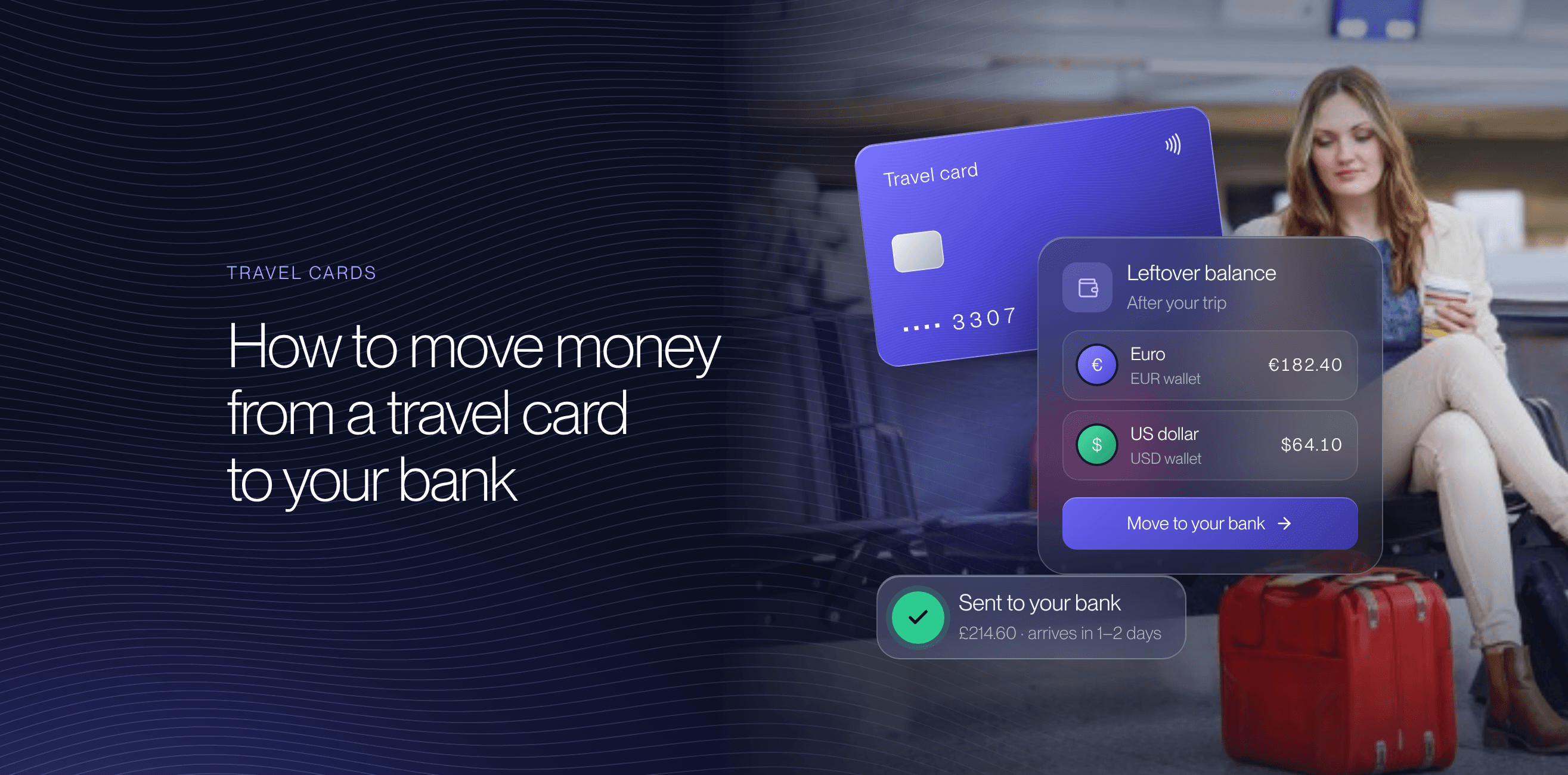
How to Move Money from a Travel Card to Your Bank (2026)

A travel card will not send a bank transfer the way a current account does. To move money from a travel card back to your bank, you ask the card company to cash out the balance, or encash it in India, and it pays the money into an account in your own name.
That costs less than people fear and more than it should. UK cards charge from nothing to £6 to cash out, SBI and Axis Bank ₹100 plus GST, and the bigger cost is the exchange rate used to turn leftover euros or dollars back into pounds or rupees.
This guide covers every route by card and by market: the Post Office, Travelex, Hays Travel and Caxton cards in the UK, the HDFC Bank, ICICI Bank, Axis Bank and SBI forex cards in India with the RBI rules on unspent currency, how to load a card in the first place, and the cheapest way back.
Can You Transfer Money from a Travel Card to a Bank Account?
Yes, but not as a normal transfer. A prepaid travel card has no sort code or account number, so it cannot send a payment. Instead you ask the issuer to cash out the balance, and it pays the money into a bank account in your own name, in pounds or rupees, after any fee and at its own exchange rate.
Why a Travel Card Cannot Send a Bank Transfer
A travel money card is a prepaid Mastercard or Visa card. It can pay shops and withdraw cash, but it sits outside the bank payment systems: there is no sort code, account number or IBAN for Faster Payments or SEPA to send from, so the only way out is a payout the issuer arranges itself.
That is also why issuers pay out only to the cardholder. Travelex and Hays Travel repay only to a UK bank or building society account in your name, and the Post Office pays redeemed funds only to the cardholder, never to a third party.
Your Legal Right to Get the Money Back
In the UK the money on a travel card is electronic money. The Electronic Money Regulations 2011 require the issuer to redeem it at par value, at any time, when you ask. A fee is allowed only if the contract states it and you redeem before the contract ends or more than a year after, and it must reflect the issuer's actual costs.
India has a similar rule for forex cards. An RBI circular of April 2012 tells issuers to redeem the unused balance immediately when a resident Indian asks, rather than making customers wait 10 days. The bank may hold back unsettled payments, up to US$100 for transactions in the pipeline, and its fees and taxes.
Credit Cards and Debit Cards Work Differently
If the card you took abroad is a debit card on a current account, the money never left your bank, so there is nothing to cash out. If it is a credit card, taking money off it counts as a cash advance or a money transfer, with fees and interest, and our guide to transferring money from a credit card to a bank account covers those options.
Paying money onto someone else's card is a job for transfer services, and our guide on how to send money to a debit card covers it.

Everything below is about the prepaid kind, loaded before a trip and emptied after it.
How to Transfer Money from a Travel Card in the UK
UK travel cards pay leftover money back to a UK bank account in your name, in pounds, after you ask online or by phone. The Post Office lists no cash out fee. Travelex and Hays Travel charge £6 and Caxton £1.50, but only if you cash out before the card expires or more than a year after it does.
Card | How to cash out | Cash out fee | Paid in | Inactivity fee |
|---|---|---|---|---|
Post Office Travel Money Card | Online, phone or at a Post Office | None listed | Pounds | £2 a month from 12 months after expiry |
Travelex Money Card | Phone, or ask in store | £6 by phone | Pounds or a card currency | £2 a month after 12 months unused |
Hays Travel card | Phone or a Hays Travel branch | £6 | Pounds or a card currency | £2 a month after 18 months unused |
Caxton Currency Card | Online, Withdraw balance | £1.50 | Pounds | £2 a month after 12 months inactive |
Wise card | Send from the balance in the app | £0 for pounds to a UK account | Pounds, at mid-market | None |
Cash out fees at Travelex, Hays Travel and Caxton apply before the card expires or more than 12 months after expiry. From each issuer's terms and conditions, fee pages and FAQs, and Wise's price data, checked 5 November 2026.
Post Office Travel Money Card
The Post Office card holds up to 22 currencies and is issued by First Rate Exchange Services, a joint venture of the Post Office and Bank of Ireland UK. You can redeem all or part of the balance by logging into your online account, calling customer services or emailing, and after an identity check the money is paid in pounds to the bank account you nominate.
Its terms list no redemption fee. Every currency is converted to pounds at the rate quoted when you ask, and payment can take up to 12 business days. You can also withdraw the balance at a Post Office, but a UK cash withdrawal costs £1.50 and the money first moves to the pound wallet at the Post Office's currency swap rates.
Travelex Money Card
To move money from a Travelex Money Card to a bank account, call Card Services. Travelex repays only to a UK bank or building society account in your name, in pounds or in any currency on the card, and some Travelex stores will cash out over the counter, with a fee you have to check in store.
The phone cash out fee is £6.00, charged if you cash out before the card expires or more than 12 months after it expires, so the year after expiry is free. The agreement ends on the expiry date, and Travelex does not return the balance automatically.
Hays Travel Card
The Hays Travel card, sold as the Hays Travel Money Currency Card, is still on sale in 2026. It holds 22 currencies, is open to UK residents aged 18 and over, and is issued by PrePay Technologies, the e-money firm behind the Travelex Money Card, so the cash-out terms are almost identical.
To get your money back, call Card Services or visit a Hays Travel branch, though not every store offers the service. The cash out fee is £6 either way, charged before expiry or more than 12 months after it. By phone you can take pounds or a currency on the card, paid only to a UK account in your name.
Caxton Currency Card
Caxton holds 15 currencies and lets you withdraw the balance yourself: log in on the web, choose Withdraw balance once pending transactions have cleared, and add your bank details if asked. Any foreign currency you unload is exchanged at Caxton's current buyback rate, not the rate you loaded it at.
Its terms set a redemption processing fee of £1.50, charged before the card expires or more than a year after the agreement ends. Caxton also charges £1.50 for each card payment and cash withdrawal in the UK, so spending the balance at home is not free either.
Step by Step: Cashing Out to Your UK Bank Account
Whichever card you hold, this order avoids most delays and a second fee.

- Wait for pending payments to clear: hotel and car hire deposits can sit on the card for days, and issuers pay out only what is left once they settle.
- Spend small leftovers first: a few pounds are cheaper spent than cashed out for a fixed fee.
- Check the expiry date: cashing out in the 12 months after expiry avoids the £6 Travelex and Hays Travel fee and Caxton's £1.50.
- Have your sort code and account number ready: the account must be in your name, and our list of the bank details needed for a transfer shows what to give.
- Ask for the rate before you confirm: Travelex and the Post Office quote their rate when you request the cash out, so compare it with the mid-market rate on the day.
If the card holds several currencies, cash them all out in one request, because each request can carry its own fee.
What Cashing Out Costs: The Cash Out Fee and the Buy-Back Rate
Getting money back from a travel card costs two things: a fixed cash out fee of £0 to £6 in the UK or up to ₹100 plus GST per currency in India, and the gap between the issuer's buy-back rate and the mid-market rate. The rate gap usually costs more: on €300, each 1 percent is about £2.50.
The fee is printed in the terms; the margin is not. None of the four UK travel card issuers in this guide states its buy-back margin as a percentage, and the cash-out rate is quoted when you ask. That makes the mid-market exchange rate your yardstick: check it on the day, then compare it with the rate you are offered.
The Buy-Back Rate on Leftover Currency
Travel card companies earn in both directions. They sell you currency at one rate when you load the card and buy back what is left at a lower one, and the difference is their margin. Caxton's terms spell it out: unloaded currency is exchanged at the current buyback rate, not the rate at which it was loaded. Our explainer on exchange rate markups shows how to work out the percentage from any quote.
Indian banks publish their card rates, which shows the size of the gap. At 9:36 am on 5 November 2026, SBI's forex card rates bought US dollars back at ₹93.98 and sold them at ₹95.07, a round-trip spread of about 1.15 percent. For euros the gap was 2.75 percent and for pounds 2.5 percent, so the currency you hold matters as much as the card.

A spread never shows up as a line on a receipt. It simply means fewer pounds or rupees land in your account.
A Worked Example: €300 Left After a Trip
Take €300 left on a card after a holiday, worth £250.23 at the mid-market rate on 5 November 2026. The fixed fee is the only cost you can price in advance, so the table shows what each route pays before the issuer's rate spread is taken off.
Route | Fixed fee | You get before any rate spread | Rate used |
|---|---|---|---|
Wise: convert in the app, then withdraw | €1.43 conversion fee | £249.04 | Mid-market, no spread |
Post Office: redeem online | None listed | £250.23 | Post Office rate on the day |
Caxton: Withdraw balance | £1.50 | £248.73 | Caxton buyback rate |
Travelex: cash out by phone | £6.00 | £244.23 | Travelex rate on the day |
Hays Travel: cash out by phone or in branch | £6.00 | £244.23 | Hays Travel rate on the day |
Mid-market rate €1 = £0.8341 and Wise's conversion fee from Wise's price data, checked 5 November 2026. Card fees from each issuer's terms, charged before expiry or more than 12 months after it. Card issuers do not state their buy-back spreads, so they are not included: each 1 percent of spread takes about £2.50 off €300.
The table flatters the card issuers, because their spread is missing. A Post Office redemption with no fee would still lose £7.51 if its rate sat 3 percent below mid-market, more than the whole £6 Travelex cash out fee. Ask for the rate before you decide.
Taking the Balance in Euros or Dollars Instead
Travelex and Hays Travel will pay the balance by phone in a card currency, which skips their buy-back rate, but a pound account then converts it at your bank's rate. UK banks that publish a margin on international payments put it at 2.2 percent at HSBC UK and 3.55 percent at Lloyds on smaller sums, which would be £5.51 to £8.88 on €300 if your bank applied the same margin.
Some banks also charge to receive a payment from abroad, so this route only makes sense if you hold a euro or dollar account to receive the money. Our guide to receiving money from abroad lists those fees bank by bank.
How to Transfer Money from a Forex Card to a Bank Account in India
In India you encash a forex card at the bank that issued it, at a branch or online, and it pays the balance in rupees into your own account at its card buying rate. SBI and Axis Bank charge ₹100 plus GST to encash, HDFC Bank and ICICI Bank list no encashment fee, and GST on the currency conversion applies.
Card | How to encash | Encashment fee | Rate used | Spending a currency not loaded |
|---|---|---|---|---|
HDFC Bank Multicurrency ForexPlus | Refund form; paid to your account or by NEFT | None listed | Bank's rate on the day | 2% |
ICICI Bank Forex Prepaid Card | Branch or online | None listed | Bank's rate on the day | 3.5% plus GST |
Axis Bank Multi-Currency Forex Card | Any Axis branch | ₹100 plus GST per currency | Card rate | 3.5% |
SBI Foreign Travel Card | SBI branch | ₹100 plus GST per request | Card buying rate | 3% plus GST |
Niyo card | Already rupees in a savings account | Not needed | Visa rate when you spend | No markup |
From each bank's fee page, schedule of charges, FAQs or refund form, checked 5 November 2026. GST is 18 percent on fees. HDFC Bank's published schedule puts GST on the currency conversion at 0.18 percent of the amount up to ₹1 lakh, minimum ₹45, on loads and refunds.
HDFC Bank and ICICI Bank
HDFC Bank's Multicurrency Platinum ForexPlus card holds 22 currencies. To encash it, fill in the forex card refund form for a full or partial refund, and the rupees go to your HDFC Bank account or by NEFT to another bank on the next business working day. The fee page lists no encashment charge, but GST on the conversion applies.
ICICI Bank lets you claim a full or partial refund through a branch or online, and its schedule of charges lists no refund fee. The bigger ICICI cost comes earlier: paying in a currency not loaded on the card costs 3.5 percent plus GST, and moving money between currency wallets 2.5 percent.
Axis Bank and SBI
Axis Bank encashes its Multi-Currency Forex Card at any Axis branch, whichever branch issued it, once you are back in India. Bring the refund form and a copy of your passport, and make sure your last card transaction was more than 10 days earlier. Encashment costs ₹100 plus GST for each currency on the card, converted at the bank's card rate.
SBI's Foreign Travel Card holds up to nine currencies and charges ₹100 plus GST per refund or cash-out request. SBI publishes its forex card rates, so here is what USD 500 left on the card turned into on 5 November 2026.
Step | Amount |
|---|---|
USD 500 at SBI's card buying rate of ₹93.98 | ₹46,990.00 |
Refund fee, ₹100 plus 18% GST | minus ₹118.00 |
GST on the currency conversion, 0.18% | minus ₹84.58 |
Paid into your account | ₹46,787.42 |
Value at the mid-market rate of ₹94.5148 | ₹47,257.40 |
Total cost of encashing | ₹469.98, about 1% |
SBI forex card rates published at 9:36 am on 5 November 2026 for transactions of ₹10 lakh to ₹20 lakh; SBI prices smaller amounts at the branch, so treat the rate as a reference. GST on the conversion uses the slab HDFC Bank publishes. Mid-market rate from Wise the same day.
Load the same $500 before a trip and bring it all back unspent, and the round trip costs about ₹892 once SBI's ₹95.07 selling rate, the ₹50 plus GST reload fee and GST on both conversions are counted: close to 2 percent on a card you never used.
Niyo and Zero-Markup Debit Cards
The Niyo card works differently. It is a debit card on a digital savings account with DCB Bank or SBM Bank (India), loaded in rupees by IMPS, NEFT or UPI, and it converts each payment abroad at the Visa rate with no forex markup. Unspent money is already rupees, so there is nothing to encash.
Wise does not issue its card to residents of India. Paying fees or rent abroad is a separate job that goes through your bank under the LRS, and our guide on how to send money abroad from an Indian bank compares SBI, HDFC Bank and ICICI Bank.
The RBI Rules on Unspent Foreign Exchange
Under FEMA rules, a resident individual must surrender unspent foreign exchange to an authorised dealer within 180 days of returning to India, and may keep up to US$2,000 in notes and travellers cheques for a later trip. Banks treat card balances more flexibly.
Axis Bank tells cardholders they can keep the card and reload it for the next trip, and ICICI Bank says you may keep the balance as per the regulations, while recommending a refund for rate clarity. If no trip is planned within six months, encash it.
Can You Send Money from a Forex Card to Someone Else?
No. You can get money from a forex card only as a refund to you, in rupees, in India. HDFC Bank's refund form asks you to declare that you are a resident Indian entitled to the refund, and Axis Bank encashes only after you return. You cannot send money from a forex card to another person's account: it comes back to you first.
The same is true of a UK travel card. If the goal is to put money in someone else's account, or to move money from a forex card to a bank account abroad, encash it to your own account first and send it from there as a normal transfer.
How to Transfer Money to a Travel Card or Forex Card
You load a UK travel card in pounds by debit card or bank transfer, in the app, online or in a branch, and choose the currency at the issuer's rate. In India you load a forex card through net banking, the bank's app or a branch under the Liberalised Remittance Scheme, and TCS applies above ₹10 lakh a year.
Topping Up a UK Travel Card
The fee depends on which currency you load. Foreign currency wallets carry no commission at the Post Office, Travelex and Hays Travel, because the cost sits in the exchange rate. Putting money to a travel card in pounds costs 1.5 percent at the Post Office (£3 minimum, £50 maximum) and 2 percent at Travelex and Hays Travel. Caxton charges nothing.
Card | Ways to load | Fee to load pounds | Minimum load | Maximum balance |
|---|---|---|---|---|
Post Office | App, online or branch | 1.5%, from £3 to £50 | £10 | £10,000 |
Travelex | App, online, store or bank transfer | 2% | £50 in store, £100 online | £5,000 |
Hays Travel | Branch for the first load, then app or online | 2% | £50 per currency | £5,000 |
Caxton | Online, phone or app; first load online | Free | £50 | £12,000 |
From each issuer's terms, FAQs and fee pages, checked 5 November 2026. Foreign currency loads carry no commission but are priced at the issuer's exchange rate.
Load in the currency you will spend. A payment in a currency the card does not hold triggers a foreign exchange fee of 5.75 percent on the Travelex and Hays Travel cards, 3 percent on the Post Office card and 2.49 percent on Caxton. The Travelex and Hays fee is the highest here, so check which currencies a card holds before a multi-country trip.
Loading Money to a Forex Card in India
Indian banks load forex cards through net banking, their apps or a branch, against your passport and PAN. HDFC Bank charges ₹75 plus GST per reload in each currency, SBI ₹50 plus GST, and Axis Bank ₹100 plus GST at a branch and nothing online, where it allows up to USD 10,000 of loads a financial year. Every load of money to a forex card counts towards the LRS limit of US$250,000 a year.
Tax collected at source is the cost people miss. From 1 April 2026, ordinary travel loads fall under other LRS purposes: no TCS on the first ₹10 lakh in a financial year across all your forex cards, remittances and card spending abroad, then 20 percent. Loads for education or medical treatment abroad attract 2 percent above ₹10 lakh.
TCS is a credit against your income tax rather than a fee. Our guide to money transfer limits covers the LRS cap and the other limits on sending money out of India.
Adding Money to a Wise Card
With Wise you add money to the account rather than to the card, and the card spends from it. Adding pounds by UK bank transfer cost nothing on our check, and £500 by debit card cost £1.59. You then convert to the currency you need at the mid-market rate, for about 0.33 percent from pounds to euros, or let the card convert as you pay.
Because both directions use the mid-market rate, the way back costs the same small fee as the way out, with no buy-back spread on top.
The Cheapest Way to Move Money from a Travel Card
The cheapest way is to need fewer cash-outs. Spend the balance down to near zero on the last day, cash out in the year after the card expires when fees are waived, or hold the money where converting back costs well under 1 percent. Wise turned €300 into £249.04 for a €1.43 fee.
Wise: Leftover Currency at the Mid-Market Rate
 Wise9.5
Wise is the one card in this guide built to make the way back cheap. Money left after a trip sits in its own currency balance with no inactivity fee, so you can keep it for the next trip. When you want it home, convert it in the app at the mid-market rate for a small fee, then send the pounds to your UK bank account at no cost.
On 5 November 2026, converting €300 to pounds cost €1.43 and $300 cost $0.99, and sending £500 from a pound balance to a UK bank account was free. Our Wise card review prices the card itself, the full Wise review covers the account and safety, and our Wise vs Revolut comparison sets two app accounts side by side.
Spend It Down or Keep It for Next Time
Small balances are often cheaper to spend than to cash out. A £6 fee on £20 is 30 percent, so use the last of the currency on the final day, on the hotel bill or a meal at the airport.

Keeping the balance for the next trip costs nothing until the inactivity fees start, after 12 months without use at Travelex and Caxton and 18 months at Hays Travel. If the next trip is uncertain, set a reminder for 11 months: one small purchase or top-up resets the clock on all three. The Post Office counts from expiry instead, 12 months after the date on the card.
Sending Leftover Money to an Account Abroad
Sometimes leftover currency is not coming home at all. If you owe a deposit to a landlord in Spain or want euros in a relative's account, cashing out to pounds and sending them back out converts twice. Send from your bank or a specialist in one step instead, and our guide to using Wise to transfer money internationally walks through the first payment.
Compare what the recipient gets before you send, with the fee and the exchange rate included, using the form below.
A Note for US Readers
Hays Travel sells only to UK residents, Travelex and Hays Travel pay out only to UK accounts, and Indian forex cards are for resident Indians, so these cards rarely apply to Americans. The question in the US is usually a foreign currency balance in an app account.
The Wise Multi-Currency Card is issued in the US, except to residents of Nevada. A dollar balance goes to a US bank account for $1.13 on $500, and €300 left after a trip converted to dollars for €1.40 on our check, at the mid-market rate.
Expiry, Inactivity Fees and Leftover Money
Money on a travel card stays yours after the card expires, but issuers do not send it back automatically, and most start charging £2 a month once a card sits unused. The Post Office starts 12 months after expiry, Travelex and Caxton after 12 months without use, and Hays Travel after 18 months.
Card | Inactivity fee | When it starts | Deadline to claim |
|---|---|---|---|
Post Office | £2 a month | 12 months after the card expires | Six years after the account closes |
Travelex | £2 a month | 12 months with no use, including after expiry | Not stated in its terms |
Hays Travel | £2 a month | 18 months with no use, including after expiry | Not stated in its terms |
Caxton | £2 a month | 12 months with no transactions, loads or balance switches | Six years after the agreement ends |
Wise | None | Not applicable | The balance stays in the account |
From each issuer's terms and FAQs, checked 5 November 2026. Travelex, Hays Travel and the Post Office charge nothing on a zero balance.
Inactivity Fees on a Multi-Currency Card
£2 a month sounds small, but it runs until the balance is gone. A forgotten £50 lasts just over two years before the fees take all of it, and £24 a year is more than any cash out fee in this guide. Cashing out or spending to zero stops it, because Travelex, Hays Travel and the Post Office charge nothing on an empty card.
On a multi-currency card the fee is taken in pounds first and then from your other currencies in a set order, at the Mastercard rate on the Travelex card, so a dormant card slowly drains every wallet on it.
What Happens When the Card Expires
Expiry ends the card, not your claim to the money. Travelex's agreement ends on the expiry date and it does not return balances automatically. The Post Office closes the account if the card is not renewed but keeps the balance yours to redeem until six years after closure, and Caxton's limit is also six years.
Indian forex cards last longer: five years for HDFC Bank's Multicurrency card and generally seven for ICICI Bank's. An expired Axis Bank card can still be encashed at any branch, or replaced for a fee.
Is the Money on a Travel Card Protected?
Not by the FSCS. Travel card balances are electronic money, and Travelex's terms say plainly that the card is not covered by the Financial Services Compensation Scheme. Issuers safeguard customer money apart from their own funds instead. Wise works the same way: its UK balances are safeguarded, not FSCS-protected, because Wise Payments Ltd is not a bank.
Travelex's terms go further and warn that if the issuer became insolvent, the money on the card could become unusable, even though it is safeguarded. That is one more reason not to leave a large balance on a card between trips.
Bottom Line
You cannot transfer money from a travel card like a bank account, but you can always get it back. In the UK, ask the issuer to cash out to an account in your name: the Post Office lists no fee, Caxton charges £1.50, and Travelex and Hays Travel £6 unless you wait until the year after expiry. In India, encash at the issuing bank, at its card rate.
The rate costs more than the fee, so spend small balances, cash out larger ones promptly and watch the £2 monthly inactivity fees. Next time, an account that converts back at the mid-market rate removes the cash-out step altogether.
Frequently Asked Questions
How do I transfer money from a travel card to a bank account?
Ask the card issuer to cash out the balance, also called redeeming or encashing it. UK issuers pay it in pounds to a bank account in your name after you ask online or by phone, and Indian banks pay rupees into your account after a refund request at a branch or online. Fees run from nothing at the Post Office to £6 at Travelex and Hays Travel, and ₹100 plus GST at SBI and Axis Bank. The issuer converts any foreign currency at its own rate, which is usually the larger cost.
Can you send money from a forex card to a bank account?
Only to yourself. A forex card cannot make a bank transfer to another person; the bank refunds the unspent balance to you in rupees once you are back in India. HDFC Bank pays the refund into an HDFC Bank account or by NEFT to another bank on the next business working day, and ICICI Bank allows full or partial refunds online or at a branch. To pay someone abroad, encash first and send an outward remittance from your bank account under the LRS.
How do I get money from a Travelex Money Card into my bank account?
Call Travelex Card Services and ask to cash out, or ask in a Travelex store that offers the service. Travelex pays only into a UK bank or building society account in your name, in pounds or in a currency on the card. The phone cash out fee is £6, charged if you cash out before the card expires or more than 12 months after expiry. Travelex tells you its exchange rate before paying you back in pounds, so compare it with the mid-market rate first.
How do I cash out a Hays Travel card?
Call Card Services or visit a Hays Travel branch, though not every store offers cash outs. By phone you can take the balance in pounds or a currency on the card, paid only to a UK account in your name, and in a store you get pounds. The cash out fee is £6 either way, waived if you cash out within 12 months after the card expires. If the card goes unused for 18 months, a £2 monthly inactivity fee starts.
How long does it take to get money from a forex card back into your bank account?
HDFC Bank credits forex card refunds on the next business working day after the request. An RBI circular requires issuers to redeem the unused balance immediately when a resident Indian asks. Banks may hold back up to US$100 and any payments still settling until they clear, and Axis Bank asks that the last card transaction be more than 10 days old. Encash after hotel and car hire deposits have been released, so one request clears the whole balance.
How do I transfer money to a forex card?
Load it through your bank's net banking, mobile app or a branch, paying in rupees from your savings account. HDFC Bank charges ₹75 plus GST per reload in each currency, SBI ₹50 plus GST, and Axis Bank nothing when you reload online. Each load counts towards the LRS limit of US$250,000 a year, and TCS of 20 percent applies to ordinary travel loads above ₹10 lakh in a financial year. GST on the currency conversion is added to each load as well.
How do I add money to a travel card in the UK?
Top up in the card's app or online account with a debit card or bank transfer, or in a branch or store. Load the currency you will spend, because loading pounds costs 1.5 percent at the Post Office and 2 percent at Travelex and Hays Travel, while foreign currency loads carry no commission. Minimum top-ups are £10 at the Post Office, £50 at Hays Travel and Caxton, and £50 in store or £100 online at Travelex. Check the rate shown before you confirm, since that is where the issuer earns on a foreign currency load.
What happens to money left on a multi-currency card after it expires?
It stays yours, but it does not come back by itself. Travelex ends the agreement on the expiry date and asks you to request the balance, and the Post Office keeps it redeemable until six years after the account closes. Most cards charge £2 a month on a balance left behind: the Post Office from 12 months after expiry, Travelex after 12 months unused and Hays Travel after 18. Cashing out in the 12 months after expiry also avoids the £6 Travelex and Hays Travel fee.
Is there a cash out fee on travel money cards?
On most, yes. Travelex and Hays Travel charge £6, Caxton charges £1.50, and the Post Office lists no redemption fee. Travelex, Hays Travel and Caxton charge it only if you cash out before the card expires or more than a year after, which UK e-money rules allow when the fee is in the contract. In India, SBI charges ₹100 plus GST per refund request and Axis Bank ₹100 plus GST per currency.
Do I have to encash a forex card within 180 days?
FEMA rules require a resident individual to surrender unspent foreign exchange within 180 days of returning to India, and you may keep up to US$2,000 in notes and travellers cheques for a later trip. Banks treat card balances more flexibly: Axis Bank says you can keep the card and reload it for your next trip, and ICICI Bank says you may keep the balance as per the regulations. If no trip is planned within six months, encashing is the safer choice. The bank's buying rate on the day you encash applies, not the rate you loaded at.
Sources
- Post Office: Travel Money Card
- Post Office: Travel Money Card terms and conditions (May 2025)
- Travelex UK: Travel Money Card
- Travelex UK: Travelex Money Card terms and conditions (December 2023)
- Hays Travel: Travel Money Card
- Hays Travel: Travel Money Currency Card FAQs, version 8.3
- Hays Travel: Travel Money Card terms and conditions (May 2024)
- Caxton: Mastercard prepaid card terms and conditions
- Caxton Help: Can I have the balance on my Caxton Card refunded to me?
- UK legislation: Electronic Money Regulations 2011, regulation 39 (redeemability)
- UK legislation: Electronic Money Regulations 2011, regulation 41 (fees for redemption)
- Wise: Card fees for UK residents
- Wise: Pricing for sending money
- Wise Help Centre: How much does it cost to send money that's in a Wise account?
- Wise Help Centre: Can I get the Wise card in my country?
- Wise Help Centre: How Wise Payments Ltd safeguards customer funds
- HSBC UK: International payments, fees and exchange rates
- Lloyds Bank: Send an international payment
- HDFC Bank: Multicurrency Platinum ForexPlus card fees and charges
- HDFC Bank: Multicurrency Platinum ForexPlus card terms and conditions
- HDFC Bank: Forex card refund form
- ICICI Bank: Forex prepaid card FAQs
- ICICI Bank: Forex prepaid card schedule of charges
- Axis Bank: Multi-Currency Forex Card
- Axis Bank: Multi-Currency Forex Card fees and charges
- State Bank of India: State Bank Foreign Travel Card
- State Bank of India: Forex card rates
- Niyo: What is a Niyo card for global travels?
- Reserve Bank of India: FEMA (Realisation, Repatriation and Surrender of Foreign Exchange) Regulations, 2015
- Reserve Bank of India: FEMA (Possession and Retention of Foreign Currency) Regulations, 2015
- Reserve Bank of India: A.P. (DIR Series) Circular No. 102, redemption of prepaid card balances (2 April 2012)
- Standard Chartered India: LRS amendment in TCS
- RBL Bank: Tax collected at source on LRS remittances
Mo is the founder of MoneyTransferStore. As an expat who has experienced the challenges of sending money across borders himself, he set out to help others like him avoid hidden fees and unfair exchange rates on international transfers. With a background spanning fintech, payments, and Web3, Mo brings years of practical experience to building a platform focused on transparency and trust.