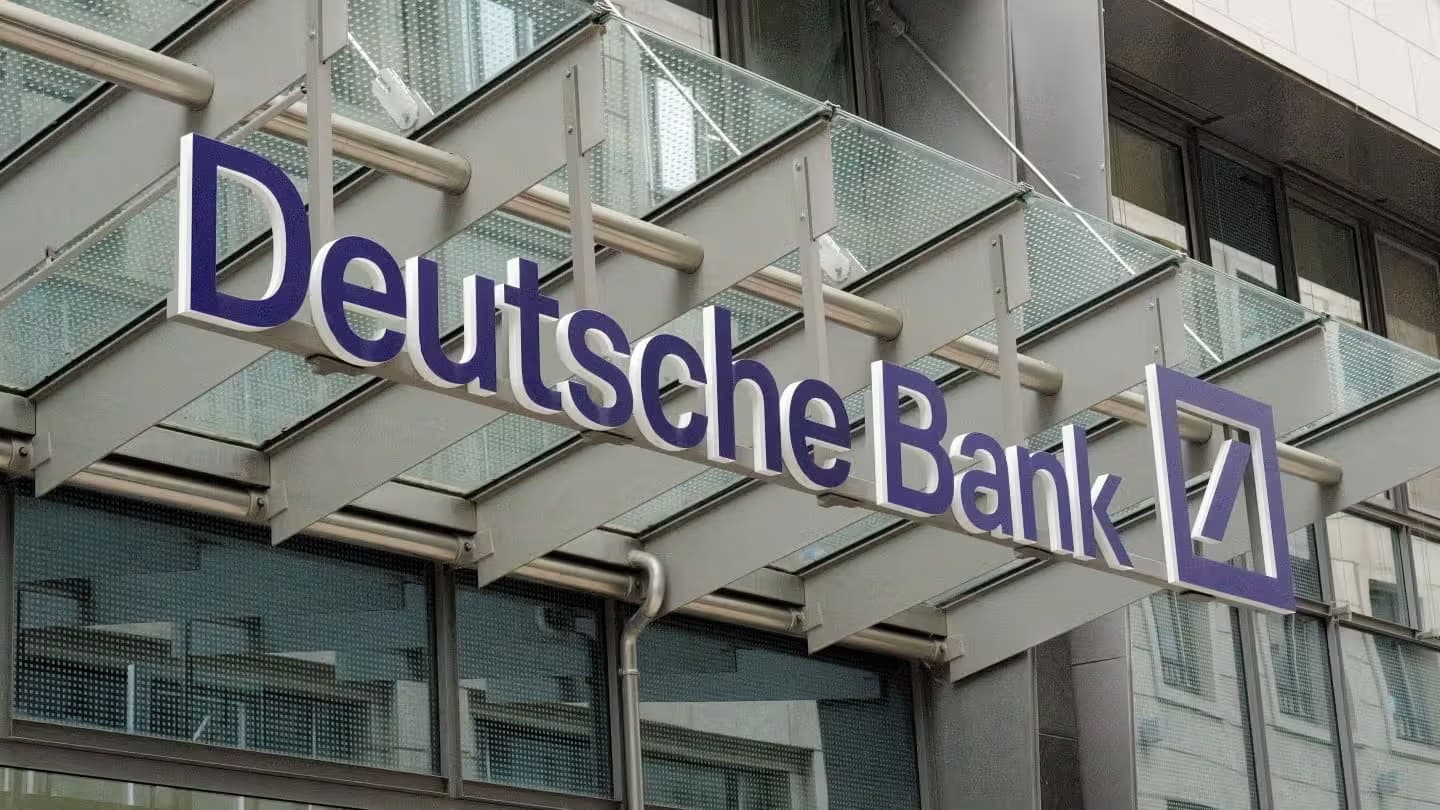
How to Open a Deutsche Bank Account in Germany (2026)

You can open a Deutsche Bank account in Germany in about five minutes online, and it will cost you between nothing and 13.90 euros a month depending almost entirely on how old you are.
What makes Deutsche Bank different from the cheaper digital banks is not the account. It is the branch network, the English speaking service line and the fact that a German landlord or employer recognises the name without thinking about it.
What makes it expensive is harder to see. Deutsche Bank publishes a 0.50 percent markup on card transactions in foreign currency, and publishes no margin at all on international transfers, which is where the larger amounts move.
This guide covers what each Deutsche Bank account costs, who can open one, the savings rates as they stand today, and what the bank charges once your money leaves the eurozone.
Can You Open a Deutsche Bank Account in Germany?
Any adult in Germany can open a current account, and Deutsche Bank says so directly. Minors can open one from age seven with a guardian's consent. The practical questions are what documents it accepts and whether it will take you before you have a German address.
Who Can Apply
Deutsche Bank accepts a valid national identity card from an EU member state or a valid passport, which means a non-EU passport holder is not shut out at the document stage the way they are at some German banks. You also give your German tax identification number and consent to a SCHUFA check.
What Deutsche Bank does not publish anywhere is a requirement for an Anmeldung on a standard Girokonto. That is an absence of a stated rule rather than a promise, so treat it as worth asking about rather than as a guarantee.
Non-EU Passports and Non-Residents
The residency signals are indirect but consistent. The bank's English microsite describes itself as set up for English speaking clients with permanent residence in Germany, the current 200 euro opening bonus requires a main residence in Germany, and Das Junge Konto requires a registered address in the EU.
Deutsche Bank publishes nothing saying a non-resident may open an account from abroad. There is only a page telling existing customers how to report a move overseas. If you are outside Germany, the realistic sequence is the one in our guide to opening a bank account in Germany as a non-resident: get an account you can open today, register your address, then open the Girokonto.
The Basiskonto, and Why It Matters
Every consumer in Germany has a statutory right to a basic account, and Deutsche Bank's Basiskonto is its version. Its eligibility statement is the broadest the bank publishes: any consumer lawfully resident in the European Union, explicitly including people with no fixed address, asylum seekers, and people without a residence permit who cannot be deported.
It costs 6.90 euros a month, the same as the AktivKonto, and it is deliberately limited. There is no Deutsche Bank Card and no credit card, only the Card Service, and it runs strictly on a credit basis with no overdraft. It also cannot be opened online, only in a branch or by post with PostIdent.
Deutsche Bank Accounts and What They Cost
There are four personal current accounts, priced from zero to 13.90 euros a month. The unusual part for anyone coming from ING, DKB or comdirect is that Deutsche Bank publishes no salary based fee waiver. If you do not qualify on age, you pay.
Account | Monthly fee | Free if | Debit card | Credit card |
|---|---|---|---|---|
db BestKonto | 13.90 EUR | No published waiver | Up to 2 included | Mastercard Gold included |
db AktivKonto | 6.90 EUR | No published waiver | 1 included | 82 EUR a year |
Das Junge Konto | 0.00 EUR | Under 30, in education | Up to 2 included | Annual fee applies |
Basiskonto | 6.90 EUR | No waiver | Not available | Not possible |
Das Junge Konto, and a Wording Problem Worth Knowing
This is the account most international students should be looking at. It is free for pupils, apprentices, students and voluntary service participants up to and including age 30, and it pays 0.01 percent on the balance where the other current accounts pay nothing.
There is a catch in the copy. The German product page sets the condition as a registered address in the EU, which a non-EU student living in Germany satisfies. The English page words it as coming from a member state of the European Union, which they do not. Those two are not the same test, and which one your branch applies is worth confirming before you rely on the account being free.
What the Monthly Fee Includes
Electronic SEPA transfers and instant SEPA payments are included on every account. Paper transfers are free on BestKonto and 1.50 euros on the others. The Deutsche Bank Card is the girocard and debit card in one and carries no separate charge, though a second card on the AktivKonto costs 10 euros a year.
Cash access runs through the Cash Group, roughly 7,000 machines shared with Commerzbank, HypoVereinsbank and Postbank, and is free. Use a German ATM outside that network and it is 1 percent with a 5.99 euro minimum, plus whatever the operator charges. Supermarket cashback at Rewe, Lidl, Aldi Sued, Penny, Netto, dm and EDEKA is free, typically on a 5 to 10 euro minimum purchase and up to 200 euros.
The overdraft is 11.60 percent a year on an arranged limit and 13.05 percent on a tolerated overdraft, against an ECB rate of 2.40 percent. Note that Deutsche Bank's own English microsite still shows 11.35 and 12.80 percent, which are out of date. The German figures are the current ones.
How to Open a Deutsche Bank Account Online
The application takes about five minutes and you can complete the whole thing from home for every account except the Basiskonto. Identity verification is the step that decides how fast you get your IBAN.
The Three Identification Methods
- Video-Legitimation. A video call from home, available 07:00 to 22:00, needing a device with a camera and speaker. The fastest route.
- PostIdent. Print the application, take it with your ID to a Deutsche Post branch. Slower, and the only online route for a Basiskonto is this by post.
- In branch. Printed application and your ID document at a Deutsche Bank branch.
After video identification you get your online banking credentials and your IBAN immediately, which matters if you have a deposit to pay or a salary date coming. Deutsche Bank does not publish a day count for the card, saying only that the card and PIN follow separately by post within a few days.
What You Need
A valid EU national identity card or a passport, your German tax identification number, and your address details. The bank runs a SCHUFA check as part of the application, and a thin credit file as a new arrival typically limits the overdraft rather than the account itself.
There is a 200 euro bonus running for online openings of the AktivKonto, BestKonto or Junges Konto during September 2026. It requires a main residence in Germany, no Deutsche Bank account in the previous six months, at least 600 euros of non-cash incoming payments in your first full calendar month, and the account held for twelve months, with payment by the end of February 2027.
Deutsche Bank Savings Accounts and Interest Rates
Deutsche Bank publishes its savings rates in a single conditions sheet, and the standing rates are low. The headline numbers you see advertised are promotional, time limited and restricted to new money, so the two need reading separately.
Product | Rate a year | Access |
|---|---|---|
Flexgeld, standing rate | 0.50 percent | Instant, quarterly interest |
Flexgeld, current promotion | 2.50 percent for 9 months | New money only, 2,500 to 250,000 EUR |
FestzinsSparen, 6 months to 3 years | 2.30 percent | Fixed term, minimum 2,500 EUR |
FestzinsSparen, 4 to 8 years | 2.40 percent | Fixed term |
SparCard | 0.15 percent | 3 months notice, 2,000 EUR a month free |
Geldmarktsparen | 0.15 percent | Minimum first deposit 5,000 EUR |
Sparbuch | 0.05 percent | Traditional passbook |
Current account balance | 0.00 percent | Junges Konto pays 0.01 percent |
Flexgeld and the Promotional Rate
Flexgeld is the instant access account, and its standing rate is 0.50 percent at every balance tier, including above ten million euros. That flatness is unusual and it tells you the product is not competing on rate.
The promotion is where the advertised number comes from: 2.50 percent for nine months, running from October 2026 to June 2027, on 2,500 to 250,000 euros of new money. New money means funds not held at Deutsche Bank, Postbank or norisbank before mid August 2026, and your total holdings have to grow. After the nine months it reverts to the 0.50 percent variable rate.
The deposit window for that promotion closes on 23 September 2026, so if you are reading this later, check the current offer rather than the rate quoted here.
The Fixed Term and Notice Products
FestzinsSparen pays 2.30 percent for terms of six months to three years and 2.40 percent for four to eight years, with a 2,500 euro minimum and online or phone opening only. A separate marketing offer has run at 2.70 percent for twelve months on new money.
The notice and passbook products are not competitive. SparCard at 0.15 percent with three months notice, Geldmarktsparen at 0.15 percent with a 5,000 euro minimum, and the Sparbuch at 0.05 percent are legacy shapes rather than places to keep savings. Deposit protection is the statutory 100,000 euros across all of them.
Is a Deutsche Bank Savings Account Worth It?
As a place to park money next to your current account, yes, because moving between the two is instant and the deposit protection is the same. As a way to earn interest, the standing rates say otherwise. A savings account paying 0.50 percent while the European Central Bank rate sits at 2.40 percent is not passing much of that on to you.
The promotional rate changes the picture for nine months and then puts you back where you started, which is the usual shape of a new money offer. If you take it, diarise the end date, because the reversion to 0.50 percent is automatic and silent.
Worth knowing about a quirk in the terms: Deutsche Bank still has a negative interest clause, the Verwahrentgelt, with an allowance of 50,000 euros per account. The rate is currently 0.0 percent so nothing is being charged, but the mechanism is still in the contract rather than removed from it.
If you are holding money in more than one currency, a savings account is the wrong container anyway. The interest you gain at 0.50 percent is smaller than the conversion margin you lose moving between currencies, which is the subject of the next two sections.
Cards, ATMs and What Deutsche Bank Charges Abroad
This is where a Deutsche Bank account gets expensive, and the charges stack. A card payment in a foreign currency carries a percentage fee on the transaction and a separate markup on the exchange rate, and most people only ever notice the first one.
The 0.50 Percent Conversion Markup
Deutsche Bank applies a currency conversion charge of 0.50 percent as a markup on the exchange rate itself. Inside the EEA in a non-euro EEA currency it is added to the last available European Central Bank reference rate. Outside the EEA it is added to the Mastercard or Visa rate.
Give the bank credit for publishing it, because most German banks do not. Then note what comes next: this 0.50 percent is on top of every percentage below, not instead of it.
Card Payments Abroad
Euro payments inside the EU and EEA are free on every card. Everything else costs 1 percent with a 1.50 euro minimum on the debit cards, and 1.75 percent with a 1.50 euro minimum on the credit cards, plus the 0.50 percent conversion markup in both cases.
So a dollar purchase on a Deutsche Bank debit card costs about 1.5 percent all in, and on a credit card about 2.25 percent. The exception is the Mastercard Travel, which carries no foreign usage fee worldwide and leaves only the conversion charge, at 94 euros a year or 60 euros with a BestKonto. Against a card with no foreign transaction fee at all, covered in our Wise card review, that annual fee is the whole argument.
ATM Withdrawals
Free at Deutsche Bank, Postbank and Cash Group machines in Germany, and free in euros inside the EU and EEA at Deutsche Bank Group branches and cooperation partners, currently including Bank of America, Barclays, BNP Paribas, Scotiabank and Westpac across more than 30 countries.
Anywhere else it is 1 percent with a 5.99 euro minimum plus the operator's own charge, and in foreign currency the 0.50 percent conversion fee applies on top. Cash on a credit card is the one to avoid entirely: 2.5 percent with a 5.75 euro minimum at an ATM, 3.0 percent over the counter, and another 1.75 percent outside the EEA.

Sending Money Abroad From a Deutsche Bank Account
Euro payments inside Europe are included in your monthly fee. Anything outside the SEPA area carries a transaction fee, a SWIFT charge and an undisclosed exchange rate margin, and the third one is almost always the largest.
SEPA Versus Third Countries
Electronic SEPA transfers and instant SEPA payments cost nothing on every Deutsche Bank account. That covers the whole eurozone plus the rest of the EEA when the payment is in euros.
Outside it, an electronic transfer costs 0.15 percent with a 10 euro minimum, plus 1.55 euros for the SWIFT message. Send it OUR, meaning you cover the receiving bank's charges as well, and Deutsche Bank adds a flat 25 euros. A paper transfer costs 13 euros up to 250 euros and 0.15 percent with a 15 euro minimum above that, and an urgent transfer adds 10 euros.
What It Actually Costs on a Worked Example
Send 5,000 euros to a dollar account electronically. The visible charges are 10 euros minimum plus 1.55 euros, so about 11.55 euros. That looks reasonable and it is not the real number.
The exchange rate margin is applied on top and is not published for consumer transfers. For its business customers Deutsche Bank does publish the equivalent figures, 0.50 percent on major pairs and 2.00 percent on everything else, which is the only guide available to what a personal customer is likely paying. At 2.00 percent, 5,000 euros costs another 100 euros. That is the argument the guide to what banks charge for money transfers makes across the whole market.

The Cheaper Route for Anything That Crosses a Currency
 Wise9.5
A specialist converts at the mid-market rate and shows the fee as a separate line, which on a five figure transfer is usually the difference between tens of euros and hundreds. It is not a replacement for a German current account, it is what you use alongside one when money leaves the euro.
It matters most for the payments people actually make from a German account: rent or a mortgage abroad, tuition, money home to family, and being paid from another country. The mechanics are in the guide to using Wise for international transfers and the product is scored in the Wise review.
Check the Real Cost Before You Send
Enter the amount and the two currencies. The comparison shows what lands on the other side after fees and the exchange rate, which is the only figure that matters when the margin is not published.
If you are sending to the United States, the Germany to US corridor page has live rates, and the general mechanics are in transferring money to an international bank account. Timings are covered in how long an international money transfer takes.

Deutsche Bank for International Students and Expats
Deutsche Bank has historically been the bank international students were pointed to, and part of that reputation is still earned. Part of it is out of date, and one piece of it has been withdrawn entirely.
English Service, With Limits
There is an English speaking service line on 069 910-10000, Monday to Friday from 08:00 to 20:00, and a separate international students line on +49 69 910-10006. Deutsche Bank provides its forms in both German and English and offers an English version of online banking.
Two limits worth knowing. The contract language is German and all general terms and conditions are in German, so you are signing a German contract whatever language you read it in. And while online banking has an English version, Deutsche Bank makes no published claim that the mobile app does.
The Blocked Account Is Closed to New Applicants
This is the piece that has changed and that most guides have not caught up with. Deutsche Bank's own page states that new blocked account openings are no longer possible and that existing accounts are unaffected.
Existing holders pay 6.90 euros a month plus a 150 euro fee for the block itself, charged again for every extension. If you need a Sperrkonto for a student visa, the live options are the specialists, covered in our guide to the blocked bank account in Germany.
The Bottom Line
The reason to open a Deutsche Bank account is the branch network and the English speaking service, not the price. If you are under 30 and in education, Das Junge Konto is free and there is little reason to look elsewhere, provided your branch reads the eligibility wording the German way rather than the English way.
If you are paying for it, the question is what the branch network is worth to you. At 6.90 euros for the AktivKonto you are paying about 83 euros a year for cash access, a physical bank and English speaking support, when ING and DKB will waive a similar fee on a modest monthly deposit and Postbank Giro pur waives it at 900 euros. That is a fair trade for some people and a poor one for others.
What is not a fair trade is running international payments through it. The card markup is published at 0.50 percent and the transfer margin is not published at all, and on a five figure transfer the undisclosed number is the one that costs you. Keep the account, move the currency somewhere you can see the price.
Related reading: the best business bank account in Germany and how to transfer money between banks.
Deutsche Bank Account FAQs
How do I open a Deutsche Bank account in Germany?
Apply online in about five minutes, then verify your identity by video call, at a Deutsche Post branch with PostIdent, or in a Deutsche Bank branch. Video identification runs from 07:00 to 22:00 and gives you online banking access and your IBAN immediately, with the card and PIN following separately by post within a few days. You need a valid EU national identity card or a passport, your German tax identification number and your address, and the bank runs a SCHUFA credit check as part of the application. The Basiskonto is the exception and cannot be opened online.
Can a foreigner open a Deutsche Bank account?
Yes, once you are in Germany. Deutsche Bank accepts a valid passport as identification, so a non-EU passport holder is not blocked at the document stage the way they are at some German banks. Its own statement is that any adult in Germany can open a current account. What the bank does not publish is any route to open from abroad, and its English service is described as being for clients with permanent residence in Germany. If you have not arrived or registered yet, open a multi currency account first and add the Girokonto once you have your Anmeldung.
How much does a Deutsche Bank account cost per month?
Das Junge Konto is free for pupils, apprentices, students and voluntary service participants up to and including age 30. The db AktivKonto is 6.90 euros a month, the Basiskonto is also 6.90 euros, and the db BestKonto is 13.90 euros. Unlike ING, DKB and comdirect, Deutsche Bank publishes no salary based waiver on the paid accounts, so unless you qualify on age you pay the fee. Electronic SEPA transfers are included on all four.
What interest does a Deutsche Bank savings account pay?
The standing rate on Flexgeld, the instant access account, is 0.50 percent a year at every balance tier. SparCard and Geldmarktsparen pay 0.15 percent and the Sparbuch pays 0.05 percent. Fixed term FestzinsSparen pays 2.30 percent for six months to three years and 2.40 percent for four to eight years, with a 2,500 euro minimum. A promotional Flexgeld rate of 2.50 percent for nine months is running on new money between 2,500 and 250,000 euros, and reverts to 0.50 percent afterwards. Check the current offer, because these rates move.
Can I open a Deutsche Bank account online?
Yes for the AktivKonto, BestKonto and Das Junge Konto. The application takes around five minutes and video identification completes it without leaving home, after which your IBAN and online banking credentials are available immediately. The Basiskonto cannot be opened online: it is branch only, or a printed postal application with PostIdent for new customers. There is also a 200 euro bonus for online openings during September 2026, conditional on a main residence in Germany and 600 euros of incoming payments in your first full month.
Does Deutsche Bank still offer blocked accounts?
No. Deutsche Bank's own page states that new blocked account openings are no longer possible, and that existing accounts continue unchanged. Anyone holding one already pays 6.90 euros a month for the account plus a 150 euro fee for the block, charged again on every extension. If you need a Sperrkonto for a student visa now, the realistic providers are Coracle, VietinBank, Expatrio and Fintiba, with first year costs ranging from about 99 to 278 euros.
What does Deutsche Bank charge for using a card abroad?
A currency conversion markup of 0.50 percent on the exchange rate, plus a transaction fee. On the debit cards that fee is 1 percent with a 1.50 euro minimum outside euro payments in the EU and EEA, and on the credit cards it is 1.75 percent with the same minimum. So a dollar purchase costs roughly 1.5 percent on debit and 2.25 percent on credit. The Mastercard Travel charges no foreign usage fee worldwide but costs 94 euros a year, or 60 euros with a BestKonto. Cash on a credit card is the expensive path at 2.5 percent with a 5.75 euro minimum.
Is Deutsche Bank good for international transfers?
Not on price. An electronic transfer outside the SEPA area costs 0.15 percent with a 10 euro minimum plus 1.55 euros for the SWIFT message, and 25 euros more if you send it OUR. The larger cost is the exchange rate margin, which Deutsche Bank does not publish for personal customers at all, saying only that it converts at its own mid settlement rate. For its business customers it publishes 0.50 percent on major pairs and 2.00 percent on everything else, which is the best available guide. On a 5,000 euro transfer a 2 percent margin is 100 euros against about 11.55 euros of visible fees.
Does Deutsche Bank have an overdraft, and what does it cost?
Yes, and it is expensive. An arranged overdraft costs 11.60 percent a year and a tolerated overdraft, meaning going beyond your agreed limit, costs 13.05 percent. For context the ECB rate is 2.40 percent. The AktivKonto advertises an included 500 euro instant overdraft subject to creditworthiness, and you need to be 18 or over. Note that Deutsche Bank's English microsite still shows the older rates of 11.35 and 12.80 percent, so use the German pages for the current figures.
Does Deutsche Bank speak English?
Partly, and it is worth knowing where the line falls. There is an English speaking service line on 069 910-10000 from Monday to Friday, 08:00 to 20:00, a dedicated international students line, forms in both German and English, and an English version of online banking. The bank also says most branch advisers speak English. What it does not offer is an English contract: the contract language is German and all general terms and conditions are in German. It makes no published claim that the mobile app is available in English either.
Sources
- Deutsche Bank, Preisaushang
- Deutsche Bank, Preis- und Leistungsverzeichnis
- Deutsche Bank, Konditionen und Preise with the savings rates
- Deutsche Bank, Flexgeld and the promotional rate
- Deutsche Bank, accounts compared
- Deutsche Bank, Das Junge Konto
- Deutsche Bank, how to verify your identity
- Deutsche Bank, international students and blocked accounts
- Deutsche Bank business accounts, for the published FX margins
Mo is the founder of MoneyTransferStore. As an expat who has experienced the challenges of sending money across borders himself, he set out to help others like him avoid hidden fees and unfair exchange rates on international transfers. With a background spanning fintech, payments, and Web3, Mo brings years of practical experience to building a platform focused on transparency and trust.