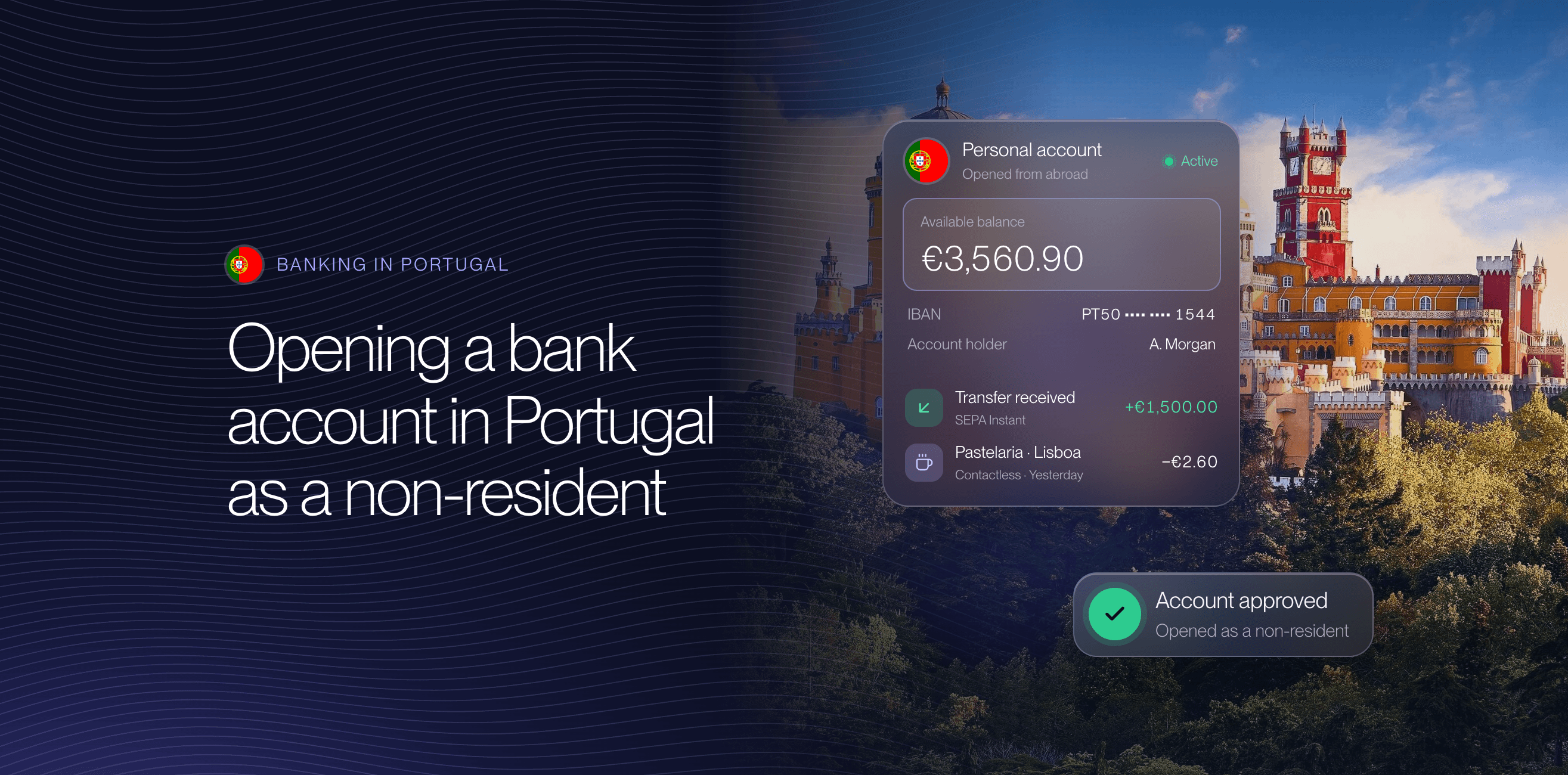
How to Open a Bank Account in Portugal as a Non-Resident (2026)

Opening a bank account in Portugal as a non-resident is possible at most of the big banks. Millennium bcp, Novo Banco, BPI and Caixa Geral de Depósitos all publish accounts for non-residents, and Novo Banco has one, the Conta +351, built for emigrants and people living abroad.
The catch is the order of things. You need a NIF, the Portuguese tax number, before almost any bank will open an account, and the online sign-ups at CGD and Santander want a Portuguese Cartão de Cidadão. For most foreigners, that means a tax office appointment first and a branch visit second.
This guide covers who can open a bank account in Portugal and how, getting a NIF, the basic account every bank must offer, the documents banks ask for, what CGD, Millennium bcp, Novo Banco, BPI, Santander and ActivoBank really charge, and the euro account you can open today, before any of it.
Can a Non-Resident Open a Bank Account in Portugal?
Yes. Portuguese banks open accounts for residents and non-residents alike: Millennium bcp's Conta Millennium, Novo Banco's Conta +351 and BPI's Conta Base are all listed for non-residents in their price lists. What you need first is a NIF, the Portuguese tax number, and in most cases a visit to a branch.
That is less common than it sounds. In Austria and Finland, the banks' online rules assume you already live in the country. In Portugal, the price lists themselves say non-residents are welcome, and some banks run products designed for the large Portuguese diaspora and the foreigners who buy homes, retire or work remotely there.
Banks that accept non-residents
Caixa Geral de Depósitos, the state-owned bank, applies its account fees to accounts held by residents, non-residents and emigrants. Millennium bcp's Conta Millennium is open to residents or non-residents aged 18 and over, with a minimum opening deposit of €250, or €50 for people aged 18 to 35 who open on its digital platform.
Novo Banco lists its standard accounts for residents and non-residents, and its Conta +351 is for emigrants and non-residents. BPI's Conta Base is open to adults resident or not. ActivoBank, Millennium bcp's online bank, says opening is subject to its client acceptance policy. The same pattern of resident and non-resident accounts runs through Spain and Italy.
Can you open a Portuguese bank account online?
Portuguese law allows an account to be opened in person or at a distance, with identification by the Chave Móvel Digital, the state's digital key, or by videoconference, depending on the bank's systems. In practice, the main banks keep online opening for people who already hold Portuguese documents.
CGD's app opens accounts in under 10 minutes, but only for single holders aged 18 or over with tax residence in Portugal, a valid Portuguese Cartão de Cidadão and a Portuguese mobile number, and all other cases go to a branch. Santander opens online only for foreigners who also hold Portuguese nationality. We could not confirm a Portuguese bank that opens fully online for a non-resident without Portuguese ID, so plan on a branch.
Residence permits and non-Schengen passports
If you already live in Portugal as a foreigner, banks ask for your residence permit, the autorização de residência. Santander goes further: at its branches, nationals of countries outside the Schengen area, except the UK, are asked for a residence permit too. CGD's document list includes the residence permit for foreigners resident in Portugal.
That makes the order of a move matter. If you are coming from the US, Brazil or India, ask each bank in advance what it accepts while your residence permit is being processed, because the rules differ: Santander asks for the permit, while Millennium bcp, Novo Banco and BPI list accounts for non-residents.
Can a US citizen open a bank account in Portugal?
Yes. Under FATCA, applied in Portugal through Decree-Law 64/2016, a US citizen is treated as a US tax resident, the account is reported to the US, and the bank asks for your US tax number, usually on form W-9. Novo Banco's checklist accepts a US Social Security card as the tax document for customers resident in the United States.
Getting a NIF: The Number You Need First
The NIF is Portugal's 9-digit tax number, and the tax authority lists opening a bank account as one of the reasons you need one. Anyone, resident or not, can request a NIF. Non-residents apply in person at a tax office by appointment, or online through a legal representative, and no fiscal representative is needed just to get it.
How to apply for a NIF as a non-resident
The tax authority offers two routes. Online, through its e-balcão service, but only via a legal representative, which is not the same as a fiscal representative. Or in person, by prior appointment, at any Serviço de Finanças or Loja do Cidadão. You book through the Portal das Finanças under Contactos, or by phone on +351 217 206 707 on working days from 9:00 to 19:00.
- Book an appointment: at a Serviço de Finanças or Loja do Cidadão, or appoint a legal representative to apply online
- Bring your passport: non-EU nationals applying in person need an entry visa in it, unless they are visa-exempt for Schengen or hold an EU visa
- Bring proof of your foreign address: if your address is not on your ID
- Use originals or certified copies: documents in another language need a certified translation
- Receive your NIF: the same 9-digit number stays with you whether you are resident or not
The NIF currently starts with the digit 3 for individuals. The tax authority's pages do not state a fee or a processing time for the NIF itself, and neither do the government's service pages, so ask when you book.
Do you need a fiscal representative?
Not to get the NIF. The tax authority's leaflet for foreign non-residents says a fiscal representative is not required when a NIF is assigned to a non-resident. That changes once you have a tax relationship in Portugal, such as property, a vehicle, an employment contract or self-employment.
From then, you have 15 days to appoint a fiscal representative or sign up for electronic notifications through the Portal das Finanças or ViaCTT. For residents of the EU, Norway, Iceland and Liechtenstein, the representative is optional. Non-EU residents who are self-employed in Portugal must appoint a VAT fiscal representative even if they use electronic notifications.
When you become tax resident
You become tax resident in Portugal if you spend more than 183 days there in any 12 months, or have a home that suggests you intend to live there habitually. Your NIF stays the same, but you must update your address with the tax authority within 60 days, and your bank will ask you to update your tax self-certification too.
There is one narrow exception for non-residents. CGD says a NIF is not mandatory for clients resident abroad whose Portuguese income is only subject to final withholding tax or is interest on savings. For everyone else, get the NIF first.
Serviços Mínimos Bancários: Portugal's Basic Account
Every deposit-taking bank in Portugal must offer the Serviços Mínimos Bancários, a basic account capped at 1% of the IAS social index a year, which is €5.37 in 2026. Anyone with the right to reside in the EU who holds no other current account can open one, and the bank must open it or refuse within 10 working days.
Who can open one
The basic account is for any person who holds no other current account, or who converts their only account into one. BPI's price list spells out who that includes: any consumer with the right to reside in an EU member state, including people with no fixed address, asylum seekers and people who cannot be expelled. The bank cannot require a minimum deposit or make you buy another product.
The bank can close the account on 60 days' notice if you stop being legally resident in the EU, open another current account in Portugal, or leave it unused for 24 months. Like similar accounts elsewhere in the EU, it is a floor, not a full banking relationship, and it has no overdraft.
What it includes and what it costs
The account comes with a debit card, cashpoint use in the EU, online banking, branch service, unlimited transfers within the same bank and at cashpoints, 48 transfers a year to other banks by online banking or app, and five app transfers a month of up to €30 each. Those transfer allowances were set by Law 24/2023.
Most banks charge a little under the cap. CGD, Millennium bcp, BPI and Santander charge €0.34 a month, €4.08 a year, Novo Banco €0.39 and ActivoBank nothing, all plus 4% stamp duty. For a newcomer, that is a working Portuguese IBAN for about €4 a year.
The Conta Base, a cheaper standard account
Banks also offer a Conta Base, a simpler standard account under a 2014 Bank of Portugal circular, without the conditions attached to the basic account. It costs €5.00 a month at CGD, €5.30 at Santander, €6.00 at Millennium bcp and Novo Banco and €6.25 at BPI, plus stamp duty. ActivoBank's equivalent, the Conta Simples, is free.
Documents You Need to Open a Portuguese Bank Account
Portuguese banks ask for a passport or ID card, your NIF, proof of address, proof of your profession and employer, and a tax residence self-certification. Foreigners living in Portugal add a residence permit. CGD's list, set under Bank of Portugal rules, also includes a declaration on whether you hold a public office.
- Photo ID: a passport for most non-EU nationals, or an EU ID card
- NIF: the document showing your Portuguese tax number
- Proof of address: in Portugal or abroad; Novo Banco wants it under six months old
- Proof of profession and employer: a professional card, a payslip or similar
- Residence permit: if you are a foreigner living in Portugal
- Tax self-certification: every tax residence, with its tax number and your date of birth
Proof of address
CGD accepts a wide range of proof, including a driving licence, a Portuguese tax assessment, a bank statement, a letter from a public body or reputable private company, and a certificate from the Junta de Freguesia, the parish council. Novo Banco's checklist for EU, Schengen and UK passport holders accepts proof under six months old, including a foreign residence certificate.
If you live abroad, bring proof of your home address there. A recent bank statement or utility bill in your name is the simplest, and if it is not in Portuguese, English, Spanish or French, ask the bank in advance whether it needs a translation.
Proof of profession
Both CGD and Santander ask foreign customers for proof of profession and employer, such as a professional card, a payslip or an employment letter. If you are retired or self-employed, ask the bank which document it accepts instead of a payslip. It is part of the bank's anti-money laundering checks, so a clear document saves a second visit.
Tax self-certification, CRS and FATCA
Under the Common Reporting Standard, as applied by Decree-Law 64/2016, the bank must obtain a tax residence self-certification at account opening, including your foreign tax number and date of birth. Novo Banco accepts a document from your foreign tax authority as proof of your tax number if you live in a country that applies the standard.
Fill it in carefully and consistently with your other documents. If you later become tax resident in Portugal, update the form at the bank as well as your address with the tax authority.
What Portuguese Banks Charge
Most standard Portuguese accounts cost €5 to €10 a month, plus 4% stamp duty, the Imposto do Selo, on every bank commission. Millennium bcp charges €5.20, Novo Banco €5.18 for its standard account and Santander €5.30. Most banks cut the fee with a salary or balance, and ActivoBank's Conta Simples has no maintenance fee.
Account fees
Bank | Account | Monthly fee, before stamp duty | How to pay less |
|---|---|---|---|
CGD | Conta Caixa S | €5.25, or €3.20 with the bonus | Salary paid in plus €50 a month of card spending; abroad, €50 of card spending only; free under 25 |
Millennium bcp | Conta Millennium | €5.20 | Free in the opening month and if the first holder is 23 or under |
Novo Banco | Conta +351 | €9.90, or €5.50 with the bonus | Digital statements plus €10,000 average balance or two household direct debits |
BPI | Conta Valor BPI | €7.99, or €4.99 with the bonus | €500 a month of salary or €10,000 invested |
Santander | Conta Santander Mais | €8.60, or €7.60 with salary | Free for the first three months |
ActivoBank | Conta Simples | €0 | No minimum deposit |
Banks' price lists, dated 1 December 2025 to 3 November 2026. All commissions carry 4% Imposto do Selo.
CGD's bonus is the one to notice if you live abroad. For residents, the lower fee needs a salary paid in plus €50 a month of card spending. For clients resident abroad, only the €50 of card spending is required, so a holiday home owner who pays a few bills by card can keep the fee at €3.20 a month.
Novo Banco's Conta +351, the account designed for emigrants and non-residents, costs €9.90 a month unless you choose digital statements and keep an average balance of €10,000 or pay two household direct debits from it, in which case it falls to €5.50.
Stamp duty on every fee
Portugal adds 4% Imposto do Selo to bank commissions, and price lists quote fees before it. Millennium bcp's €5.20 becomes €5.41, or about €64.90 a year. CGD shows its Conta Caixa accounts with stamp duty included on its own site, at €5.46, €6.55 and €7.59 a month for the S, M and Azul versions, which is why the numbers do not always match.
The cheapest ways to bank in Portugal
If you just need a Portuguese IBAN, three options cost almost nothing: ActivoBank's Conta Simples at €0, the basic account at about €4 a year, or a free account through an age waiver at CGD under 25 or Millennium bcp to 23. The Conta Base, at €5 to €6.25 a month, sits between them and a full account.

Sending and Receiving Money Internationally
Euro transfers in SEPA cost €0.95 to €1.25 online at most Portuguese banks and nothing at ActivoBank. Transfers outside SEPA cost 0.16% to 0.25% with minimums of €4.99 to €20, sometimes plus a telecom charge, and receiving one costs €15 to €19.23 at most banks. None of the six price lists publishes the exchange margin.
International transfer fees
Bank | Sending €1,000 outside SEPA, online | Receiving from outside SEPA |
|---|---|---|
CGD | €15 (0.25%, minimum €15, maximum €25) | €3.94 |
Millennium bcp | €4.99 (0.25%, minimum €4.99) | €19.23 |
Novo Banco | €30 (€150.01 to €12,500) | €15 |
BPI | €20 (0.25%, minimum €20), plus telecom and correspondent fees | €17.99 |
Santander | €15 (0.25%, minimum €15), plus €20 telecom and VAT | €17.50 |
ActivoBank | €19.23 (0.16%), or a Wise-powered transfer with Wise's fees only | €19.23 |
Banks' price lists, 2025 and 2026. Before 4% stamp duty and the exchange margin. SEPA transfers in euros cost €0 to €1.25 online.
Two details change the numbers. The UK is in SEPA for euro transfers, so sending euros to a UK account is cheap, but sending pounds is a non-SEPA payment. And ActivoBank offers transfers run by Wise, up to €12,500, where you pay only Wise's fees and no bank fee, which says something about where the cost of a bank transfer really sits.
The exchange margin is the part you do not see. None of the six price lists publishes the margin on an outgoing conversion. The only published rates we found were at Millennium bcp: incoming payments through its STR service at the ECB reference rate plus 0.5%, and a Western Union exchange margin of 0% to 6%.
The exchange margin, in money
Our comparison data has no Portuguese bank in it, so here is what three Spanish banks did with the same transfer; these are the Spanish banks, not their Portuguese arms. On 4 November 2026, €1,000 sent to a UK account delivered £791.85 through Sabadell, after a €22 fee and a 3.01% margin, £793.87 through CaixaBank and £820.60 through Santander in Spain.
Wise delivered £830.19 for a €5.76 fee at the mid-market rate, about £38 more than Sabadell. Some other specialists also beat the banks, so compare on the day. We explain how to check any quote in what is the mid-market exchange rate, and how banks build the margin in foreign exchange for money transfers.
Moving your savings to Portugal
Sending to Portugal | Euros that arrive | Exchange margin |
|---|---|---|
1,000 GBP, Barclays | €1,165.70 | 2.75% |
1,000 GBP, NatWest | €1,170.54 | 2.35% |
1,000 GBP, HSBC | €1,172.16 | 2.21% |
1,000 GBP, Wise | €1,194.18 | 0%, fee of £3.81 |
1,000 USD, Wells Fargo | €866.35 | 3.04% |
1,000 USD, Chase | €862.56 | 2.98% plus a $5 fee |
1,000 USD, Wise | €888.69 | 0%, fee of $5.47 |
Wise comparison data, 3 November 2026, mid-market rates of 1.1988 EUR per GBP and 0.8936 EUR per USD. Before any receiving fee charged by the Portuguese bank.
On £1,000, Wise delivered about €28 more than Barclays and €22 more than HSBC. On 1,000 dollars, about €22 more than Wells Fargo and €26 more than Chase. On €250,000 for a house in the Algarve, a 2.75% margin is €6,875; see transferring large sums internationally.
Wise also pays euros into a Portuguese account as an ordinary SEPA transfer from inside Europe, so the €15 to €19.23 that most Portuguese banks charge to receive a payment from outside SEPA does not apply. We cover the receiving side in receiving money from abroad.

Paying friends with MB WAY
Portugal's MB WAY payment app needs a Portuguese bank card enabled for the service, though an international mobile number is allowed if it is linked to such a card. It can now send money to Bizum, Bancomat and IRIS users abroad at the same cost and limits as at home, and bcp and CGD cap it at €2,000 per transfer. App transfers are free up to €30 each, €150 and 25 transfers a month.
Compare providers on your route
Rates move every day and no provider is cheapest on every route, so compare on the day. Enter your amount and destination to see what arrives today; our guide to comparing money transfer providers shows what to check beyond the headline fee.
For the main routes, see sending money from Portugal, including Portugal to Brazil, Portugal to the UK and Portugal to India, and for money coming in, Brazil to Portugal, the UK to Portugal and the US to Portugal.
Open a Wise Account Before You Move
Wise is not a Portuguese bank, but it fills the gap before your NIF and branch appointment. It opens online from your home country with your passport, gives you euro account details for SEPA payments, and converts at the mid-market rate with a visible fee, so you can pay a deposit or move savings before any Portuguese bank says yes.
 Wise9.5
What a Wise account gives you in Portugal
You get euro account details for receiving payments free by local European transfer, or for €2.39 by SWIFT, balances in more than 40 currencies, and a card for spending in Portugal. The card costs €7, the digital card is free, a replacement is €4 and there is no monthly fee. You can withdraw €250 a month at cashpoints with no Wise fee, then 2.69% on the amount above that.
Wise Europe SA is an authorised payment institution supervised by the National Bank of Belgium. Our Wise review covers the company and the Wise card review covers spending. If you live in the UK or the US and only need euros now and then, compare euro accounts in the UK, the best euro account in the UK and euro accounts in the USA.
What Wise cannot do in Portugal
Wise does not issue Portuguese IBANs: its euro details use a Belgian BIC and a Wise address in Belgium, and Wise says it does not currently issue local IBANs. Your money is safeguarded at large banks and in money market funds, but Wise's payment services are not covered by a deposit guarantee such as Portugal's, which protects up to €100,000 per depositor at each bank.

There is no MB WAY, which needs a Portuguese bank card, no mortgage and no Portuguese credit history. Visa rules can also make a Portuguese account useful: the D7 visa asks retirees and passive income applicants to prove the income is available in Portugal, and the D2 entrepreneur visa accepts proof of funds held with a Portuguese financial institution. The digital nomad residence visa asks for average monthly income of at least four times the minimum wage over the last three months, €3,680 a month in 2026. Check with the consulate what evidence it accepts.
The setup that works for most newcomers
Open Wise before you move and use it for the deposit and for moving savings at the mid-market rate. Book your NIF appointment, then open a Portuguese account at a branch, ideally on the same trip. Keep Wise for money crossing the border and the Portuguese account for MB WAY, direct debits and your salary. If you are leaving the UK, see opening a UK bank account as a non-resident on keeping your UK account.
Choosing the Best Bank in Portugal for Foreigners
The best bank in Portugal for foreigners depends on your plans. For no monthly fee, ActivoBank's Conta Simples is the cheapest. For a branch network and a non-resident track, Millennium bcp, CGD and Novo Banco's Conta +351 all accept non-residents, and CGD's bonus for clients abroad needs only €50 a month of card spending.
If you live abroad
Compare CGD, Novo Banco and Millennium bcp. CGD's Conta Caixa S falls to €3.20 a month with €50 of card spending for clients resident abroad. Novo Banco's Conta +351 is built for non-residents, at €5.50 with the bonus. Millennium bcp's Conta Millennium is €5.20 for residents or non-residents, with a €250 opening deposit.
If you are moving to Portugal
If you want the lowest cost, ActivoBank's Conta Simples has no maintenance fee and no minimum deposit, but a digital opening must be funded by bank transfer first. If you are under 25, CGD waives its fee, and Millennium bcp waives it to 23.
If you send money to Brazil, India or the UK
Look at the non-SEPA fee as well as the monthly one. Millennium bcp's €4.99 minimum online is the lowest of the six banks for a €1,000 transfer, Novo Banco's €30 the highest, and none publishes its exchange margin. ActivoBank's Wise-powered transfer drops the bank fee entirely. Millennium bcp and ActivoBank also receive emigrant remittances free.
Opening a Business Bank Account in Portugal
A Portuguese single-partner company can start with €1 of capital, there is no requirement for a Portuguese partner, and the Empresa na Hora service sets one up for €360. Non-resident shareholders and managers each need a NIF. The company account comes after incorporation, because in practice a bank cannot open one before.
Setting up the company
AICEP, the government's investment agency, lists the main forms: a Sociedade Unipessoal por Quotas with one partner and €1 minimum capital, a Sociedade por Quotas, or Lda, with two or more partners and €2, and a Sociedade Anónima with €50,000. Empresa na Hora costs €360, and Empresa Online €220 with pre-approved articles or €360 with your own.
Partners without a Cartão de Cidadão give their NIF and show an ID card, passport or residence permit. Beneficial owners must be identified in the incorporation document under the RCBE, the beneficial owners register. Non-EU residents who are shareholders or managers also appoint a representative or sign up for electronic notifications.
Capital and the company account
The capital is deposited within five working days of incorporation unless deferred, and Lda partners may declare that cash contributions will be paid into the company account by the end of the first financial year. That is the reverse of Austria, where the bank confirmation comes before registration.
What Portuguese banks ask for
Novo Banco's checklist for an Lda asks for the commercial register certificate, the company tax number, the RCBE declaration, and the IDs and NIFs of the managers and every holder of 5% or more. Non-residents from outside the EU, Schengen or the UK use a passport, and documents not in Portuguese, Spanish, English or French need a certified translation.
If your company is abroad and only needs to be paid by Portuguese clients, a Wise Business account can give it euro account details; check that Wise accepts your business type first. See international money transfers for business.
How Long It Takes to Open a Bank Account in Portugal
Online, under 10 minutes at CGD if you hold a Portuguese Cartão de Cidadão. For most foreigners, the timeline is set by the NIF appointment first and the branch visit second, and neither has a published processing time. The basic account, the Serviços Mínimos Bancários, must be opened or refused within 10 working days.
Route | Typical time | What it depends on |
|---|---|---|
Wise account | Minutes to a day | The identity check on your passport |
NIF | One appointment | An appointment slot at a tax office or Loja do Cidadão |
CGD online | Under 10 minutes | A Portuguese Cartão de Cidadão and Portuguese tax residence |
Branch account, non-resident | One visit, if your file is complete | NIF, ID, proof of address and profession |
Serviços Mínimos Bancários | Up to 10 working days | Holding no other current account |
Banks' account opening pages and the Bank of Portugal, November 2026.
The first deposit
CGD's online accounts need €150 paid in within 30 days, and Millennium bcp's Conta Millennium €250, or €50 for 18 to 35 year olds opening digitally. ActivoBank's digital openings must be funded first by bank transfer. A transfer from an account in your name is the usual way, and a euro account makes it a simple SEPA payment.
Is your money safe in a Portuguese bank?
Yes. The Fundo de Garantia de Depósitos covers up to €100,000 per depositor at each bank, for residents and non-residents alike and in any currency. Portuguese IBANs start with PT; we explain the format in what is an IBAN, and transfer timings in how long an international money transfer takes.
Bottom Line
Opening a bank account in Portugal as a non-resident is possible at CGD, Millennium bcp, Novo Banco and BPI, but get your NIF first and expect a branch visit, because online opening wants Portuguese ID. If you hold no other account, the basic account costs about €4 a year, and Wise covers euros from day one.
If you are moving to Portugal
Get the NIF, open an account on the same trip, and use an age waiver, a salary bonus or ActivoBank to keep the fee near zero. If you buy property or start work, appoint a fiscal representative or sign up for electronic notices within 15 days.
If you live abroad
Compare CGD's €3.20 bonus for clients abroad with Novo Banco's Conta +351, and plan any large transfer separately. For comparison, see how the rules work in France, Austria and Belgium.

The expensive mistake is not the account fee but the exchange rate. A margin you are not shown, on the money you move into or out of Portugal, costs more in a year than any monthly fee.
How do I open a bank account in Portugal as a non-resident?
Get a NIF first, at a tax office by appointment or online through a legal representative. Then visit a branch of a bank that accepts non-residents, such as Millennium bcp, CGD, Novo Banco or BPI, with your passport, NIF, proof of address and proof of profession. Online opening at CGD and Santander needs Portuguese ID, so plan on a branch.
Can a foreigner open a bank account in Portugal?
Yes. Portuguese banks open accounts for residents and non-residents, and several price lists say so: Millennium bcp's Conta Millennium, Novo Banco's standard accounts and BPI's Conta Base are open to non-residents. Foreigners living in Portugal add a residence permit, and Santander asks non-Schengen nationals other than Britons for one at its branches.
Do I need a NIF to open a bank account in Portugal?
Almost always. The tax authority lists opening a bank account as one of the reasons you need a NIF, and banks ask for it in their document lists. The narrow exception is at CGD, where a NIF is not mandatory for clients resident abroad whose Portuguese income is only subject to final withholding tax or is savings interest.
How do I get a NIF in Portugal as a non-resident?
Book an appointment at any Serviço de Finanças or Loja do Cidadão, through the Portal das Finanças or on +351 217 206 707, and bring your passport and proof of your foreign address. Or apply online through a legal representative. Documents must be originals or certified copies, with certified translations if needed. No fiscal representative is required to get the NIF.
Can I open a Portuguese bank account online?
Only with Portuguese ID at the main banks. CGD's app opens accounts in under 10 minutes for holders of a Portuguese Cartão de Cidadão with tax residence in Portugal, and Santander opens online only for foreigners with Portuguese nationality. We could not confirm a bank that opens fully online for a non-resident without Portuguese documents. A Wise account opens online from anywhere.
What documents do I need to open a bank account in Portugal?
A passport or ID card, your NIF, proof of address, proof of profession and employer such as a payslip, and a tax self-certification with your foreign tax number and date of birth. Foreigners living in Portugal add a residence permit, and CGD also asks for a declaration on whether you hold a public office.
What is the cheapest bank account in Portugal?
ActivoBank's Conta Simples has no maintenance fee. The basic account, the Serviços Mínimos Bancários, costs €4.08 a year at CGD, Millennium bcp, BPI and Santander and nothing at ActivoBank, plus 4% stamp duty, if you hold no other current account. CGD waives fees for under 25s and Millennium bcp to age 23.
Which is the best bank in Portugal for foreigners?
It depends on your plans. ActivoBank is cheapest with no maintenance fee. Millennium bcp, CGD and Novo Banco all accept non-residents with branches, and Novo Banco's Conta +351 is designed for people living abroad. CGD's bonus for clients resident abroad needs only €50 a month of card spending, bringing the fee to €3.20 a month.
How much does a bank account cost in Portugal?
Most standard accounts cost €5 to €10 a month before 4% stamp duty: Millennium bcp €5.20, Novo Banco €5.18, Santander €5.30, and BPI's Conta Valor €7.99 or €4.99 with a salary. Many waive or cut the fee with a salary, a balance or an age limit, and the basic account costs about €4 a year.
Can a US citizen open a bank account in Portugal?
Yes. Under FATCA, applied through Decree-Law 64/2016, a US citizen is treated as a US tax resident, the bank reports the account and asks for your US tax number on form W-9. Santander asks non-Schengen nationals for a residence permit at its branches, so ask each bank what it accepts before you visit.
How much do Portuguese banks charge for international transfers?
SEPA transfers in euros cost €0.95 to €1.25 online, and nothing at ActivoBank. Sending €1,000 outside SEPA online costs €4.99 at Millennium bcp, €15 at CGD and Santander plus a telecom fee at Santander, €20 at BPI and €30 at Novo Banco, before 4% stamp duty and an exchange margin none of them publishes.
Can I open a bank account in Portugal on a D7 or digital nomad visa?
Yes, the account rules are the same as for any foreigner living in Portugal: a NIF, ID, proof of address and profession, and your residence permit once issued. The visa rules are separate. The D7 asks retirees and passive income applicants to prove the income is available in Portugal, and the digital nomad visa needs average income of €3,680 a month over the last three months. Neither page names a bank account, so check what proof the consulate accepts.
Is my money protected in a Portuguese bank?
Yes. The Fundo de Garantia de Depósitos covers up to €100,000 per depositor at each bank, for residents and non-residents and in any currency. Money in a Wise account is safeguarded at large banks and in money market funds, but it is not covered by a deposit guarantee scheme.
How long does it take to open a bank account in Portugal?
Under 10 minutes online at CGD if you hold a Portuguese Cartão de Cidadão. For most foreigners it takes a NIF appointment and then a branch visit, and neither has a published processing time. The basic account must be opened or refused within 10 working days of a complete request.
Sources
- Portal das Finanças: apply for your NIF
- Portal das Finanças: NIF for non-resident foreign citizens (leaflet)
- gov.pt: request a NIF
- Banco de Portugal: Serviços Mínimos Bancários brochure, June 2026
- CGD: full price list
- CGD: opening an account
- CGD: account opening documents
- Millennium bcp: price list
- Novo Banco: price list
- Novo Banco: checklist for EU, Schengen and UK passport holders
- BPI: price list
- Santander: price list
- Santander: opening a bank account in Portugal as a foreigner
- ActivoBank: price list
- Decree-Law 64/2016 (CRS and FATCA)
- AICEP: setting up a company
- Vistos MNE: residence visa documents
- MB WAY: frequently asked questions
- Wise: card fees in Portugal
- Wise: using your EUR account details
- Wise: how Wise Europe SA safeguards customer funds
Mo is the founder of MoneyTransferStore. As an expat who has experienced the challenges of sending money across borders himself, he set out to help others like him avoid hidden fees and unfair exchange rates on international transfers. With a background spanning fintech, payments, and Web3, Mo brings years of practical experience to building a platform focused on transparency and trust.