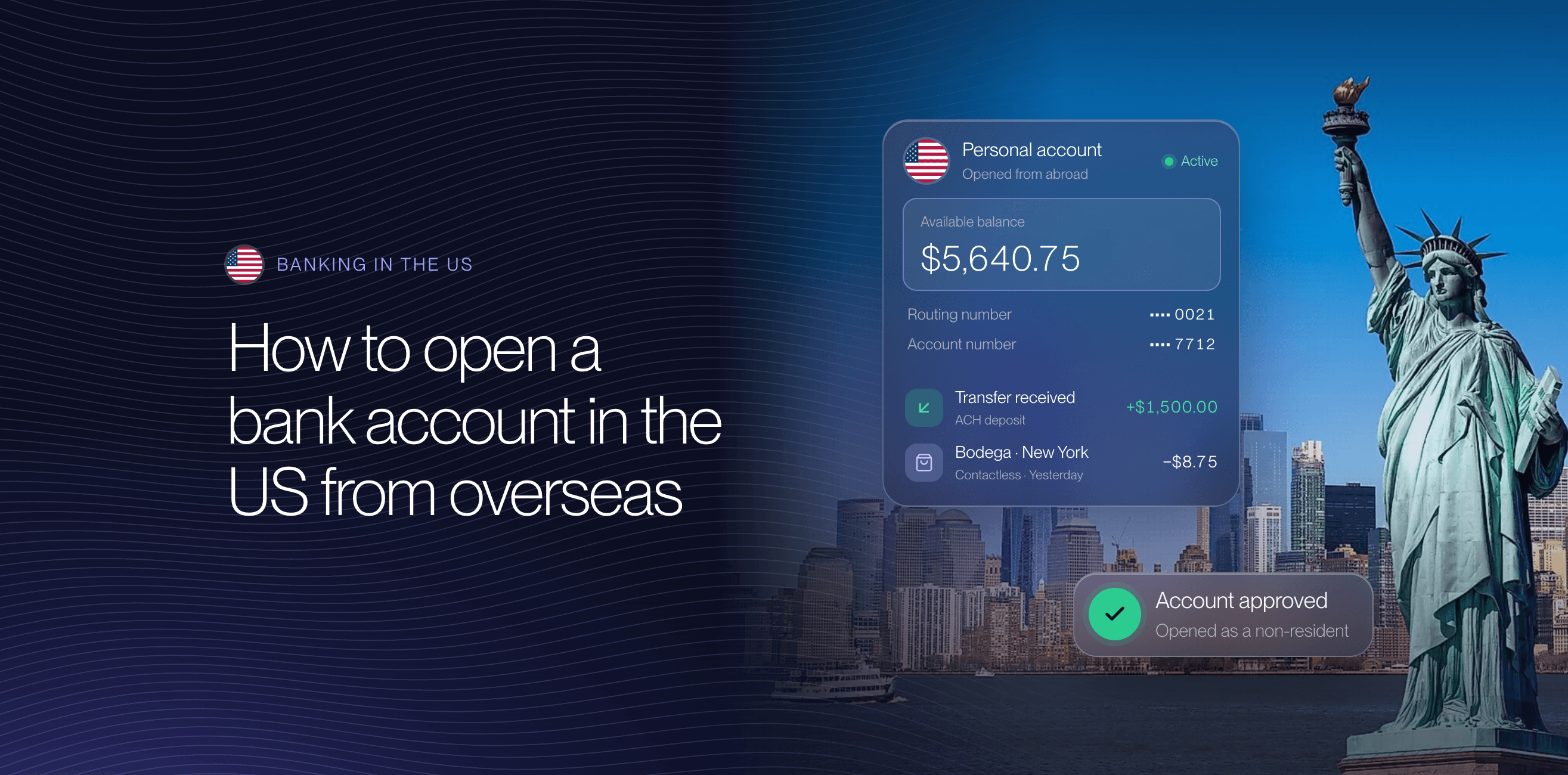
How to Open a US Bank Account as a Non-Resident (2026)

A US bank account is one of the hardest accounts for a non-resident to open, but not because of the law. Federal rules let a bank open an account with a passport number and a foreign address; it is the banks' own policies, asking for a Social Security number, a US address or a branch visit, that turn most applicants away.
Bank of America opens accounts for non-residents in person and says it does not require an SSN. Chase wants proof of a US address, Wells Fargo needs an SSN or ITIN online, and Citi and Capital One only open online accounts for US citizens and residents.
This guide covers which US banks open accounts for non-residents, the documents and tax forms you need, what the accounts and wires really cost, how to move money in without losing 2% to 3% on the exchange rate, how a non-US resident LLC gets a business account, and the account you can open today from wherever you live.
Can a Non-US Resident Open a Bank Account in the US?
Yes. US law does not require you to live in the US or have a Social Security number to open a bank account: a passport number and a foreign address are enough under the federal identification rule. But each bank sets its own policy, and most add an SSN, a US address or a branch visit on top.
That gap between the law and the banks is why non-residents get such different answers. A bank that says no online may say yes in a branch, and a bank that accepts your passport may still want a US utility bill. The answer depends far more on the bank than on your nationality.
What the law requires
The Customer Identification Program rule, 31 CFR 1020.220, requires a bank to collect four things before opening an account: your name, date of birth, address and an identification number. The address must be a residential or business street address, and it does not have to be in the US.
For a non-US person, the identification number can be a US taxpayer number, or a passport number and country of issuance, an alien identification card number, or the number of another government-issued photo ID. The rule even lets a bank open an account while your taxpayer number application is pending. An SSN is not a legal requirement.
Why most banks still say no online
Banks can ask for more than the law requires, and most do. Wells Fargo's online application needs an SSN or ITIN, a physical US address and a mobile number in your name. Citi's online checking accounts are for US citizens and resident aliens, and Capital One 360 checking is for US citizens and permanent residents with a US address.
The reason is risk and cost. Verifying a foreign passport and a foreign address takes staff time and carries compliance risk, so most banks route non-residents to a branch, where an employee checks documents in person, or decline them. Online, an SSN lets the bank run its usual automated checks.
The W-8BEN form
Whichever bank you choose, expect to fill in Form W-8BEN. It certifies to the bank that you are not a US person for tax purposes, so the bank can apply the right rules to any interest you earn. You give it to the bank, not to the IRS, and the current version is dated October 2021.
Without it, the bank has no record that you are a foreign person, which affects how interest on the account is reported and taxed. If the bank does not hand you the form, ask for it, and keep a copy of what you signed.
Which US Banks Open Accounts for Non-Residents
Bank of America is the most realistic big bank for non-residents: it opens accounts in a branch by appointment, with two IDs and no SSN. Chase accepts a passport but wants proof of a US address. HSBC US opens online for people in about 48 countries. Wells Fargo needs an SSN or ITIN online.
Bank | Non-residents? | What it asks for |
|---|---|---|
Bank of America | Yes, in a branch by appointment | Two unexpired IDs, a foreign address and a US mailing address, no SSN |
Chase | In a branch, holder typically present | Passport, proof of a US address, ITIN if a number is required |
Wells Fargo | In a branch; online needs SSN or ITIN | Two IDs in a branch; SSN or ITIN, US address and mobile online |
HSBC US | Online from about 48 countries | SSN or a valid tax certificate, passport, proof of permanent address |
Citi | Online for US citizens and resident aliens only | Not open online to non-residents |
Capital One 360 | US citizens and permanent residents only | US address, US mobile, SSN or ITIN |
Banks' account opening pages, November 2026. Branch policies can vary, so call ahead.
Bank of America for non-US residents
Bank of America opens accounts for non-resident aliens in person, by appointment at a branch. You need two unexpired IDs, such as your passport and a secondary ID like a foreign driving licence, and you give a foreign physical address as well as a US mailing address. Its international page says it does not require an SSN.
The catch is the trip: you must be in the US for the appointment, and you need a US mailing address for cards and statements. If you are visiting anyway, Bank of America is the most straightforward of the big banks for non-residents, and its Advantage SafeBalance account costs $4.95 a month unless waived. Our Bank of America international money transfer guide covers sending money abroad once the account is open.
Chase
Chase's guide for non-residents says an ITIN can stand in for an SSN if one is required, that a passport is accepted, and that you may need more than one form of ID. It also asks for proof of a US address, such as a utility bill from the last 60 days, and the account holder typically must be present in a branch.
That US address requirement is what stops most non-residents who do not live in the US. Chase Total Checking costs $15 a month unless you meet a waiver, and incoming and outgoing wires are priced separately, as the fee tables below show. Our Chase international money transfer guide covers the transfer options inside a Chase account.
Wells Fargo
Wells Fargo's online application needs an SSN or ITIN, a physical US address and a mobile number. In a branch, it asks for an SSN or ITIN plus two forms of ID, and says non-US citizens without a taxpayer number can give a government-issued ID instead. Wells Fargo Everyday Checking costs $15 a month unless waived.
HSBC US
HSBC US is the main exception for people who want to apply online from abroad. It lets you open a sole account online if you are 18 or over, have an SSN or a valid tax certificate, and are located in one of about 48 listed countries, including the UK, Germany, Spain, France, the UAE and India.
You need a passport valid for at least six months and proof of your permanent address. The trade-off is cost: HSBC Premier charges $50 a month unless you keep a $100,000 relationship balance, receive $5,000 a month in direct deposits, or hold an HSBC US mortgage.
Citi and Capital One
Citi's online checking accounts are open to US citizens and resident aliens only, and Capital One 360 checking needs you to be a US citizen or permanent resident with a US address, a US mobile number and an SSN or ITIN. For a non-resident, neither is a realistic first account.
Opening a US Bank Account Online as a Non-Resident
Few US banks let you open an account online as a non-resident. HSBC US accepts online applications from about 48 countries if you have an SSN or a valid tax certificate. Wells Fargo needs an SSN or ITIN and a US address. Everyone else wants you in a branch, so Wise is the usual online route.
Why the US address and phone number block most applications
Online forms at US banks are built around a US address and a US mobile number. The address is where the debit card and statements go, and the phone number receives the one-time codes the app uses to log you in. Without both, most applications stop at the first screen, whatever your passport says.
Using a friend's address or a mail forwarding service to get around that is a bad idea. Banks check the details you give against their own records, and an account opened on details that turn out to be wrong can be frozen or closed once the bank reviews it.
Applying to HSBC US from abroad
If you live in one of HSBC's listed countries, the online route is real but narrow. You need the SSN or valid tax certificate HSBC asks for, a passport with at least six months left, and proof of your permanent address abroad. Check the country list before you start, because applications from other countries are not accepted online.
The Premier account is aimed at people with significant money to move, which is why its fee is set against a $100,000 relationship balance. For someone who wants to receive a salary or client payments in dollars, that is often more bank than they need.
What an online account can replace
Most non-residents do not need a full US checking account. They need US account details to be paid by a US employer, client or platform, somewhere to hold dollars, and a cheap way to convert them. That is what a Wise account offers online from your home country, without the US address or branch visit, and it is the main reason people look for an international bank account they can open online.
What it does not replace is the US credit history, cheque book and branch that come with a US bank, which matter if you are moving to the US. For those, open a US bank account once you arrive, and use Wise to move your savings across.
What You Need to Open a US Bank Account
To open a US bank account as a non-resident you usually need your passport, a second form of ID, your foreign address, often a US address, and Form W-8BEN. Some banks also ask for an SSN or an ITIN, but the law does not require one, and Bank of America says it does not.
- Passport: valid and unexpired, with at least six months left at HSBC US
- Second ID: such as a foreign driving licence or national ID card, at Bank of America and Wells Fargo
- Foreign address: your permanent address abroad, with proof at HSBC US
- US address: a mailing address at Bank of America, proof such as a recent utility bill at Chase
- Tax form: Form W-8BEN, plus an SSN or ITIN where the bank asks for one
SSN or ITIN
An SSN is issued to US citizens, permanent residents and people authorised to work in the US, so most non-residents cannot get one. An ITIN, an Individual Taxpayer Identification Number, is issued by the IRS to people who need a US taxpayer number but cannot get an SSN. Chase accepts an ITIN in place of an SSN if a number is required, and Wells Fargo accepts either.
Neither number is needed under the law, and a passport works as your ID at the banks that accept non-residents. Treat an ITIN as something you get when you have a US tax reason, not as a step towards a bank account.
How to get an ITIN
You apply for an ITIN with Form W-7, normally attached to a federal tax return unless you qualify for an exception. You send it by post to the IRS in Austin, take it to an IRS Taxpayer Assistance Center, or go through a Certifying Acceptance Agent.
The IRS says an ITIN takes about seven weeks, or nine to eleven weeks if you apply between 15 January and 30 April or from overseas. The ITIN is for tax purposes only, and a non-resident usually cannot get one just to open a personal bank account.
Proof of address
Proof of address is where non-residents most often get stuck. Chase asks for a document such as a utility bill from the last 60 days showing a US address. Bank of America asks for a US mailing address alongside your foreign physical address. HSBC US asks for proof of your permanent address abroad, which is easier for someone who lives outside the US.
If you are moving to the US, a signed lease or the first utility bill in your name usually solves this within your first weeks. If you are not moving, a bank that asks for proof of a US address is not the right bank for you.
What US Banks Charge
US checking accounts cost $4.95 to $15 a month at the big banks unless you meet a waiver, and $50 at HSBC Premier. Wires cost $15 to receive at Bank of America and Chase and $30 to $50 to send abroad in dollars, while sending in a foreign currency is cheap on the fee line but priced in the rate.
Monthly account fees
Bank and account | Monthly fee | How to avoid it |
|---|---|---|
Bank of America Advantage SafeBalance | $4.95 | $500 minimum daily balance; under 25; $25 to open |
Bank of America Advantage Plus | $12 | $1,500 minimum daily balance or one direct deposit of $250 or more; $100 to open |
Chase Total Checking | $15 | $500 in electronic deposits (not wires); $1,500 daily balance; $5,000 linked |
Wells Fargo Everyday Checking | $15 | $500 in electronic deposits; $1,500 minimum daily balance; $5,000 linked; age 17 to 24 |
HSBC Premier | $50 | $100,000 relationship balance; $5,000 a month in direct deposits; HSBC US mortgage |
Banks' fee schedules, November 2026.
For a non-resident, the waivers are harder to meet than they look. Most depend on a US salary paid in by direct deposit or a balance kept in the account, and money arriving by international wire does not always count. The cheapest choice is usually the account with the lowest fee you can avoid with a balance, which at Bank of America is SafeBalance.
Wire transfer fees
Bank | Receiving a wire | Sending abroad in USD | Sending in foreign currency |
|---|---|---|---|
Bank of America | $15 | $45 | No fee, exchange markup applies |
Chase | $15 | $40 online, $50 with a banker | $5 online, $0 at $5,000 or more |
Wells Fargo | No fee | $30 online, $40 in a branch | $0 online |
Banks' wire fee schedules, November 2026. All three say their exchange rates include a markup or spread.
The pattern is the same at all three: a fee to send dollars, and little or no fee to send a foreign currency. That is because the bank earns on the conversion. Bank of America says it makes money from the foreign currency exchange, Chase says its rate includes a spread, and Wells Fargo says its rate includes a markup. More on how that works in international wire transfer fees.

The exchange rate margin
On 3 November 2026, $1,000 sent from the US to the UK delivered £722.58 through Wells Fargo, a 3.07% margin, and £719.87 through Chase, a $5 fee plus 2.94%. Wise delivered £741.07 for a $5.89 fee at the mid-market rate. That is £18 to £21 more on one transfer, before any receiving fee.
Sending euros showed the same gap: Wells Fargo delivered €866.35 and Chase €862.56 for $1,000, against €888.69 through Wise. Wise was not the cheapest provider on every route that day, and some other specialists also beat the banks, so compare on the day. We explain how to check a quote in what is the mid-market exchange rate, and how the margin is built into a bank's rate in foreign exchange for money transfers.
Moving Money Into and Out of a US Bank Account
Funding a US account from abroad through your home bank usually costs up to 3% in the exchange rate. On £1,000 sent to the US on 3 November 2026, UK banks delivered $1,305 to $1,334 and Wise $1,335.28. Sending dollars home from a US bank costs about 3% above the mid-market rate.
Funding your US account from the UK or Europe
Sending to the US | Dollars that arrive | Exchange margin |
|---|---|---|
1,000 GBP, Barclays | $1,305.39 | 2.70% |
1,000 GBP, NatWest | $1,311.54 | 2.24% |
1,000 GBP, HSBC | $1,334.38 | 0.53% |
1,000 GBP, Wise | $1,335.28 | 0%, fee of £4.60 |
1,000 EUR, Commerzbank | $1,091.96 | 0.95% plus a €15 fee |
1,000 EUR, Santander Spain | $1,100.61 | 1.67% |
1,000 EUR, Wise | $1,112.15 | 0%, fee of €6.21 |
Wise comparison data, 3 November 2026, mid-market rates of 1.3415 USD per GBP and 1.1191 USD per EUR.
On pounds, the gap between the cheapest and most expensive bank was about $30 on a single £1,000 transfer, and one UK bank came within a dollar of Wise that day. On euros, Wise delivered about $20 more than Commerzbank. Scale that to a house deposit or a year of tuition and the channel you choose matters more than the account you open. If you want to keep pounds or euros on the US side rather than convert them, we cover GBP accounts in the USA and euro accounts in the USA.
Then add the receiving fee: up to $15 at Bank of America and Chase for each incoming wire, nothing at Wells Fargo. Dollars paid into a US account through Wise usually arrive as a domestic payment rather than an international wire, so the incoming wire fee does not apply. We cover the costs on the receiving side in receiving money from abroad, and the timings in how long a wire transfer takes.

Sending dollars home
Once you are paid in dollars, the same maths runs in reverse. A US bank's international wire costs $30 to $50 in dollars, or little on the fee line in a foreign currency with a margin of around 3% built into the rate. We cover the bank steps in sending money internationally from a US bank.
Compare providers on your route
Rates move every day and no provider is cheapest on every route. Enter your amount and destination to see what arrives today with each provider, before you choose how to move money out of a US account. Our guide to comparing money transfer providers shows what to check beyond the headline fee.
For the main routes and what each provider charges, see sending money from the US, and for the most common routes, sending money from the UK to the US and from the US to the UK.
Get US Account Details With Wise
Wise is not a US bank, but it gives non-residents in many countries US account details: an account number and ACH and wire routing numbers. You can be paid in dollars by US employers, clients and platforms, hold the money, and convert it at the mid-market rate, without an SSN, a US address or a branch visit.
 Wise9.5
What Wise gives you
With Wise's USD details, you can receive ACH payments for free and domestic and SWIFT wires for $6.11 each. Customers in the UK get a US account number, routing number and SWIFT code, and Wise offers USD details to customers in many other countries, though not in every region, so check before you rely on it.
You also get balances in more than 40 currencies and a debit card that spends dollars at the mid-market rate. Our Wise review covers fees and safety, and banks that operate in both the US and UK lists the cross-border banks if you need a traditional account on both sides. If you live in the UK and mainly want to hold dollars, our guide to opening a USD account in the UK compares the options, and the Wise card review covers spending.
For freelancers and remote workers, this is often the whole answer: a US client pays by ACH to your Wise USD details, you hold the dollars or convert them when the rate suits you, and the money reaches your home bank account at the mid-market rate with a fee shown upfront. Many freelancers use PayPal for US clients instead, which charges around 3% to 4% above the mid-market rate to convert; we compare the options in PayPal alternatives for freelancers.

What Wise cannot do in the US
Wise says plainly that it is not a bank. Money held with Wise US is not FDIC insured unless you opt into its interest feature, which gives pass-through FDIC cover of up to $250,000 through JPMorgan Chase, and customers in the UK are protected by safeguarding rules instead. There is no overdraft, no loan and no US credit history.
Some US payers, landlords and services expect a US bank account in your own name and may not accept every set of details. If you are moving to the US, open a US bank account once you have an address, and keep Wise for money crossing the border.
The setup that works for most non-residents
If you are not moving, open Wise and use its USD details to be paid in dollars. If you are moving, open Wise before you go, move your savings at the mid-market rate, and open a Bank of America or Chase account once you have a US address. If you are moving from the UK, keep your UK account open; our guide to opening a UK bank account as a non-resident explains why it is hard to get back.
US Bank Account or Wise: Which Do You Need?
If you need US credit history, FDIC cover on large balances or a cheque book, you need a US bank account, which usually means a branch visit. If you need to be paid in dollars, hold them and convert them cheaply, a Wise account does that without an SSN or a US address.
What you need | US bank account | Wise USD details |
|---|---|---|
Who can open it | Non-residents mostly in a branch; online mainly at HSBC US | Online from many countries, with your passport |
Monthly fee | $4.95 to $15 unless waived, $50 at HSBC Premier | No monthly fee |
Receiving ACH payments | Free | Free |
Receiving a wire | $15 at Bank of America and Chase, free at Wells Fargo | $6.11 for a domestic or SWIFT wire |
Sending money abroad | $30 to $50 in dollars, or a margin of around 3% in a foreign currency | Mid-market rate plus a fee shown upfront |
Deposit protection | FDIC up to $250,000 per depositor, per bank, per category | Not FDIC insured unless you opt into interest |
US credit history | Yes, over time | No |
Banks' and Wise's pricing pages, November 2026.
When a US bank account is worth the trip
A US bank account earns its branch visit if you are moving to the US, buying property there, or keeping a large balance in dollars for years. It gives you FDIC cover, a US debit card, and the start of a US credit history, which matters for renting, a phone contract or a car loan.
It also makes sense if a US employer, broker or government agency insists on paying into a US bank account in your name. In that case, choose the account with the lowest fee you can avoid with a balance, and keep the money that has to cross the border out of the bank's exchange rate.
When Wise is enough
For freelancers paid by US clients, sellers paid by US marketplaces and anyone who receives occasional dollar payments, US account details are the part that matters. Wise gives you those with free ACH receiving, holds the dollars, and converts them at the mid-market rate, so the cost of each payment is a small, visible fee rather than a 3% margin.
Running both
Plenty of people end up with both: a US bank account for life in the US and Wise for money crossing the border. Paying dollars from Wise into your US account usually arrives as a domestic payment, so the $15 incoming wire fee at Bank of America or Chase does not apply, and you choose the day you convert.
Business Bank Account for Non-US Residents
A business bank account for a non-US resident usually starts with a US company, most often an LLC, and an Employer Identification Number from the IRS. Foreign owners without an SSN or ITIN cannot get an EIN online, so they apply by phone, fax or post, and most banks then expect the owners in a branch.
Getting an EIN as a foreign owner
The IRS online EIN application needs an SSN or ITIN and a US place of business. International applicants can call the IRS on 267-941-1099, or send Form SS-4 by fax, which takes about four business days, or by post, which takes about four weeks.
Form your LLC first, because the EIN is issued to the company. Then keep the EIN letter safe: banks ask for it, along with the company's formation documents and the owners' passports.
Opening a bank account for a non-US resident LLC
Chase's checklist for an LLC account requires an EIN, and only single-member or manager-managed LLCs can apply online; others open in a branch with all members present. In practice, a non-US resident LLC owner should expect to travel to the US to open a business account at a big bank, with passports, the EIN letter and the LLC documents.
Online platforms aimed at foreign founders exist, but check whether you are dealing with a bank or a fintech that holds money at a partner bank, and what deposit cover applies, before you move company money in.
If you only need to be paid in dollars
Many foreign businesses do not need a US entity at all. If your aim is to invoice US clients and get paid in dollars, a Wise Business account can give your existing company USD account details with no monthly fee. Check that Wise accepts your business type and country before you apply. UK companies can compare the options in USD business accounts in the UK, and for paying suppliers abroad see international money transfers for business.
Is Your Money Safe in a US Bank Account?
Yes. FDIC insurance covers deposits up to $250,000 per depositor, per insured bank, for each ownership category, and you do not need to be a US citizen or resident to be covered. Check that the bank is FDIC insured, because some apps that look like banks are not banks themselves.
How FDIC cover works for non-residents
The FDIC says deposit insurance applies to depositors in an insured bank whatever their citizenship or residence. The limit is per bank and per ownership category, so a single account and a joint account at the same bank are counted separately, and money spread across two insured banks is covered at each.
Large balances
If you are moving a large sum, such as the proceeds of selling a home, spread it so that no single bank holds more than $250,000 in one ownership category. Readers with UK accounts can compare the two schemes in FSCS vs FDIC; the UK limit is now £120,000 per person per bank.
Bottom Line
Opening a US bank account as a non-resident is legal without an SSN, but most banks add a US address or a branch visit. Bank of America is the most realistic big bank in person, and HSBC US the main online option from abroad. For being paid in dollars, a Wise account is usually enough.
If you are not moving to the US
Open a Wise account and use its USD details for clients, employers and platforms. Only open a US bank account if you need something Wise cannot give you, such as US credit history or a cheque book, and if you do, plan a branch visit at Bank of America or check whether you qualify for HSBC US online. If you live in Canada, a US dollar account at a Canadian bank is another route, which we cover in opening a bank account in Canada as a non-resident.
If you are moving to the US
Open Wise before you go and move part of your savings when the rate suits you. Once you have a US address, open a checking account at Bank of America, Chase or Wells Fargo, choose one with a fee you can waive, and give the bank Form W-8BEN or your SSN, depending on your tax status.

The expensive mistake is rarely the bank you choose. It is moving money through the bank's exchange rate: at a 3% margin, every $10,000 that crosses the border costs $300 you never see on a fee table.
Can a non-US resident open a bank account in the US?
Yes. Federal law requires a bank to collect your name, date of birth, address and an ID number, and for a non-US person a passport number and country are enough, with no SSN and no US address required by law. Each bank adds its own rules, though. Bank of America opens accounts for non-residents in a branch without an SSN, while Citi and Capital One only open online accounts for US citizens and residents.
Can I open a US bank account online as a non-resident?
Rarely. HSBC US accepts online applications from people located in about 48 countries who have an SSN or a valid tax certificate, a passport valid for six months and proof of address. Wells Fargo's online form needs an SSN or ITIN and a US address, and most other banks want you in a branch. A Wise account opens online from your home country with US account details.
Which US bank is best for non-residents?
Bank of America is the most realistic big bank, because it opens accounts in a branch by appointment with two IDs and says it does not require an SSN. HSBC US suits people with large balances who want to apply online from one of its listed countries. If you only need to be paid in dollars, a Wise account is usually simpler than either.
Does Bank of America open accounts for non-US residents?
Yes, in person by appointment at a branch. You need two unexpired IDs, such as a passport and a foreign driving licence, plus your foreign physical address and a US mailing address. Bank of America says it does not require an SSN. Its Advantage SafeBalance account costs $4.95 a month unless you keep a $500 minimum daily balance or are under 25.
Do I need an SSN to open a US bank account?
Not by law. The federal identification rule accepts a passport number and country of issuance for a non-US person. Some banks ask for an SSN or ITIN anyway, including Wells Fargo online and Capital One, while Chase accepts an ITIN if a number is required and Bank of America says it does not require an SSN.
Can I get an ITIN just to open a bank account?
Usually not. An ITIN is for tax purposes, and you normally apply with Form W-7 attached to a federal tax return. The IRS says it takes about seven weeks, or nine to eleven weeks from overseas or between 15 January and 30 April. A passport is accepted as ID at the banks that open accounts for non-residents.
Is there a free US bank account for non-residents?
Not without conditions at the big banks. Bank of America Advantage SafeBalance costs $4.95 a month unless you keep $500 as a minimum daily balance or are under 25, and Chase and Wells Fargo charge $15 unless you meet a waiver. A Wise account has no monthly fee and gives you US account details, but it is not a bank.
How do I open a business bank account as a non-US resident?
Form a US company, usually an LLC, then get an EIN: without an SSN or ITIN you apply by phone on 267-941-1099, by fax in about four business days or by post in about four weeks. Banks then ask for the EIN, the company documents and the owners' passports. At Chase, only single-member or manager-managed LLCs can apply online; others open in a branch with all members.
Can I open a US bank account with a foreign address?
Yes, the law allows it: the identification rule only needs a residential or business street address, which does not have to be in the US. In practice it depends on the bank. Bank of America takes a foreign physical address alongside a US mailing address, HSBC US asks for proof of your permanent address abroad, and Chase asks for proof of a US address, such as a recent utility bill.
Can a non-resident open a Chase account?
Sometimes, in a branch. Chase says a passport is accepted, an ITIN can stand in for an SSN if a number is required, and you may need more than one form of ID. It also asks for proof of a US address, such as a utility bill from the last 60 days, and the account holder typically must be present, which rules out most non-residents who do not live in the US.
How can I get paid in dollars without a US bank account?
Use an account that gives you US account details. Wise gives customers in the UK and many other countries an account number and ACH and wire routing numbers, with free ACH receiving and $6.11 for domestic or SWIFT wires, and converts at the mid-market rate. PayPal also works for US clients but charges around 3% to 4% above the mid-market rate to convert.
Is my money FDIC insured if I am not a US resident?
Yes, if the bank is FDIC insured. Cover is $250,000 per depositor, per bank, for each ownership category, and you do not need to be a US citizen or resident. Wise is not a bank: Wise US balances are not FDIC insured unless you opt into interest, which gives pass-through cover through JPMorgan Chase.
What documents do I need to open a US bank account as a non-resident?
Your passport, a second ID, your foreign address and Form W-8BEN, which tells the bank you are not a US person for tax. Many banks also want a US address, and Chase asks for proof such as a utility bill from the last 60 days. Some ask for an SSN or ITIN, but the law does not require one.
Sources
- eCFR: 31 CFR 1020.220, customer identification programs
- IRS: about Form W-8BEN
- Bank of America: banking for international clients
- Bank of America: personal schedule of fees
- Chase: US bank accounts for non-residents
- Chase: Total Checking
- Chase: LLC business account checklist
- Wells Fargo: identification required to open an account
- Wells Fargo: service fees
- HSBC US: account opening FAQs
- HSBC US: Premier checking
- Capital One: 360 Checking disclosures
- IRS: Individual Taxpayer Identification Number
- IRS: get an Employer Identification Number
- FDIC: understanding deposit insurance
- Wise: using your USD account details
- Wise: how Wise US protects customer funds
Mo is the founder of MoneyTransferStore. As an expat who has experienced the challenges of sending money across borders himself, he set out to help others like him avoid hidden fees and unfair exchange rates on international transfers. With a background spanning fintech, payments, and Web3, Mo brings years of practical experience to building a platform focused on transparency and trust.